
How a Construction Financing Loan Helps You Build a Home
A construction financing loan is short-term funding for building a home. Instead of receiving the full loan amount at once, your builder is paid in stages as work is completed and inspected. During the build, you usually make interest-only payments on the amount already drawn. Once the home is finished, the loan may convert to a regular mortgage or be paid off with a separate permanent loan.
This financing can cover the lot, labor, materials, and permits. It is built for buyers who want a custom home but need a clear plan for higher costs, changing timelines, and lender-required inspections.
For many California buyers, the biggest decision is whether to choose a single-close construction-to-permanent loan or a two-close construction-only loan. The right fit depends on your credit, down payment or land equity, builder, project budget, and comfort with future interest-rate risk.
I’m Dale Gremillion, a Senior Loan Officer and Producing Branch Manager with more than 25 years of residential lending experience, including construction financing loan options. In the sections ahead, I’ll break down the process so you can ask better questions, prepare for lender requirements, and move toward a realistic building plan.
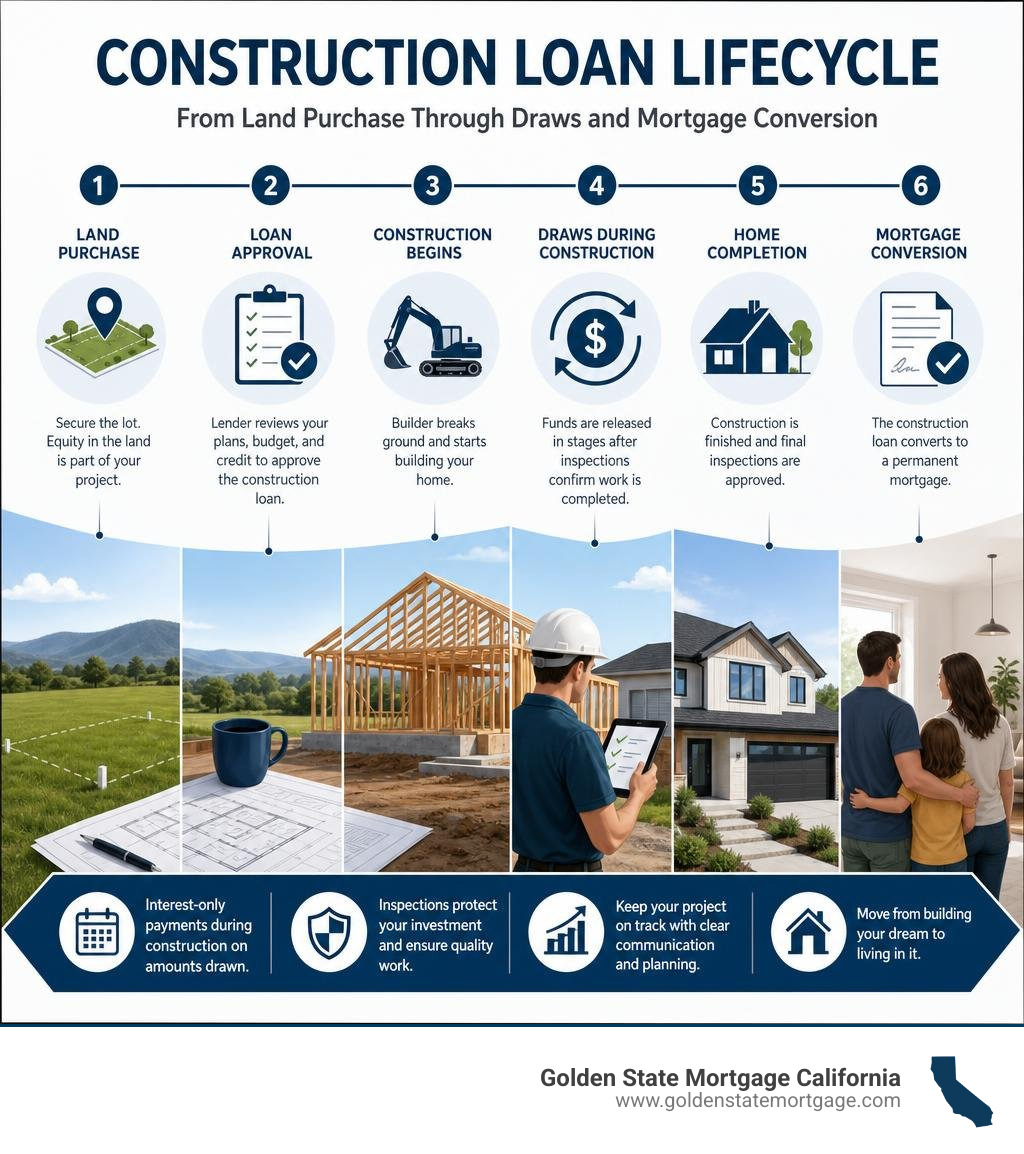
What Is a Construction Financing Loan and How Does It Work?
Building a custom home from the ground up is an exciting endeavor, but traditional mortgages are simply not designed to finance a structure that does not yet exist. A construction financing loan provides interim, short-term debt specifically structured to fund the hard and soft costs of homebuilding.
Unlike a purchase loan for an existing house, construction lending is governed by risk management, structured milestones, and phased fund releases. Because there is no finished home to serve as immediate collateral, lenders manage their exposure through detailed project oversight. As outlined in the AGC Guide to Construction Financing, interim construction debt relies on continuous verification of building progress before funds are disbursed, ensuring that loan proceeds match the real-time physical improvement of the property.
Construction Loans vs. Traditional Mortgages
When you purchase an existing property, your lender delivers a lump-sum payout at closing to acquire the completed structure. The home acts as collateral from day one, allowing the lender to establish fixed amortization terms immediately.
Construction loans operate differently:
- Collateral Structure: The loan is secured by the land and the planned value of the unbuilt home.
- Funding Mechanism: Instead of a single payout, funds are placed into an escrow facility and released across predetermined project milestones.
- Appraisal Approach: Valuation is conducted via an “as-completed” appraisal, which evaluates architectural blueprints, specifications, and building site conditions to project the home’s future market value upon structural completion.
- Risk Profile: The lender assumes completion risk—the possibility that a builder walks away, materials spike in price, or structural defects occur before the home is livable.
Understanding Construction Financing Loan Interest Rates and Terms
Construction loan interest rates are typically higher than standard 30-year fixed mortgage rates by roughly one percentage point. Because interim construction debt carries higher performance risk, lenders set interest rates against a variable benchmark—frequently the Prime Rate or the Secured Overnight Financing Rate (SOFR)—plus a margin spread.
During the active building phase (which typically spans 12 to 18 months), borrowers make interest-only payments based exclusively on the funds disbursed to date, rather than the total approved loan commitment. For example, if your total approved facility is $900,000 but your contractor has only drawn $200,000 for site preparation and foundation work, your monthly interest payment is calculated solely on that $200,000 balance.
Some lenders also allow borrowers to build an interest reserve directly into the total project budget, which finances the interest payments automatically during the build period so you do not carry double housing expenses while renting during construction.
What Costs Are Covered vs. Excluded
A construction loan covers the major expenses required to take a project from vacant dirt to a finished Certificate of Occupancy. However, it does not cover every design expense.
| Covered Costs (Eligible for Draws) | Excluded Costs (Paid Out-of-Pocket) |
|---|---|
| Land and lot acquisition | Architectural drafting and design fees incurred prior to loan setup |
| Foundation, framing, and roofing materials | Interior designer consulting fees |
| Subcontractor and general contractor labor | Non-permanent interior furniture and staging |
| City and municipal building permit fees | Pre-closing feasibility studies and initial engineering soft costs |
| Permanent utility hookups (sewer, water, electrical) | Specialty decor and standalone appliances not permanently affixed |
Major Types of Construction Financing Options
Choosing how to finance your custom build depends on whether you prefer a single underwriting process or greater flexibility across separate financing phases.
| Feature | Single-Close (Construction-to-Permanent) | Two-Close (Stand-Alone Construction) |
|---|---|---|
| Closing Transactions | 1 (Single closing before groundbreaking) | 2 (One for construction, one for permanent mortgage) |
| Closing Costs | Single set of settlement fees | Dual sets of closing fees and title charges |
| Interest Rate Risk | Rate can often be locked upfront for permanent loan | Exposed to market interest rate fluctuations at build completion |
| Re-qualification Risk | Underwritten once prior to initial closing | Borrower must re-qualify financially once the home is finished |
| Flexibility | Less flexible for mid-project budget expansions | Easier to adjust loan amounts if substantial changes occur |
Construction-to-Permanent Loans (Single-Closing)
A construction-to-permanent loan combines your interim construction loan and your long-term 15- or 30-year mortgage into one transaction. You sign closing paperwork once before breaking ground. Throughout the 12-to-18-month construction timeline, you make interest-only payments on drawn funds.
Once the local building department issues a final Certificate of Occupancy, the loan automatically converts into permanent amortizing mortgage debt. This single-closing structure saves substantial money on settlement charges, title insurance fees, and administrative closing costs. It also shields you from the risk of worsening market interest rates or unexpected personal credit changes during the build phase.
Stand-Alone Construction-Only Loans (Two-Closing)
A stand-alone construction loan covers only the physical build phase. Once the property is complete, the borrower must secure a separate permanent “take-out” mortgage to pay off the interim construction balance.
This structure requires paying two sets of closing costs, undergoing two full underwriting evaluations, and securing two separate appraisals. While it provides flexibility if you plan to sell your existing home later to pay down the construction debt, it carries significant risk: if interest rates spike or your financial situation shifts during construction, you could face hurdles qualifying for the permanent take-out loan.
Renovation Loans and Owner-Builder Programs
If you are expanding or remodeling an existing property rather than constructing from scratch, you do not necessarily need a ground-up construction loan. Specialized Renovation Loans allow you to finance both the purchase (or refinance) and the repair costs within a single primary mortgage. Government-backed programs like FHA 203(k) and conventional options like Fannie Mae HomeStyle assess the property’s future remodeled value to determine your borrowing limit.
For borrowers interested in managing their own builds, owner-builder construction loans allow individuals to act as their own general contractor. However, lenders strictly limit these programs. To qualify, you typically must be a fully licensed general contractor by trade with active insurance, trade references, and demonstrated building experience in the local market.
The Construction Loan Process: Draws, Inspections, and Timelines
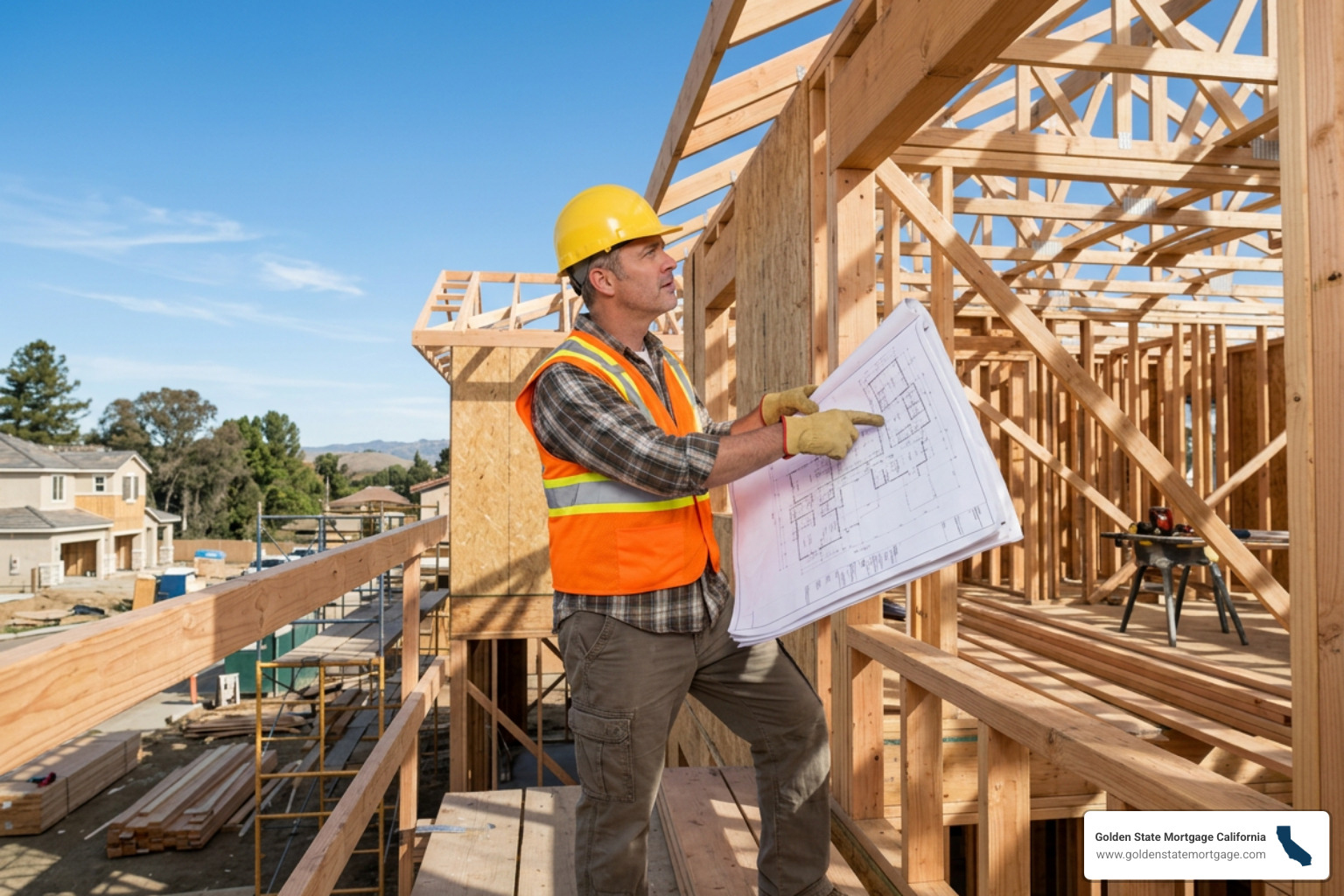
Once your construction loan closes, funds are not handed over in a lump sum. Instead, they are distributed through a structured draw schedule tied to verified milestones, detailed in institutional frameworks such as the EX-10.9 Construction Term Loan Agreement.
Navigating the Draw Schedule and Site Inspections
The draw schedule establishes when and how much money your builder receives. Lenders typically conduct between four and six physical site inspections during the project before releasing funds for completed stages:
- Draw Request Submission: The general contractor submits an itemized draw request outlining the completed work stage and requesting reimbursement or supplier payment.
- Third-Party Site Inspection: The lender dispatches an independent inspector to the job site to confirm that materials are installed according to the architectural blueprints.
- Title Down-Date Search: A title company executes a down-date search to confirm no mechanics’ liens have been filed by unpaid subcontractors or material suppliers.
- Lien Waivers & Retainage: The contractor submits executed lien waivers from the previous draw, and the lender disburses the requested funds, often withholding a 5% to 10% retainage until final punch-list completion.
Handling Delays, Cost Overruns, and Contingency Reserves
Unexpected challenges—such as winter weather delays, permit processing backlogs, or material price spikes—can impact construction budgets. Lenders enforce strict “Loan in Balance” covenants, requiring that total available loan funds plus verified borrower cash always equal or exceed the remaining cost to complete the project.
To manage unforeseen expenses, lenders require a contingency reserve line item (typically 5% to 15% of total hard construction costs) built directly into the initial construction budget. If cost overruns exceed this contingency reserve, the borrower must provide deficiency deposits out-of-pocket to bring the loan back into balance before subsequent draws are authorized.
Using Land Equity to Finance Your Build
If you already own the parcel of land where your home will be built, you can leverage that equity directly toward your down payment requirement. Rather than requiring cash, lenders credit the appraised fair market value (or purchase cost if recently acquired) of your lot toward your equity contribution.
If you own an existing home with substantial accrued value, learning how to cash out your home equity to build your dream space can provide the liquidity needed to acquire land or fund pre-construction site engineering costs. However, lenders evaluate raw land carefully, requiring clear proof of road access, zoning compliance, and utility feasibility before approving project funding.
Key Eligibility Requirements and Application Steps

Qualifying for construction financing involves underwriting both your personal financial profile and the project itself.
How to Qualify for a Construction Financing Loan
Because interim construction lending carries higher financial exposure, eligibility guidelines are more stringent than those for standard home purchases:
- Credit Score: Most conventional construction programs require a minimum credit score of 680, though some select government-backed or portfolio programs may consider scores down to 620.
- Down Payment: Lenders generally require a down payment of at least 20% of the total project cost (land purchase plus construction budget), compared to 3% to 5% on standard existing-home mortgages.
- Debt-to-Income (DTI) Ratio: Borrowers typically must maintain a total DTI ratio below 43%, though exceptions up to 45% exist for applicants with strong cash reserves. To understand how existing debt impacts your capacity, you can calculate your cash-out refinance savings and loan amounts easily to optimize your debt structure prior to applying.
- Post-Closing Reserves: Lenders often require 6 to 12 months of principal, interest, taxes, and insurance (PITI) held in liquid reserve assets to ensure payment continuity during the build phase.
Required Documentation and Builder Approval
Your builder’s qualifications are evaluated right alongside your personal finances. Before granting final loan approval, the lender must formally vet and approve the general contractor.
The required submission package includes:
- Builder Credentials: General contractor license, active commercial general liability insurance, workers’ compensation coverage, and verified client references.
- Construction Documentation: Complete architectural blueprints, civil engineering reports, grading plans, and local municipal building permits.
- Sworn Cost Statements: An itemized, line-by-line budget categorizing all hard costs (materials, labor, framing, foundation) and soft costs (permits, architectural fees, connection charges).
- Executed Construction Contract: A signed Guaranteed Maximum Price (GMP) or fixed-price contract establishing clear milestone schedules and completion deadlines.
- Builder’s Risk Insurance: A comprehensive policy protecting the structure against fire, storm damage, vandalism, and material theft during active construction.
Frequently Asked Questions About Construction Loans
Can I act as my own general contractor on a construction loan?
Most institutional lenders do not allow borrowers to act as their own general contractor under standard residential construction loan programs. To qualify for an owner-builder construction loan, lenders require the borrower to be a fully licensed general contractor by trade with an active license, liability coverage, and a documented track record of completing custom residential structures.
How does an as-completed appraisal work for new construction?
An as-completed appraisal determines what the home will be worth once fully constructed according to the proposed plans. The licensed appraiser analyzes the architectural blueprints, the itemized materials specification sheet, the lot value, and recent comparable sales of newly built custom homes in the immediate neighborhood to establish the future fair market value.
What happens if my build exceeds the 12 to 18-month construction timeline?
If construction extends past the initial loan term due to unforeseen delays, you must notify your lender immediately to request a formal loan extension. Lenders may grant 30- to 90-day extensions, which often involve extension fees and require updated financial documentation. Under Fannie Mae guidelines, if a single-close loan exceeds 18 months in the construction phase, it must be restructured and converted into a two-closing transaction.
Conclusion
Building your custom home allows you to create a living space tailored to your exact specifications. While navigating the draw schedules, inspections, and underwriting guidelines of a construction financing loan requires careful preparation, partnering with an experienced lending team keeps the process structured and predictable.
At Capital Home Mortgage California, our in-house underwriting and processing teams support you through every stage—from land acquisition and builder approval to construction draw disbursements and permanent mortgage conversion.
Ready to make your custom home project a reality? Explore our specialized California construction home mortgages or speak directly with our loan specialists seven days a week to start your pre-approval process today.


