
Compare Construction Loan Rates Today Before You Build
Construction loan rates today generally run about 6.5% to 9% through banks and credit unions, while private or hard-money financing can cost 10% to 15%. During construction, many loans use a floating rate and interest-only payments on the funds already drawn. After the home is finished, the loan may convert to a permanent mortgage, with rates commonly lower than the construction-phase rate.
Before choosing a loan, compare more than the headline rate:
- Whether the construction rate is fixed or tied to prime or SOFR
- The permanent mortgage rate and when it can be locked
- One-time-close versus two-time-close fees
- Draw, inspection, extension, and conversion costs
- How your land equity can reduce cash needed at closing
For California buyers building a custom home, a construction-to-permanent loan can provide one closing and a locked permanent rate. A stand-alone construction loan may offer more flexibility if rates fall, but it usually means a second approval, appraisal, and closing later.
I am Dale Gremillion, a Senior Loan Officer and Producing Branch Manager with more than 25 years in residential lending, including construction financing. I help California borrowers compare construction loan rates today, understand draw schedules, and choose financing that fits both their build plan and long-term budget.
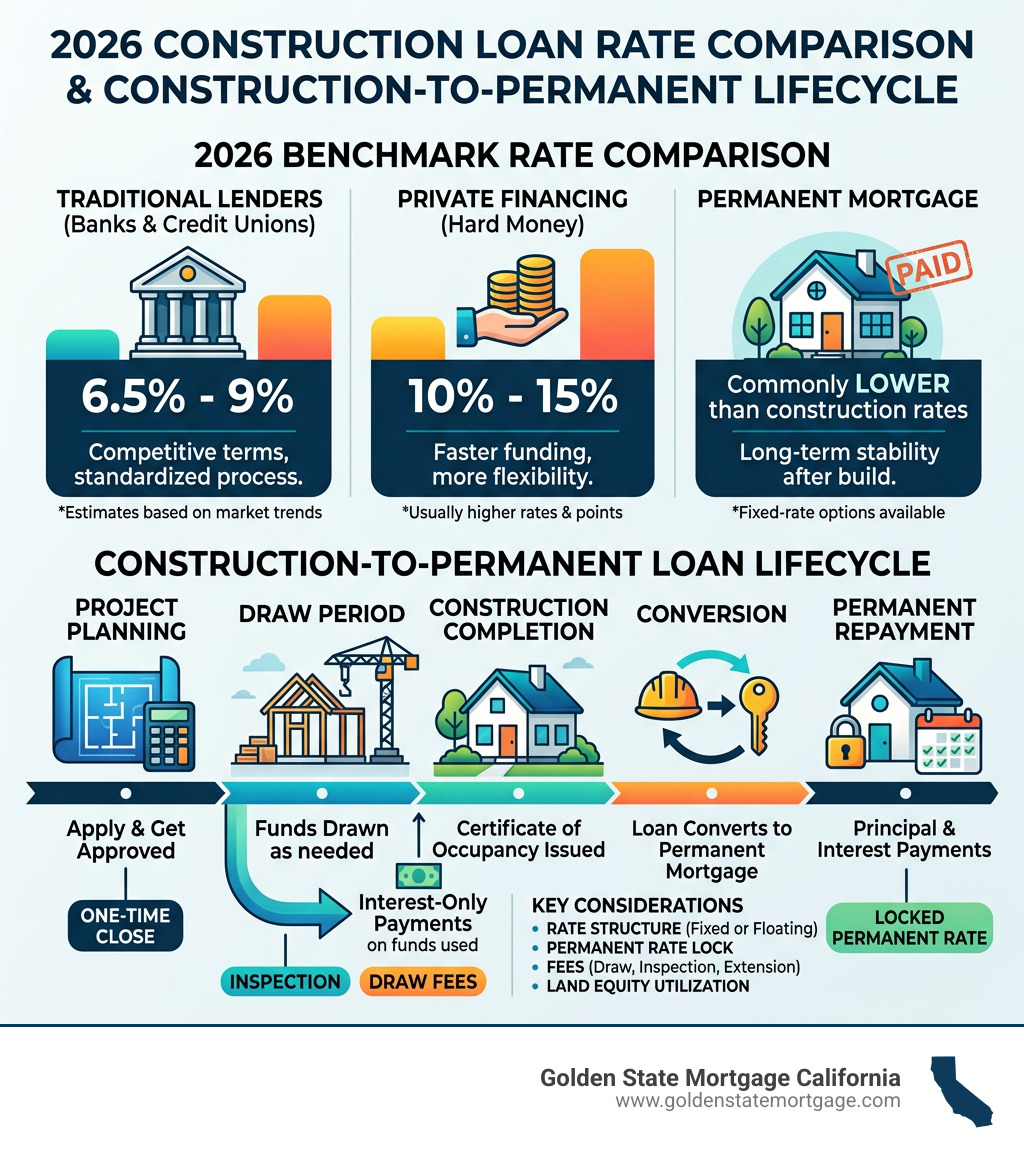
Current Construction Loan Rates Today: 2026 Benchmark Comparison
Securing financing for a ground-up build requires understanding the difference between short-term interim risk and long-term debt. When lenders underwrite a vacant parcel of land and a blueprint, they face elevated exposure until the final certificate of occupancy is issued. As a result, construction financing carries a spread above traditional 30-year fixed mortgages.
In 2026, benchmark interest rates reflect stabilizing monetary policy, yet construction phase pricing remains tied to broader economic indices. We ensure our clients evaluate both the interim construction pricing and the final permanent mortgage terms before breaking ground. To review foundational concepts, explore our guide on construction financing loan basics to understand core requirements.
| Loan Program | Construction Phase Rate (2026) | Permanent Phase Rate (Take-Out) | Typical Down Payment | Closing Structure |
|---|---|---|---|---|
| Conventional Construction-to-Permanent | 7.00% – 8.50% | 6.50% – 7.50% | 10% – 20% | One-Time Close |
| FHA One-Time Close (OTC) | 6.50% – 7.50% | 6.00% – 7.00% | 3.5% | One-Time Close |
| VA Construction Loan | 5.85% – 7.00% | 5.50% – 6.50% | 0% ($0 Down) | One-Time Close |
| Stand-Alone Construction (Bank) | 6.50% – 9.00% | N/A (Requires Refinance) | 15% – 25% | Two-Time Close |
| Owner-Builder Construction | 7.50% – 9.50% | 7.00% – 8.00% | 20% – 25% | Varies |
| Hard Money / Private Bridge | 10.00% – 15.00% | N/A (Short-Term Only) | 20% – 35% | Two-Time Close |
| SBA 504 Commercial Construction | 6.50% – 8.50% | 6.00% – 7.50% | 10% – 15% | Two-Tier Structure |
Comparing Construction Loan Rates Today Across Loan Programs
Selecting the right program depends on your project scope, eligibility, and cash reserves. For primary residences across California—from custom builds in Sacramento to estate properties in San Diego—government-backed and conventional programs deliver distinct cost structures.
- Conventional Single-Close Loans: Conventional options balance competitive interest rates with manageable documentation requirements. Borrowers putting down 20% avoid private mortgage insurance (PMI), making this ideal for high-balance custom homes.
- FHA One-Time Close: Designed for accessible entry, FHA construction loans allow credit scores down to 620 with a 3.5% minimum down payment. These loans appeal to first-time custom homebuilders seeking predictable terms.
- VA Construction Loans: For eligible active military and veterans, VA construction loans provide exceptional terms: $0 down payment, no monthly mortgage insurance, and market-leading interest rates between 5.85% and 7.00%.
- SBA 504 Programs: For owner-occupied commercial or mixed-use builds, SBA 504 financing offers competitive blended rates starting at 6.50%, requiring just 10% down from established business owners.
When evaluating regional financing across major markets, borrowers often compare San Jose, CA mortgage rates and loans to weigh local borrowing costs against broader state averages.
How Prime Rates and SOFR Dictate Construction Loan Rates Today
Most interim construction loans use variable rates tied to the Wall Street Journal Prime Rate or the Secured Overnight Financing Rate (SOFR). Lenders add a margin—typically between 0.50% and 2.50%—to the index to establish your note rate.
Unlike standard home loans, interest during construction is charged only on the funds disbursed. When your foundation is poured, you pay interest on that initial draw, not the entire loan balance. Think of it like a restaurant tab: you only pay for the dishes that have arrived at your table, not the whole menu at once.
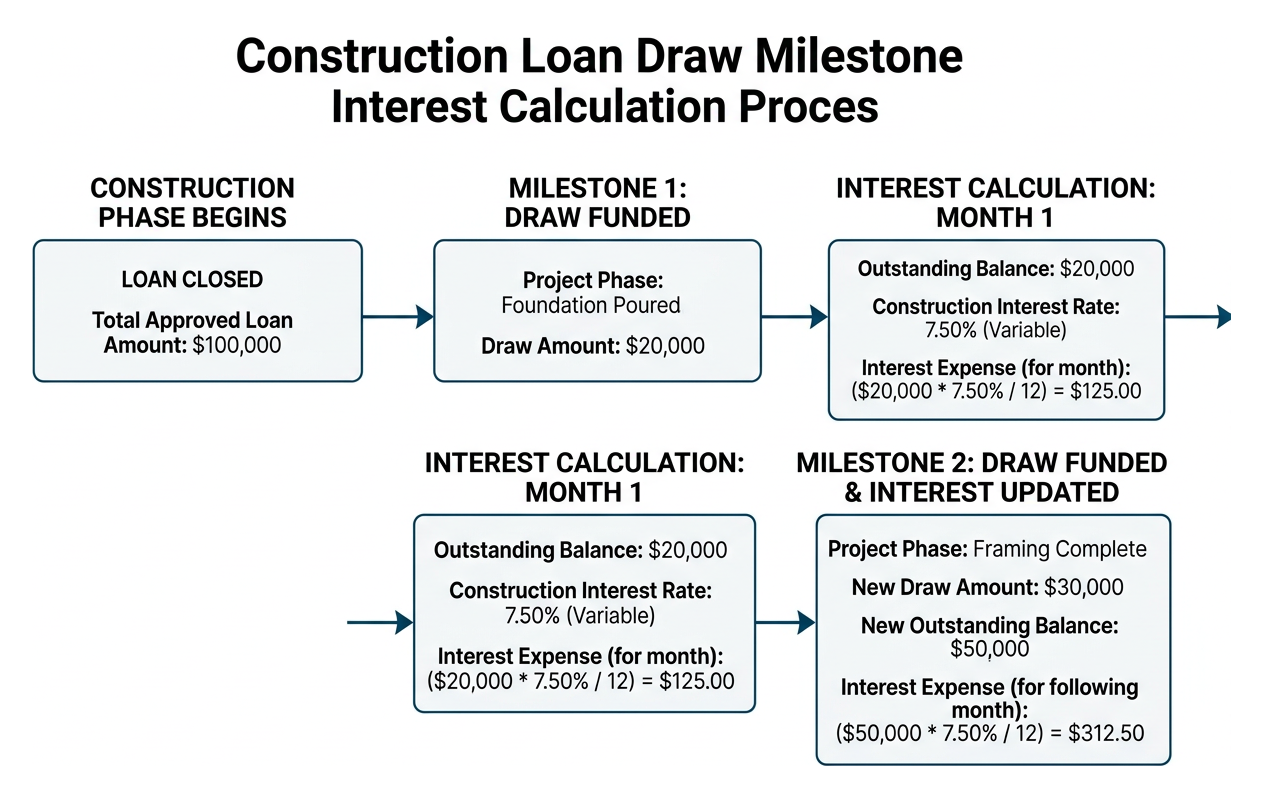
To see how milestone disbursements impact monthly interest reserves during an active build, use this construction loan calculator for draw schedules and land equity to project cash flow requirements accurately.
Understanding Loan Structures: One-Time Close vs. Two-Time Close
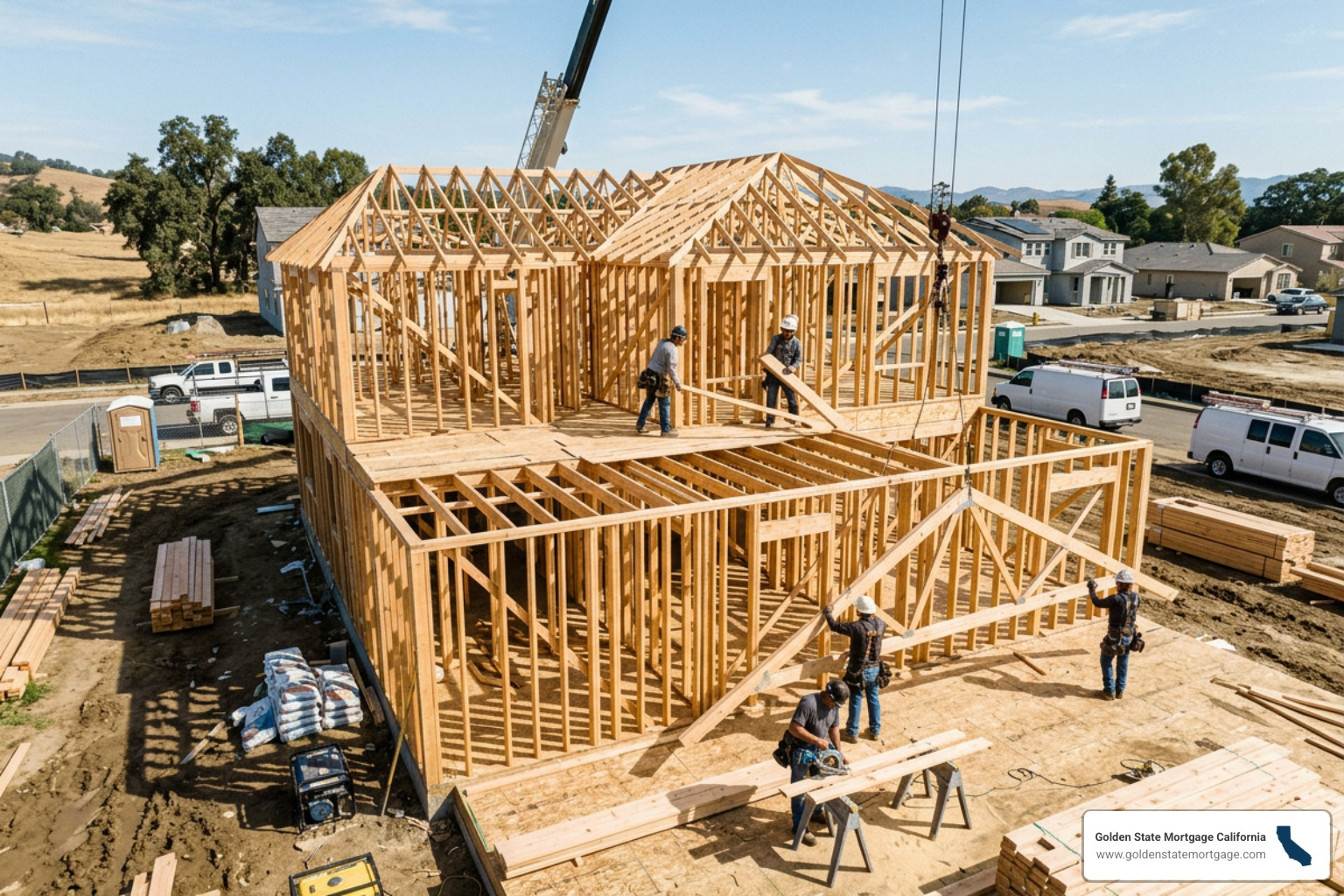
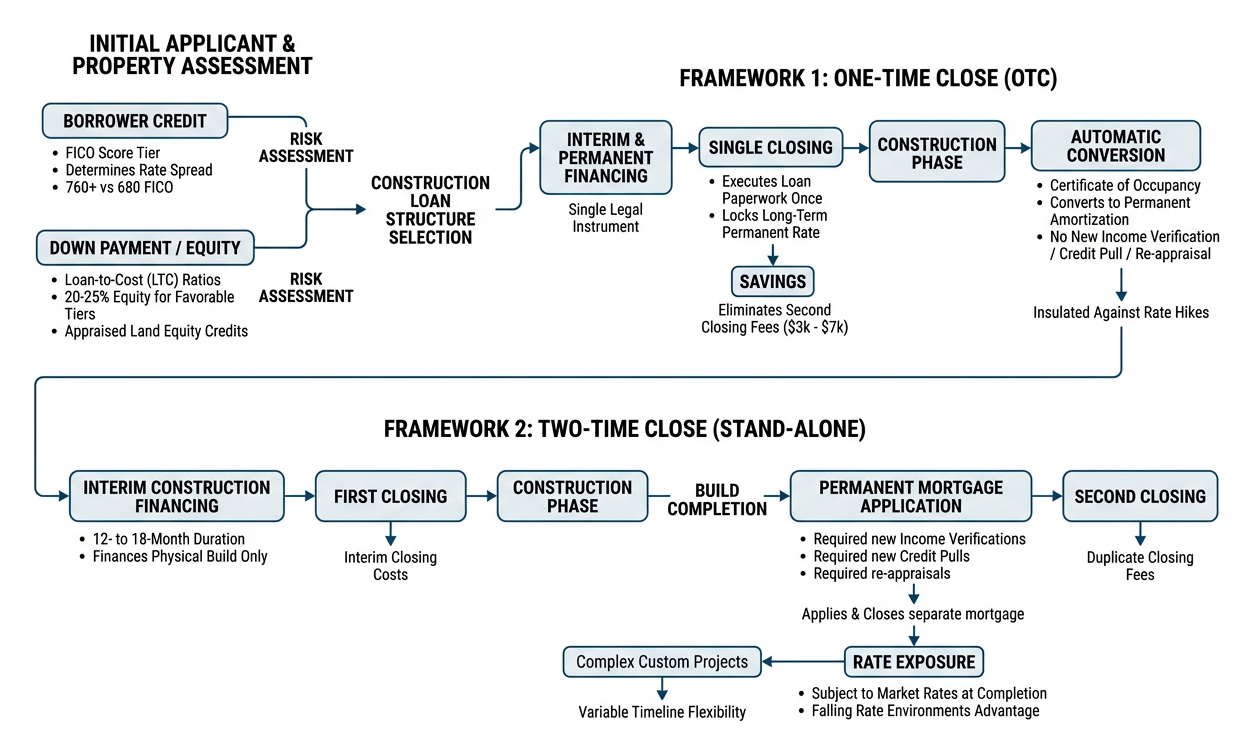
Choosing between a one-time close (OTC) and a two-time close structure significantly impacts your total closing costs, interest exposure, and underwriting complexity. We provide diverse construction loan options tailored to match your specific construction schedule and appetite for rate risk.
The Single-Close Construction-to-Permanent Advantage
A one-time close loan wraps interim construction financing and 30-year permanent take-out financing into a single legal instrument. You execute loan paperwork once, establish your long-term permanent rate before breaking ground, and avoid duplicate closing fees.
- Closing Cost Reductions: By eliminating a second closing, borrowers save between $3,000 and $7,000 in duplicate title policies, escrow charges, and administrative underwriting fees.
- Protection Against Rate Hikes: If benchmark rates climb during your 12-month build, your locked permanent rate remains insulated.
- Automatic Conversion: When the home is certified for occupancy, the loan converts directly to permanent amortization without requiring new income verifications, credit pulls, or re-appraisals.
Borrowers looking to understand how permanent mortgages amortize can expand their knowledge through our mortgage education resources.
Stand-Alone Interim Construction Financing Dynamics
A stand-alone construction loan—often structured as a two-time close—finances only the physical build phase for a 12- to 18-month duration. Once construction finishes, you must apply for and close a separate permanent mortgage to pay off the interim balance.
While this structure carries duplicate closing costs, it provides tactical advantages under specific conditions:
- Falling Rate Environments: If market interest rates are projected to decline substantially over your build window, a stand-alone loan allows you to lock a permanent take-out mortgage at lower prevailing rates upon completion.
- Complex Custom Projects: High-value architectural builds with variable timelines benefit from the flexibility of interim lines of credit before committing to permanent financing.
For homeowners considering remodeling an existing property rather than ground-up construction, exploring renovation loan alternatives can deliver comparable transformation without full site development costs.
Key Factors That Determine Your Construction Loan Interest Rate
Lenders assess construction loan risk across both borrower creditworthiness and project feasibility. Understanding these factors allows you to secure optimal pricing. To review how baseline qualifications influence final interest terms, check our published stated rate assumptions.
Credit Score, Down Payment, and Land Equity Impact
- Credit Tiering: Higher credit scores directly lower your rate spread. A borrower with a 760+ FICO score typically receives a construction interest rate 0.50% to 1.00% lower than an applicant with a 680 score. Over a 30-year permanent mortgage on a $350,000 loan balance, a 2.0% rate difference (such as 6.0% versus 8.0%) amounts to $169,224 in additional interest.
- Loan-to-Cost (LTC) Ratios: Injecting 20% to 25% equity into the total build cost provides favorable risk tiers, reducing the interest rate by 0.25% to 0.50% compared to maximum leverage options.
- Land Equity Credits: If you own your building parcel outright or have accumulated equity, lenders credit the appraised land value directly toward your down payment requirement. For example, if you own a lot appraised at $120,000 on a $500,000 build budget, that equity satisfies a 24% down payment requirement without requiring additional cash.
Homeowners leveraging existing real estate to fund land acquisition or site preparation often look into cashing out home equity for construction to optimize project capitalization.
Builder Credentials and Project Scope
Because your builder represents the operational engine of the project, lenders thoroughly underwrite general contractors (GCs) before issuing loan approvals. Underwriters verify:
- Active state contractor licensing, general liability insurance, and worker’s compensation policies.
- A verifiable track record of completing comparable residential builds within regional California submarkets.
- The contract structure: Guaranteed Maximum Price (GMP) or Fixed-Price contracts secure lower interest margins than Cost-Plus contracts because they limit the risk of cost overruns.
- Adequate contingency reserves: Lenders typically mandate a 5% to 10% hard-cost contingency reserve within the build budget to handle unexpected site conditions without stalling construction.
Rate Lock Strategies and Mitigating Conversion Costs

With average annual interest rate volatility running around 140 basis points in 2026 (roughly 11.67 basis points per month), selecting an effective rate lock strategy protects your long-term housing budget from unexpected market shifts.
Managing Float-Downs and Long-Term Rate Locks
Standard mortgage locks run 30 to 60 days, but residential builds typically require 9 to 14 months. To eliminate market risk, lenders provide extended rate locks covering 120, 180, or even 360 days.
- Lock Break-Even Analysis: A 120-day rate lock on a $485,000 loan balance may require an upfront fee of approximately $604 (around 0.125%). If market interest rates climb by just 0.12% (12 basis points) during that period, the lock fee pays for itself immediately.
- Float-Down Provisions: A float-down option provides a safety net: you secure an interest rate ceiling before construction starts, but if market rates drop during construction, you can adjust your permanent rate downward before conversion.
- Slippage Buffers: Always secure a lock window that extends 60 to 90 days past your builder’s projected completion date to absorb supply chain or permitting delays without incurring costly extension fees.
Avoiding Hidden Conversion Fees and Appraisal Overlays
When a construction loan finishes, converting from interim debt to permanent amortization should proceed smoothly. However, third-party lenders that outsource their permanent underwriting often introduce hidden conversion expenses. Working with a direct California lender featuring in-house processing mitigates these unexpected fees:
- Appraisal Update Fees ($450 – $850): Single-close programs avoid full re-appraisals, requiring only a final completion inspection (Form 1004D) verifying work matches approved plans.
- Title Policy Endorsements ($800 – $1,400): Ensures all contractor lien waivers are recorded and title coverage transitions cleanly to the permanent lien.
- Lender Overlay and Processing Surcharges ($600 – $1,200): Lenders that broker the permanent loan elsewhere often pass administrative conversion fees to the borrower. In-house conversion maintains streamlined underwriting without extra markups.
Frequently Asked Questions About Construction Loan Rates
How much higher are construction loan rates than standard mortgage rates?
Construction loan interest rates typically sit 0.50% to 1.50% higher than standard 30-year fixed purchase mortgages. This margin reflects collateral risk: the lender is financing a structure that does not yet exist. Once the home passes final inspection and converts to a permanent mortgage, the interest rate drops to standard market tiers.
Can I use my existing land equity instead of a cash down payment?
Yes. If you own your building lot, lenders allow the appraised value of the land (minus any existing lot liens) to count directly toward your required equity contribution. On high-value California lots, existing equity frequently covers the entire 15% to 20% down payment requirement, allowing you to break ground with minimal out-of-pocket cash.
When is the best time to lock in my permanent mortgage rate?
For single-close construction-to-permanent loans, lock your permanent rate before initial closing to protect against rate volatility during the 9- to 12-month build phase. If using a two-time close loan, initiate your permanent mortgage rate lock approximately 60 to 90 days prior to receiving the final Certificate of Occupancy.
Conclusion
Building a custom home across California requires balancing architectural vision with disciplined financial structuring. Securing competitive construction financing in 2026 demands evaluating interim draw mechanics, leveraging existing land equity, and selecting rate-lock terms that shield your long-term budget from market swings.
Whether you are breaking ground on an estate in Los Angeles, constructing a family home in Fresno, or developing a parcel in Riverside, our team provides transparent in-house processing and personalized guidance at every stage. Explore our California construction home mortgage solutions to compare program options, lock in competitive terms, and fund your custom build with total confidence.


