
California First Time Home Buyer Programs Can Reduce Upfront Costs
California first time home buyer programs can help eligible buyers cover a down payment, closing costs, or both. The best starting point is to get pre-qualified with an approved lender, compare state and local assistance, complete required homebuyer education, and confirm that the home and your household income meet program rules.
Key options include:
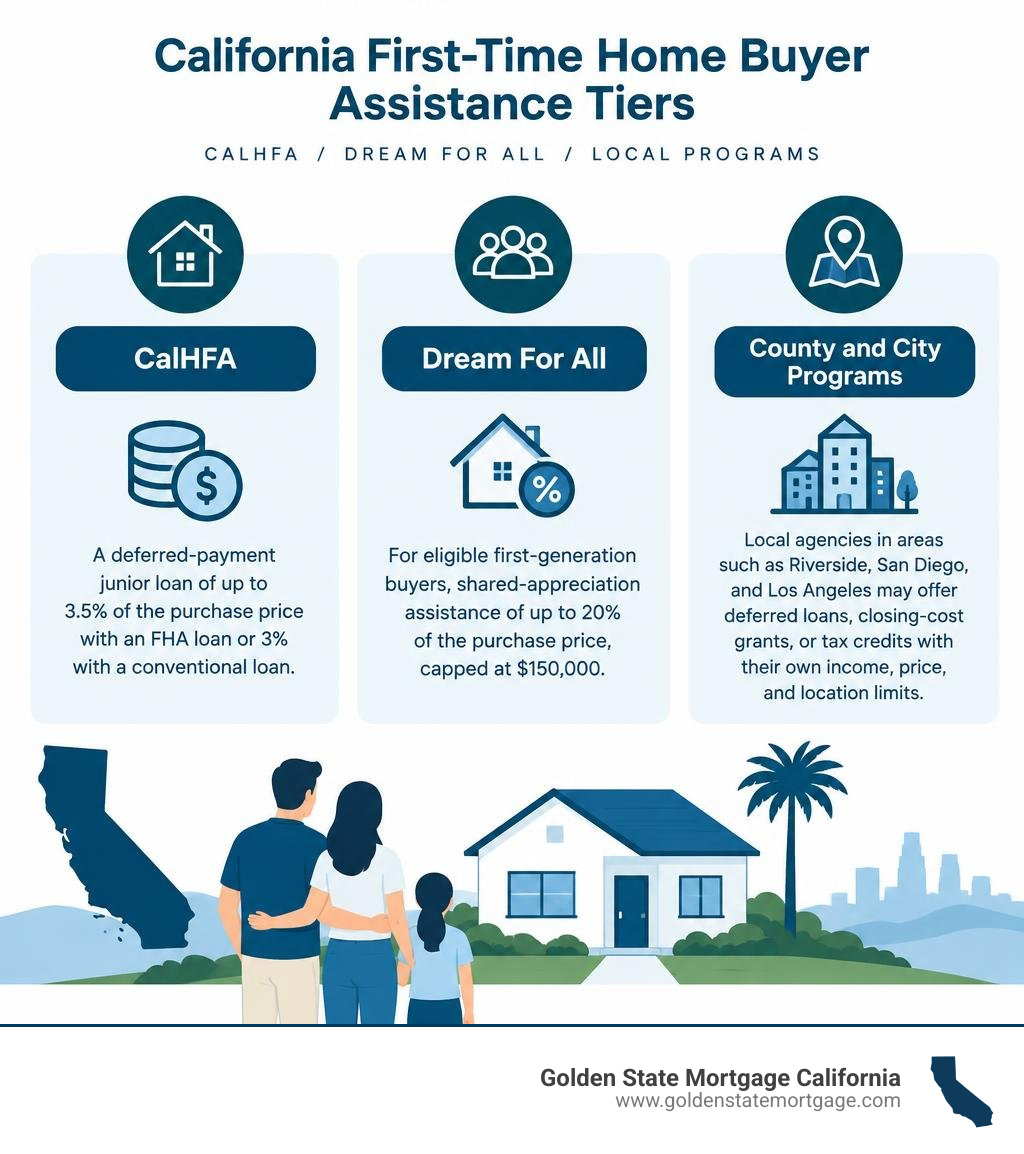
- CalHFA MyHome Assistance: A deferred-payment junior loan of up to 3.5% of the purchase price with an FHA loan or 3% with a conventional loan.
- California Dream For All: For eligible first-generation buyers, shared-appreciation assistance of up to 20% of the purchase price, capped at $150,000.
- County and city programs: Local agencies in areas such as Riverside, San Diego, and Los Angeles may offer deferred loans, closing-cost grants, or tax credits with their own income, price, and location limits.
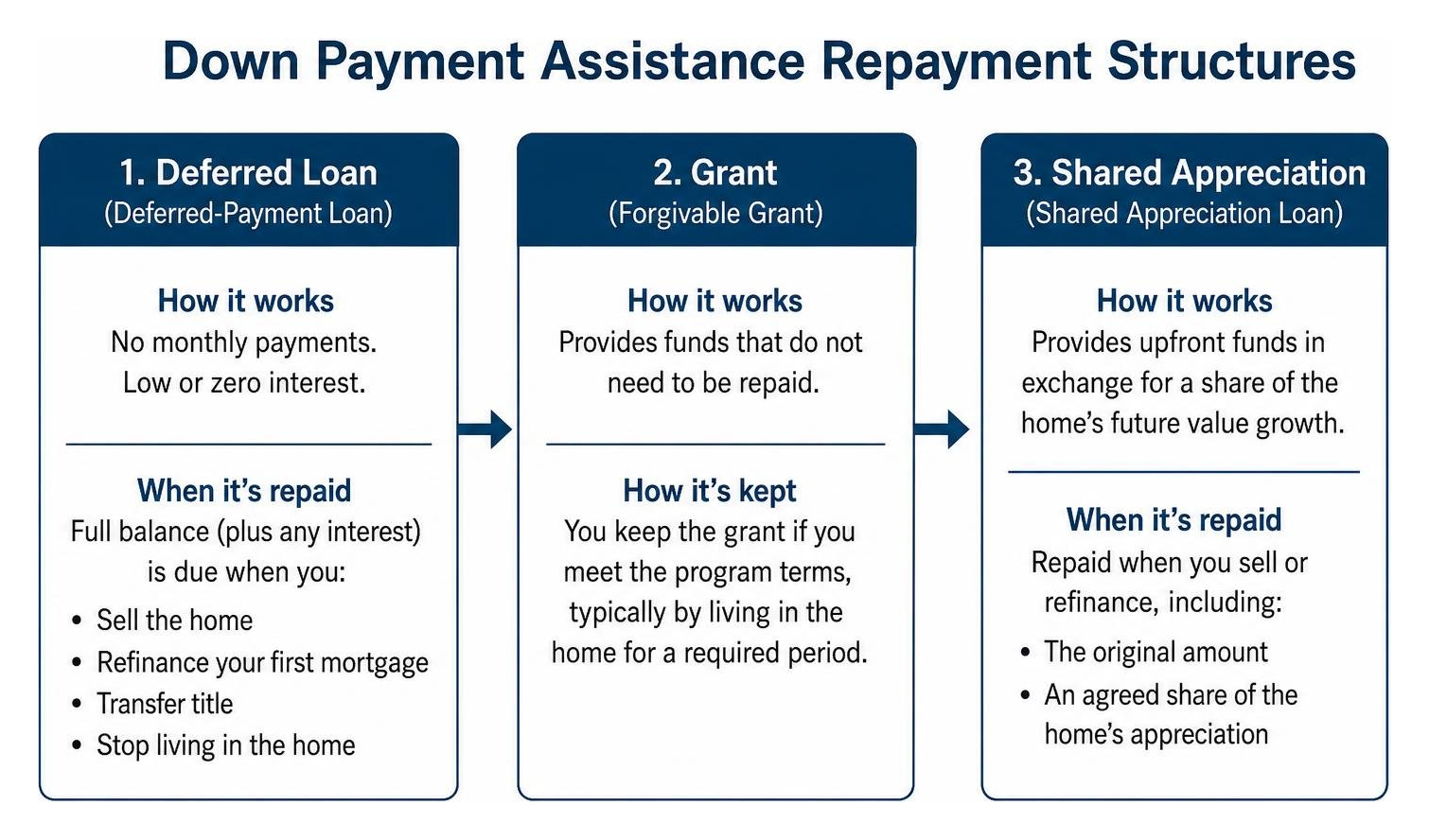
These programs are not all the same. A deferred loan may not require monthly payments, but is usually repaid when you sell, refinance, or stop living in the home. A grant generally does not have to be repaid if its terms are met. Shared-appreciation assistance is repaid along with an agreed share of the home’s value growth.
I am Dale Gremillion, a Senior Loan Officer and Producing Branch Manager with more than 25 years of residential lending experience, including Conventional, FHA, VA, USDA, jumbo, and construction financing. In this guide to California first time home buyer programs, I will help you sort through the options and understand the practical steps to choosing financing that fits your budget.
Understanding First-Time Homebuyer Eligibility and Assistance Structures
Entering the California real estate market can feel daunting, but state and municipal agencies provide significant support structures to lower upfront hurdles. Navigating down payment assistance (DPA) requires understanding how lenders view borrower eligibility and how different subordinate liens work together.

First-Time Homebuyer Definition and Minimum Requirements
In California lending guidelines, a first-time homebuyer is defined as someone who has not held an ownership interest in their principal residence at any point during the preceding three years. If you owned a property four years ago and rented afterward, you reset your eligibility under state guidelines.
This three-year ownership gap also applies to spouses when establishing household eligibility. Standard exceptions exist for displaced homemakers or single parents who previously only held joint ownership with an ex-spouse. The purchased property must serve as your owner-occupied primary residence within 60 days of closing; these programs cannot be used for investment properties or secondary vacation homes.
When structuring your transaction, you can explore various options, including first-time buyer grants, to establish a sustainable foundation before submitting purchase offers.
Assistance Types: Deferred Loans, Grants, and Shared Appreciation
Down payment assistance is not a one-size-fits-all product. California assistance models generally fall into three structural categories:
- Deferred-Payment Loans (Silent Seconds): These junior liens sit in a subordinate position behind your primary 30-year mortgage. They require zero monthly payments, carrying either a low fixed simple interest rate or zero interest. The full principal and accrued interest become due when you sell the property, refinance your first mortgage, transfer title, or vacate the home.
- Forgivable Loans and Grants: These are true non-repayable funds, provided you maintain owner occupancy for a specified compliance duration. For instance, some local programs convert second mortgages into grants after a 15-year affordability period.
- Shared Appreciation Loans: These provide substantial upfront equity in exchange for a percentage of your property’s future capital growth. When you eventually sell or refinance, you repay the original principal plus an agreed-upon share of the home’s price appreciation.
Borrowers who want to minimize upfront cash requirements can evaluate no down payment loan options to identify which financial model aligns with their long-term wealth goals.
Major California First Time Home Buyer Programs and Assistance Options
California provides statewide assistance programs through the California Housing Finance Agency (CalHFA), along with local programs run by city and county housing departments.
| Program Type | Administering Entity | Maximum Assistance Amount | Primary Repayment Mechanism | Target Borrower Demographic |
|---|---|---|---|---|
| MyHome Assistance | CalHFA | Up to 3.5% (FHA) or 3% (Conventional) | Deferred junior lien; due upon sale, transfer, or refinance | Standard first-time buyers statewide meeting income limits |
| Dream For All | CalHFA | Up to 20% of purchase price (Max $150,000) | Original principal plus 15%–20% of home appreciation | First-generation homebuyers selected via state drawing |
| County of Riverside FTHB | Riverside Housing & Workforce Solutions | Up to 20% of purchase price | Deferred 15-year loan; converts to a forgiven grant | Low-to-moderate income buyers (HOME & PLHA programs) |
| City of San Diego Low-Income | San Diego Housing Commission (SDHC) | Up to 17% (Max $125,000) + $10k closing grant | 3% simple interest deferred loan; 30-year term | Low-income households earning $\le 80\%$ Area Median Income (AMI) |
| City of San Diego Middle-Income | San Diego Housing Commission (SDHC) | $40,000 deferred loan + $10,000 closing grant | 4% simple interest deferred loan; 30-year term | Middle-income households earning $80\%$–$150\%$ AMI |
| City of Los Angeles LIPA | LA Housing Department (LAHD) | Substantial down payment and closing assistance | Deferred subordinate lien; payable upon sale or transfer | Low-income first-time buyers within Los Angeles city limits |
Comparing Statewide California First Time Home Buyer Programs: Standard Assistance vs. Shared Appreciation
Statewide buyers primarily evaluate the trade-offs between standard junior loans and shared appreciation models.
CalHFA’s flagship initiative, the MyHome Assistance Program, offers a deferred subordinate lien capped at 3.5% of the sales price when paired with an FHA first loan, or 3% when paired with conventional financing. MyHome is designed to bridge the exact down payment gap without claiming any future equity upside.
In contrast, the California Dream For All | Shared Appreciation Loan provides up to 20% of the purchase price (capped at $150,000) for down payment or closing costs. To qualify, at least one borrower must be a first-generation homebuyer—meaning they have not owned a home in the U.S. in the last seven years, their parents do not currently own a home, or they grew up in foster care.
When the home is sold or refinanced, the homeowner repays the original 20% loan plus a 20% share of the property’s appreciation (or a 15% share for borrowers earning 80% AMI or less).
Government vs. Conventional Loan Programs
CalHFA organizes its first mortgages into two primary divisions: government loans and conventional loans.
The California Housing Finance Agency Government Loan Program Handbook establishes parameters for CalHFA FHA, CalPLUS FHA, CalHFA VA, and CalHFA USDA loans. Government loans offer flexible underwriting guidelines, an entry credit score baseline of 640, and the ability to add Zero Interest Program (ZIP) loans covering 2% to 3% of the first mortgage balance for closing costs.
For conventional financing, the California Housing Finance Agency Conventional Loan Programs Handbook and the First Time Home Loans | CalHFA Conventional Program use Fannie Mae HFA Preferred structures. These loans require private mortgage insurance (PMI) rather than upfront government mortgage insurance premiums. They allow financing for single-family residences, eligible condominiums, planned unit developments, and manufactured homes. Borrowers purchasing factory-built properties can also review specialized manufactured home down payment assistance guidelines.
Regional California First Time Home Buyer Programs in Southern California
Local municipalities across Southern California offer dedicated municipal down payment programs to supplement or substitute for state options.
In Riverside County, the Housing & Workforce Solutions department administers programs using federal HOME Investment Partnerships and state Permanent Local Housing Allocation (PLHA) funding. The maximum purchase price for a new construction single-family home under Riverside County’s FTHB program is $607,050. Income limits depend on household size:
- A 1-person household can earn up to $68,900 under HOME (80% AMI) or $89,520 under PLHA (120% AMI).
- A 4-person household can earn up to $98,400 under HOME or $127,800 under PLHA.
Riverside County assistance provides up to 20% of the sales price as a subordinate loan. After a 15-year affordability period of continuous owner-occupancy, the loan converts into a forgiven grant.
The San Diego Housing Commission First-Time Homebuyer Program Manual & Guidelines outlines assistance for San Diego buyers:
- The City of San Diego Low-Income FTHB Program offers a deferred loan of up to 17% (maximum $125,000) at 3% simple interest, plus a closing cost grant of up to $10,000.
- The City of San Diego Middle-Income FTHB Program provides $50,000 in total aid ($40,000 deferred loan at 4% simple interest and a $10,000 closing grant) for properties priced up to $1,250,000.
- The County of San Diego Low-Income Program offers a deferred loan of up to 22% for down payment and a closing cost loan of up to $10,000 (maximum purchase price $743,000).
Since 1988, the San Diego Housing Commission has helped more than 6,100 families and individuals buy their first homes. Buyers in San Diego County can explore local options by reviewing San Diego local homebuyer grants.
In the City of Los Angeles, the First-Time Homebuyers – LAHD – City of Los Angeles portal provides access to the Low Income Purchase Assistance (LIPA) and Moderate Income Purchase Assistance (MIPA) programs, alongside Mortgage Credit Certificates (MCC). The MCC program gives buyers a direct federal tax credit of up to 20% of annual mortgage interest paid, improving ongoing monthly affordability.
Orange County buyers can similarly review dedicated municipal resources like Santa Ana down payment programs when purchasing within city borders. Across Northern and Central California, programs such as Homebuyer Assistance | City of San José, MOHCD homebuyer programs in San Francisco, and Fresno County’s First-Time Homebuyer Program offer comparable local assistance.
Federal Loan Integration: Pairing FHA, VA, and USDA Loans with California Aid
Layering federal loan products with state down payment assistance allows you to minimize upfront out-of-pocket costs while securing regulated, fixed-rate financing.

FHA, VA, and USDA Program Guidelines
Federal loan programs provide the primary foundation for many first-time homebuyer transactions:
- FHA Loans: Backed by the Federal Housing Administration, these mortgages require a standard 3.5% down payment. Pairing an FHA loan with the Downpayment Assistance Program | MyHome Assistance Program allows you to cover the required 3.5% down payment through a subordinate second mortgage.
- VA Loans: Guaranteed by the U.S. Department of Veterans Affairs, VA loans offer eligible active-duty service members, veterans, and surviving spouses a 0% down payment structure with no monthly mortgage insurance. Subordinate California assistance can be used to pay closing costs, escrow impounds, and lender origination fees.
- USDA Loans: Backed by the U.S. Department of Agriculture, these 100% financing loans are available in designated rural and suburban perimeter communities across California. Buyers looking at eligible agricultural and semi-rural regions can review our guides on rural USDA loan options and baseline USDA loan eligibility criteria.
Credit Scores, DTI Limits, and Underwriting Rules
Qualifying for layered financing requires meeting specific credit score, automated underwriting, and debt-to-income (DTI) requirements:
- Credit Score Minimums: CalHFA requires a 640 minimum credit score for all government loan programs (FHA, VA, USDA). CalPLUS and CalReady government options generally require a 660 credit score. For conventional loans, the credit threshold is 660 for borrowers earning 80% AMI or less, and 680 for borrowers earning above 80% AMI.
- Debt-to-Income (DTI) Caps: Standard CalHFA guidelines cap total debt-to-income at 45%. However, government loan borrowers with credit scores of 700 or higher can qualify with DTI ratios up to 50% via automated underwriting systems. Manual underwriting files are restricted to a maximum 43% DTI.
- Combined Loan-to-Value (CLTV): When stacking a first mortgage with secondary liens like MyHome or local municipal subordinate loans, the total combined loan-to-value can reach up to 105%.
Step-by-Step Application Process for California Homebuyers
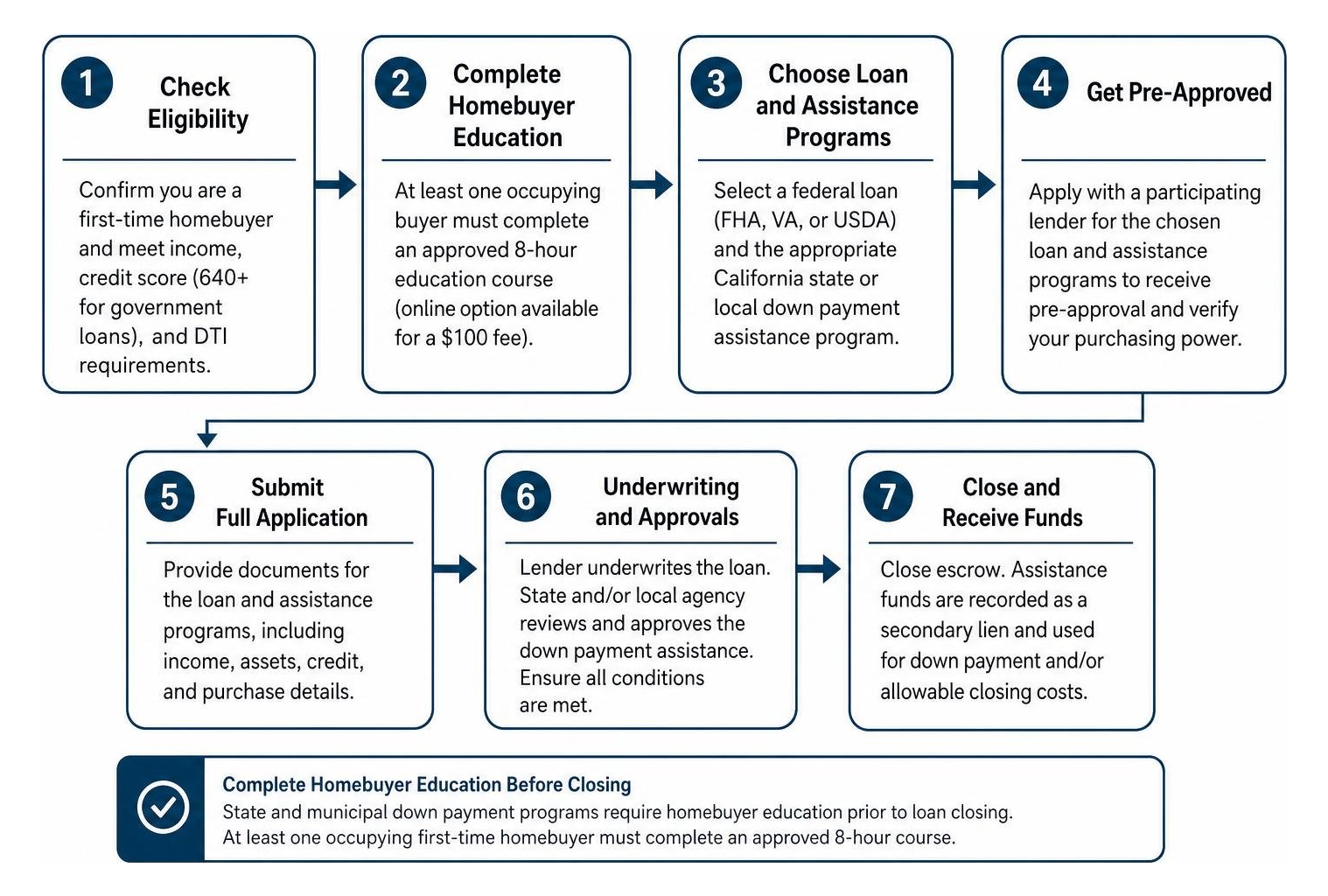
Applying for layered assistance programs requires following a structured sequence to ensure all lender and agency approvals are completed on schedule.
Completing Mandatory Homebuyer Education
State and municipal down payment programs require homebuyer education before loan closing. Following the official Steps to Buying a Home | CA Housing Finance Agency guidance:
- At least one occupying first-time homebuyer must complete an approved 8-hour education course.
- The standard online course is offered through eHome America for a $100 fee.
- Borrowers using the Dream For All Shared Appreciation program must also complete a free, dedicated 1-hour DFA online module.
- In-person and virtual courses are also available through local HUD-approved housing counseling agencies.
Your completion certificate remains valid for one year and must be uploaded to the underwriting portal during loan processing.
Working with Approved Lenders and Securing Property Escrow
CalHFA and municipal housing departments do not accept direct loan applications from the public. Instead, assistance funds are delivered exclusively through approved participating mortgage lenders who hold direct master servicing connections.
To streamline the pre-approval process, gather the following documentation before meeting with your loan officer:
- Most recent 30 days of consecutive pay stubs reflecting year-to-date earnings
- Complete federal personal tax returns (Form 1040) including all W-2s and 1099s from the past two years
- Most recent two months of full bank statements for checking, savings, and investment accounts (all numbered pages included)
- Driver’s license or valid government-issued photo ID, along with proof of legal residency status
- Certificate of completion from an approved homebuyer education and counseling provider
- Written documentation verifying first-generation homebuyer status (if applying for the California Dream For All program)
Once pre-approved, you can begin shopping for a property with your real estate agent, submit an offer within the program’s purchase price limits, and issue the required Homeownership Notice to the seller during escrow.
Frequently Asked Questions About California Homeownership Programs
What is the difference between standard statewide assistance and shared appreciation assistance?
Standard statewide assistance—such as the MyHome Assistance Program—provides a deferred junior loan capped at 3% to 3.5% of the purchase price. It acts as a standard subordinate lien with zero monthly payments, repayable upon sale, transfer, or refinance. In contrast, the California Dream For All Shared Appreciation loan provides up to 20% of the purchase price (capped at $150,000) for first-generation buyers, but requires repaying the original loan plus a 15% to 20% share of the property’s appreciation upon sale or refinancing.
Can I combine California assistance with local city or county down payment programs?
Yes. In many cases, borrowers can layer state programs with municipal initiatives (such as Riverside County PLHA or City of San Diego deferred loans), provided the combined loan-to-value (CLTV) remains within program limits (typically up to 105%) and all subordinate liens are recorded in an acceptable lien position.
What are the credit score and debt-to-income limits for California first-time buyer loans?
CalHFA requires a minimum credit score of 640 for standard government loans (FHA, VA, USDA) and 660 to 680 for conventional financing, depending on household income relative to Area Median Income. Debt-to-income ratios are generally capped at 45%, but can expand to 50% for borrowers with credit scores of 700 or higher through automated underwriting systems.
Conclusion
Overcoming upfront down payment and closing cost barriers in California is achievable when you pair the right first mortgage with available state, county, and municipal assistance programs. Whether you use a CalHFA MyHome junior lien, a local city deferred loan, or federal financing options, these programs provide practical pathways to help you purchase your first property.
We are a direct mortgage lender offering purchase, refinance, and specialty loan programs across California. With in-house processing and underwriting, our team focuses on fast, reliable closings while helping you evaluate available down payment programs. Connect with our lending team today for personalized home loan solutions and take your next step toward homeownership in California.


