
Find a First House Grant in California
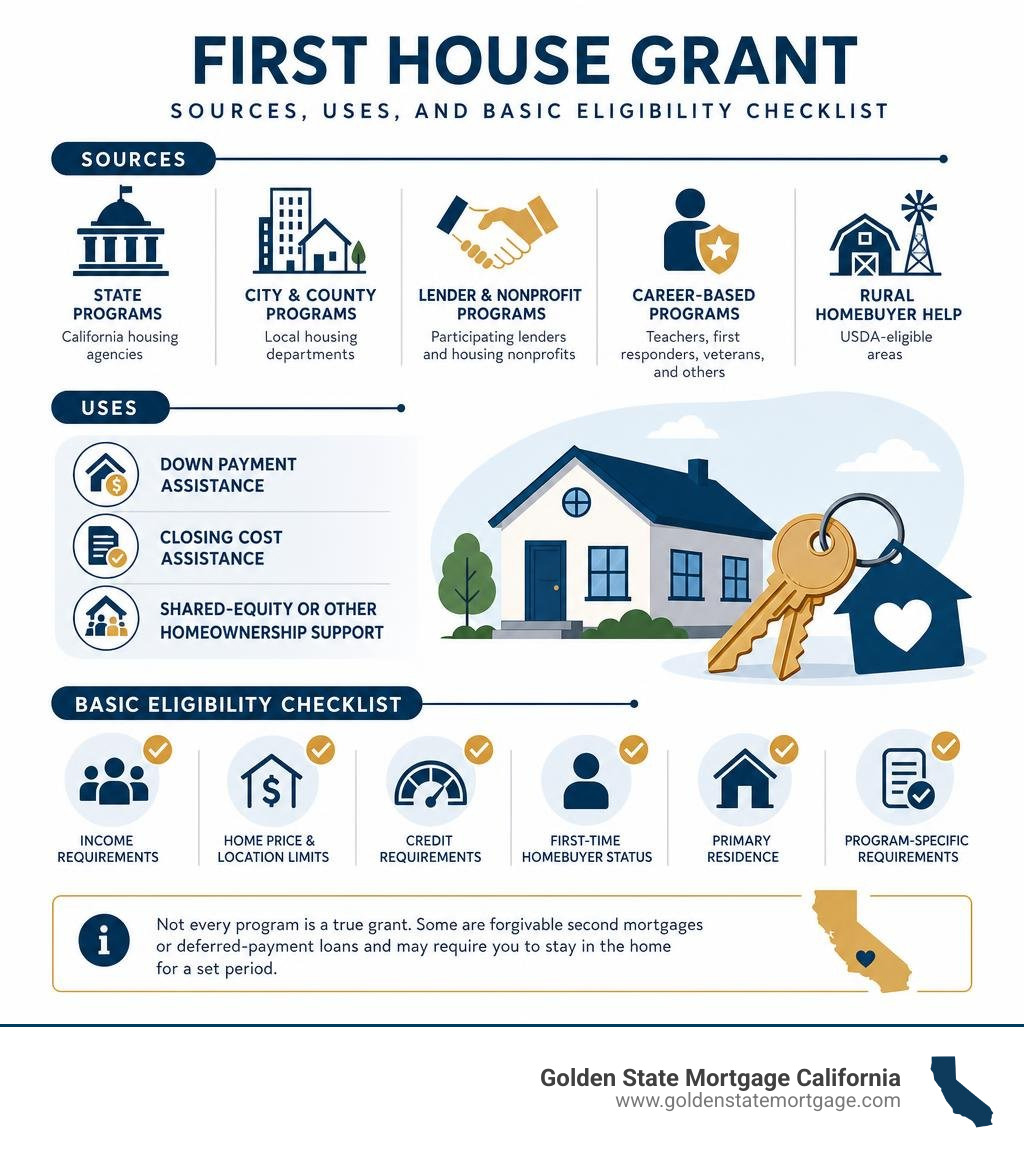
A first house grant can help California buyers cover part of a down payment or closing costs without adding another monthly loan payment. The best opportunities are usually offered through state housing agencies, cities, counties, nonprofit partners, and certain employer or profession-based programs.
Here is the quick answer:
| Type of help | Where to look | What it may help pay for |
|---|---|---|
| State programs | California housing agencies | Down payment, closing costs, shared-equity assistance |
| City and county programs | Local housing departments | Grants or deferred loans for buyers in specific areas |
| Lender and nonprofit programs | Participating lenders and housing nonprofits | Closing-cost credits, matching funds, education support |
| Career-based programs | Programs for teachers, first responders, veterans, and others | Purchase discounts or targeted assistance |
| Rural homebuyer help | USDA-eligible areas | Low- or no-down-payment financing and rural housing support |
Not every program is a true grant. Some are forgivable second mortgages or deferred-payment loans, which can require you to stay in the home for a set period. Eligibility can also depend on household income, the home’s price and location, credit, first-time buyer status, and whether the property will be your main home.
I am Dale Gremillion, a Senior Loan Officer and Producing Branch Manager with more than 25 years of residential lending experience, including helping buyers assess mortgage options that may work alongside a first house grant. The list below explains where California buyers can start looking and what each type of assistance may require.
Key Eligibility Guidelines for a First House Grant
When evaluating a first house grant, it helps to understand that public and private funding sources establish clear guardrails to ensure funds support buyers who truly need them. While every municipal, state, or lender program maintains its own rulebook, several core eligibility standards appear across almost all homeownership assistance initiatives in California.

Generally, grant administrators review your past property ownership, gross household income, legal residency, credit profile, and the purchase price of the property you intend to buy.
Qualification Criteria for First-Time Homebuyers
The single most important threshold for receiving a first house grant is satisfying the formal definition of a first-time homebuyer. Under standard federal guidelines and California housing agency rules:
- The Three-Year Rule: You are officially considered a first-time homebuyer if you (and any co-borrower) have not held an ownership interest in a primary residence at any point during the three years immediately preceding the purchase date.
- Spouse and Co-Applicant Rules: If you are buying a home with a spouse or domestic partner, program administrators usually evaluate ownership history for both individuals. Even if one partner will not be listed on the mortgage note or title, their previous homeownership status can still affect eligibility under certain government-backed programs.
- Natural Person Requirement: Applicants must be natural persons—individual human beings purchasing a home to live in—rather than corporations, trusts, or real estate investment entities.
- Income Limits and Area Median Income (AMI): Most grants are tailored toward low- to moderate-income buyers. Household income limits are calculated based on overall household size and compared against your local county’s Area Median Income (AMI). For example, programs may restrict eligibility to households earning 80% or 120% or less of the AMI.
- Credit Score Minimums: While a first house grant is not a loan that you pay back monthly, receiving one almost always requires securing an underlying first mortgage loan. Approved participating lenders generally look for a minimum credit score of 620 to 640 depending on whether you choose conventional or FHA financing.
To explore more strategies on qualifying for entry-level mortgage programs, review our comprehensive First-time homebuyer resources.
Property and Residency Rules for a First House Grant
Beyond applicant eligibility, the property itself must meet specific program thresholds:
- Eligible Property Types: Most programs allow single-family detached homes, townhomes, approved condominiums, and manufactured homes on permanent foundations. Certain programs also cover new builds or substantially renovated homes.
- Property Value Caps: Local and state agencies often cap the maximum purchase price or appraised value to ensure funds assist buyers acquiring modest, affordable housing.
- Primary Residency Requirements: A first house grant cannot be used to buy investment properties, vacation homes, or rental units. You must occupy the property as your primary residence.
- Move-In Deadlines and Residency Length: Programs require you to move into the home within a specified window—typically 30 to 60 days following loan closing—and maintain continuous occupancy for a set length of time (often 3 to 10 years for forgivable loans or grants).
- Clawbacks and Repayment Penalties: If you vacate, rent out, or sell the property before meeting the required continuous residency period, you may be required to repay a prorated portion or the entire amount of the assistance provided.
Top Federal, State, and City First House Grant Programs
Finding the right first house grant means exploring national resources alongside state and local municipal channels. The following table provides an overview of primary assistance options available to California buyers:
| Program Level | Typical Assistance Offered | Key Qualification Focus |
|---|---|---|
| State Programs (CalHFA) | Deferred equity-share loans & zero-interest second loans | Income caps, 3-year first-time buyer rule, primary residence |
| City & County Grants | $10,000 to $50,000+ in grants or deferred silent seconds | strict local county AMI limits, local residency/employment |
| Federal / USDA Programs | 100% zero-down financing & targeted discounts | Rural property boundaries, low-to-moderate household income |
| Bank & Lender Credits | $2,500 to $10,000 closing cost grants | AMI limits (typically 50% to 80% AMI), lender pre-qualification |
| Regional FHLBank Programs | 4-to-1 matching funds (up to $30,000+) | Household savings match, mandatory homebuyer education |
Major California First House Grant Options
California offers several powerful assistance initiatives designed to bridge the affordability gap in higher-cost real estate markets:
- California Housing Finance Agency (CalHFA) Programs: CalHFA offers state-level down payment and closing cost programs, including the popular California Dream For All program. This shared-appreciation loan structure provides up to 20% of the purchase price toward a down payment or closing costs, allowing first-generation buyers to acquire a home with significantly reduced monthly mortgage burdens.
- San Diego Housing Commission Assistance: For buyers searching in San Diego County, the San Diego Housing Commission programs offer closing cost grants and deferred-payment second loans that help lower-income households purchase single-family homes or condos within city limits.
- City of San José Homebuyer Assistance: Silicon Valley buyers can tap into City of San José homebuyer assistance, which connects local residents with equity-share down payment programs and municipal assistance designed to make regional housing accessible.
Regional and Professional Assistance Programs
In addition to state-wide agencies, regional banks, municipal housing divisions, and federal initiatives offer targeted assistance:
- FHLBank San Francisco WISH Program: The Federal Home Loan Bank of San Francisco offers the Workforce Initiative Subsidy for Homeownership (WISH) program through participating member lenders. Qualifying low- and moderate-income buyers can receive matching grant funds—often up to $30,000 or more on a 4-to-1 match basis—to apply toward down payment and closing expenses. Explore more details at FHLBank San Francisco grants.
- Central Valley Municipal Programs: Municipalities in the Central Valley provide structured homebuyer support. For example, local buyers can utilize the Fresno Mortgage Assistance Program to access down payment silent-second funds that simplify entry into homeownership.
- USDA Rural Development Loans: For buyers looking in designated rural or suburban edge communities across California (such as parts of Riverside, Fresno, or Sacramento counties), USDA Single Family Housing Direct and Guaranteed programs offer 100% financing with zero down payment required.
- Good Neighbor Next Door Program: Sponsored by HUD, this federal initiative allows eligible K-12 teachers, law enforcement officers, firefighters, and emergency medical technicians to purchase single-family homes in designated revitalization areas at a 50% discount off the list price, provided they commit to living in the property for at least 36 months.
- Lender-Specific Closing Cost Credits: Major mortgage entities and government-sponsored enterprises (Fannie Mae HomeReady and Freddie Mac Home Possible) offer direct $2,500 down payment or closing cost credits for borrowers earning 50% or less of their area’s median income.
To learn more about combining home purchase financing with specialized financial structures, browse our Mortgage education guides.
How First House Grants Differ From Loans and Other Assistance
It is easy to confuse a first house grant with other homebuying assistance structures like second mortgages or soft loans. Understanding the financial mechanics of each option ensures you pick the right strategy for your home purchase.
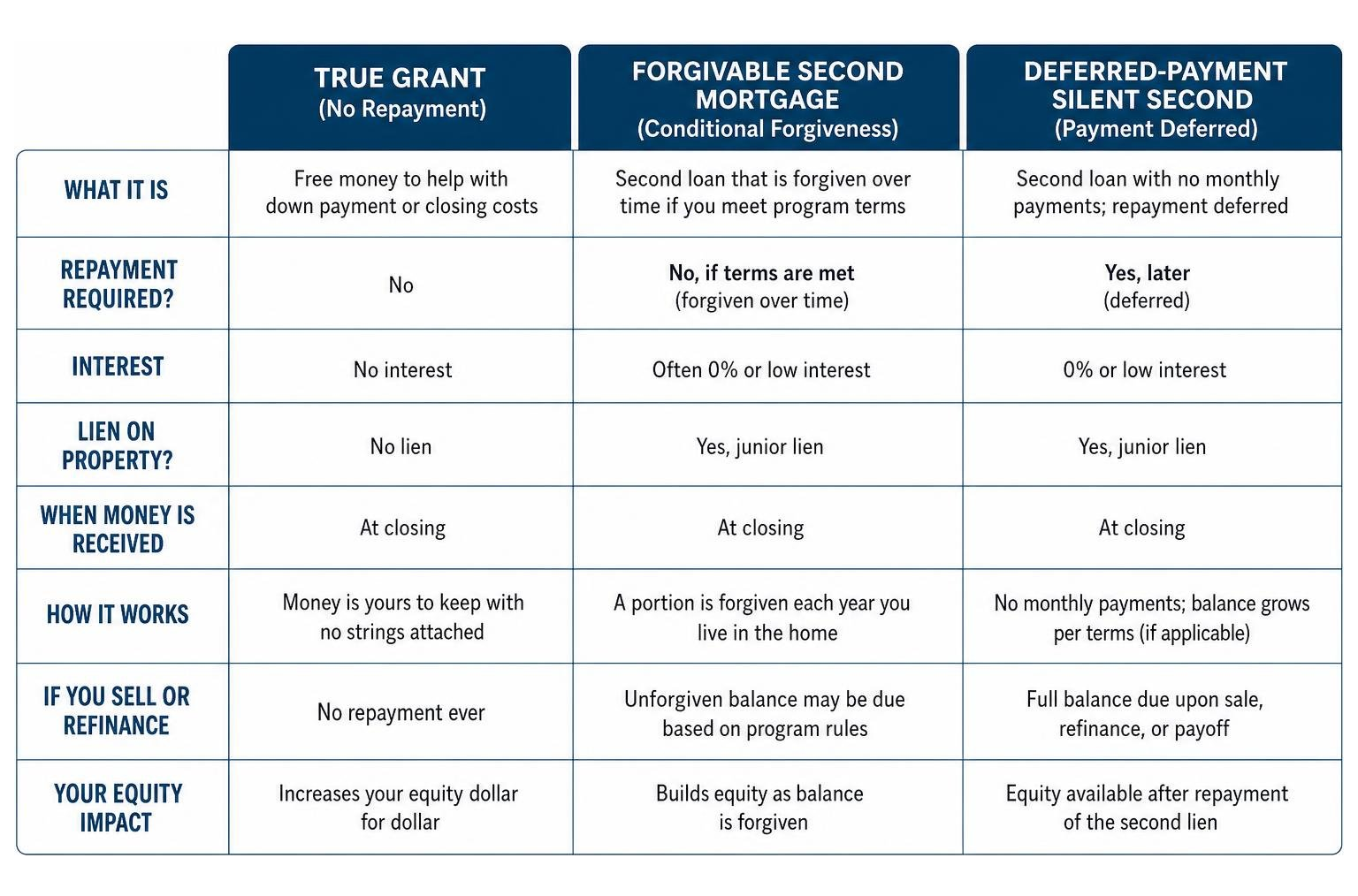
Here is how common financial aid formats break down:
- True Grants: Pure grant funding provides money that does not require repayment, carries no interest rate, and places no lien on your home title. Once awarded at closing, the money belongs to you as equity.
- Forgivable Second Mortgages: These structured programs provide down payment funds in exchange for a junior lien recorded against your home. However, a percentage of the loan balance is forgiven for every year you live in the property. If you satisfy the residency timeframe (e.g., 5 continuous years), the balance drops to $0 without cash repayment.
- Deferred-Payment Silent Seconds: These second loans carry 0% or low interest, but repayment is deferred until you sell the home, refinance the primary mortgage, or pay off the first loan. While not a outright grant, they eliminate monthly payments during your ownership tenure.
- Shared Appreciation Loans: Programs like the CalHFA Dream For All program provide significant upfront down payment support in exchange for a percentage of your home’s future equity appreciation when you sell or refinance down the road.
- Layering Assistance: Many public programs allow buyers to combine (“layer”) multiple aid sources—such as pairing a municipal grant with a lender closing cost credit—provided your total combined loan-to-value (CLTV) ratio stays within program boundaries.
To dive deeper into navigating large assistance figures and grant layering tactics, check out The Ultimate Guide to $25,000 First Home Buyer Grants.
How to Apply for Grant Funding and Required Documents
Securing a first house grant requires careful timing and preparation. Because grant funds are disbursed during loan settlement, your grant application moves hand-in-hand with your primary mortgage pre-approval.

Follow this step-by-step roadmap to apply efficiently:
- Partner with an Approved Participating Lender: Most government and municipal grants cannot be accessed directly by consumers; they must be originated through an approved mortgage lender who coordinates program underwriting.
- Get Pre-Approved and Verify Income: Your loan officer will analyze your income against county AMI thresholds to determine which specific grant or assistance tiers you qualify for.
- Complete Required Homebuyer Education: Almost all grant programs require borrowers to complete a HUD-approved homebuyer education course. These courses cover budgeting, credit management, home maintenance, and loan mechanics, and can often be taken online or in a classroom setting.
- Gather Document Packet: Have your paperwork ready prior to writing purchase offers. Essential documents include:
- Recent pay stubs covering the last 30 to 60 days
- W-2 forms and 1099s from the past two years
- Federal tax returns (1040s) from the past two years
- Two months of complete bank account statements
- Government-issued photo identification and proof of legal residency status
- Homebuyer education completion certificate
- Execute Purchase Contract and Reserve Funds: Once your offer on a qualifying primary residence is accepted, your lender locks in your mortgage rate and formally reserves your grant funds with the administering housing authority before closing escrow.
Frequently Asked Questions About First House Grants
Is money received from a first house grant considered taxable income?
In most cases, direct government grants provided for residential housing assistance, municipal down payment support, or forgivable state programs are non-taxable under federal tax guidelines because they represent homebuying subsidies rather than earned income. However, certain commercial bank grants or lender-paid credits may generate a 1099-MISC or 1099-INT form at year-end. You should always consult a qualified CPA or tax advisor regarding your specific situation.
What happens if I sell or move out of the property before meeting the residency period?
If your assistance was delivered as a true non-repayable grant with no lien, moving out early usually incurs no financial penalty. However, if your first house grant was structured as a forgivable second loan or silent second mortgage, selling, refinancing, or converting the property into a rental before the mandatory occupancy window expires will trigger a clawback provision. You will be required to repay the un-forgiven balance from your net sale proceeds or refinance funds.
Can I combine a first house grant with other down payment assistance programs?
Yes, program layering is frequently permitted! Many California buyers combine local city grants, FHLBank matching funds, and lender closing cost credits alongside conventional or FHA financing. However, total combined assistance must conform to maximum allowable Combined Loan-to-Value (CLTV) ratios established by your primary mortgage investor and loan program guidelines.
Conclusion
Navigating the landscape of homebuying assistance across California does not have to feel overwhelming. Whether you are searching for a true first house grant, a forgivable down payment loan, or career-specific assistance, leveraging these resources can drastically reduce out-of-pocket costs and fast-track your path to homeownership.
At Capital Home Mortgage California (a direct mortgage lender operated by Golden State Mortgage California), our team provides end-to-end guidance to help first-time buyers connect with suitable mortgage structures and down payment assistance strategies across Los Angeles, San Diego, San Jose, San Francisco, Sacramento, Fresno, Riverside, Irvine, and surrounding communities.
When you are ready to take your next step, Explore Santa Ana Down Payment Assistance Programs or contact our loan specialists today to get pre-approved!


