
Chattel vs. Real Property: The Crucial Factor for DPA Eligibility
The single most important distinction determining whether you qualify for down payment assistance for manufactured homes is how the home and land are legally classified.
Financing falls into two primary categories:
- Chattel Loans (Personal Property): When a manufactured home is purchased without land—such as in a traditional leased-land mobile home park—it is usually titled as personal property (chattel), much like a vehicle or boat. Approximately 70% of new manufactured homes are financed this way. However, standard mortgage-based down payment assistance programs almost never apply to chattel loans.
- Real Property Financing: When a manufactured home is permanently attached to land owned by the homebuyer (or on an approved long-term land lease) and the title is legally converted to real estate, the home is classified as real property. This conversion unlocks standard mortgage products—like FHA, VA, USDA, and conventional loans—along with eligibility for state and national down payment assistance grants and deferred loans.
To qualify as real property, the home must meet HUD Code standards (built after June 15, 1976), sit on an engineered permanent foundation, and have its vehicle title officially retired with the state or county recorder. You can learn about California manufactured home advantages to see how real property titling significantly improves long-term financing options.
Federal Mortgage Programs Supporting Manufactured Housing
Federal mortgage programs provide the baseline financing structure that makes layering down payment assistance for manufactured homes possible. Federal regulations, including federal regulations on USDA manufactured home loans, establish strict installation and title rules that govern government-backed financing for these properties.
The USDA has expanded program access nationwide. Updated guidelines under recent USDA updates on existing manufactured housing eligibility allow 100% financing for existing manufactured units, provided they meet HUD safety criteria and sit on approved foundations.
Navigating FHA Title I vs. Title II and Down Payment Assistance for Manufactured Homes
The Federal Housing Administration (FHA) offers two distinct loan pathways for factory-built structures:
- FHA Title I: Designed for personal property (chattel) loans, financing the home unit alone or a home combined with a lot lease. While valuable for buyers in parks, Title I loans generally cannot be paired with state Housing Finance Agency (HFA) down payment assistance programs.
- FHA Title II: Treats the manufactured home as real estate under standard mortgage rules. Title II requires a modest 3.5% down payment and allows full integration with third-party down payment assistance grants and secondary loans. Properties must meet HUD minimum property standards, have a minimum square footage (400 sq. ft. for FHA), and reside on a permanent foundation.
Fannie Mae MH Advantage and Freddie Mac CHOICEHome Low Down Payment Options
Conventional mortgage giants Fannie Mae and Freddie Mac offer specialized loan products—MH Advantage and CHOICEHome, respectively—that bridge the gap between manufactured housing and traditional site-built homes:
- Low Down Payment Requirements: Both options allow qualified buyers to put down as little as 3%.
- Site-Built Aesthetics: To qualify for these programs, homes must feature site-built architectural characteristics, such as higher roof pitches, lower-profile foundations, covered porches, and attached garages.
- Appraisal Parity: Appraisers evaluate these properties using site-built comparable sales, which helps support stronger appraisal valuations and steady home equity growth.
How State HFA and National Programs Provide Down Payment Assistance for Manufactured Homes
State Housing Finance Agencies (HFAs) and nationwide non-profit organizations offer powerful financial tools designed to lower out-of-pocket costs at closing. To get a comprehensive overview of national program availability, review this guide to mobile and manufactured home DPA options. You can also explore more insights on manufactured homes through our dedicated mortgage resources.
National entities like the National Homebuyers Fund (NHF) provide up to 5% of the total loan amount in grant or assistance funds for eligible buyers. State agencies (like CalHFA in California) administer similar low-interest or zero-interest secondary financing that covers both minimum down payment requirements and closing costs.
Qualifications and Single-Wide Eligibility for Down Payment Assistance for Manufactured Homes
Qualifying for down payment assistance requires meeting specific borrower and property criteria:
- Credit Score Minimums: While baseline FHA guidelines allow credit scores down to 580, most DPA programs impose higher credit thresholds—typically requiring a 620 to 660 minimum FICO score for manufactured homes.
- Income Limits: Assistance programs are designed for low- to moderate-income buyers, capping eligibility at 80% to 120% of the Area Median Income (AMI) depending on county and family size.
- Single-Wide Restrictions: Program rules regarding single-wide homes vary. National programs like the NHF exclude single-wides from DPA eligibility, requiring double-wide or multi-section homes. However, certain state HFA programs and federal loans (such as standard FHA Title II) permit single-wide homes provided they meet minimum size requirements and native real property land titling.
Key Program Types: Grants, Forgivable Loans, and Silent Seconds
Down payment assistance comes in three primary financial structures:
- Grants: True grant funds require zero repayment. They instantly reduce the upfront cash required at closing without adding secondary debt.
- Forgivable Second Mortgages: These 0% interest loans are forgiven incrementally over a specific timeframe (e.g., 20% per year during years 11 through 15, or fully forgiven after 3 to 5 years of continuous occupancy).
- Deferred “Silent” Second Mortgages: Accounting for roughly 67% of all DPA structures, these loans require zero monthly payments. Repayment is deferred until you sell the property, pay off the primary mortgage, or refinance the loan.
Property Standards and Application Steps for DPA Approval
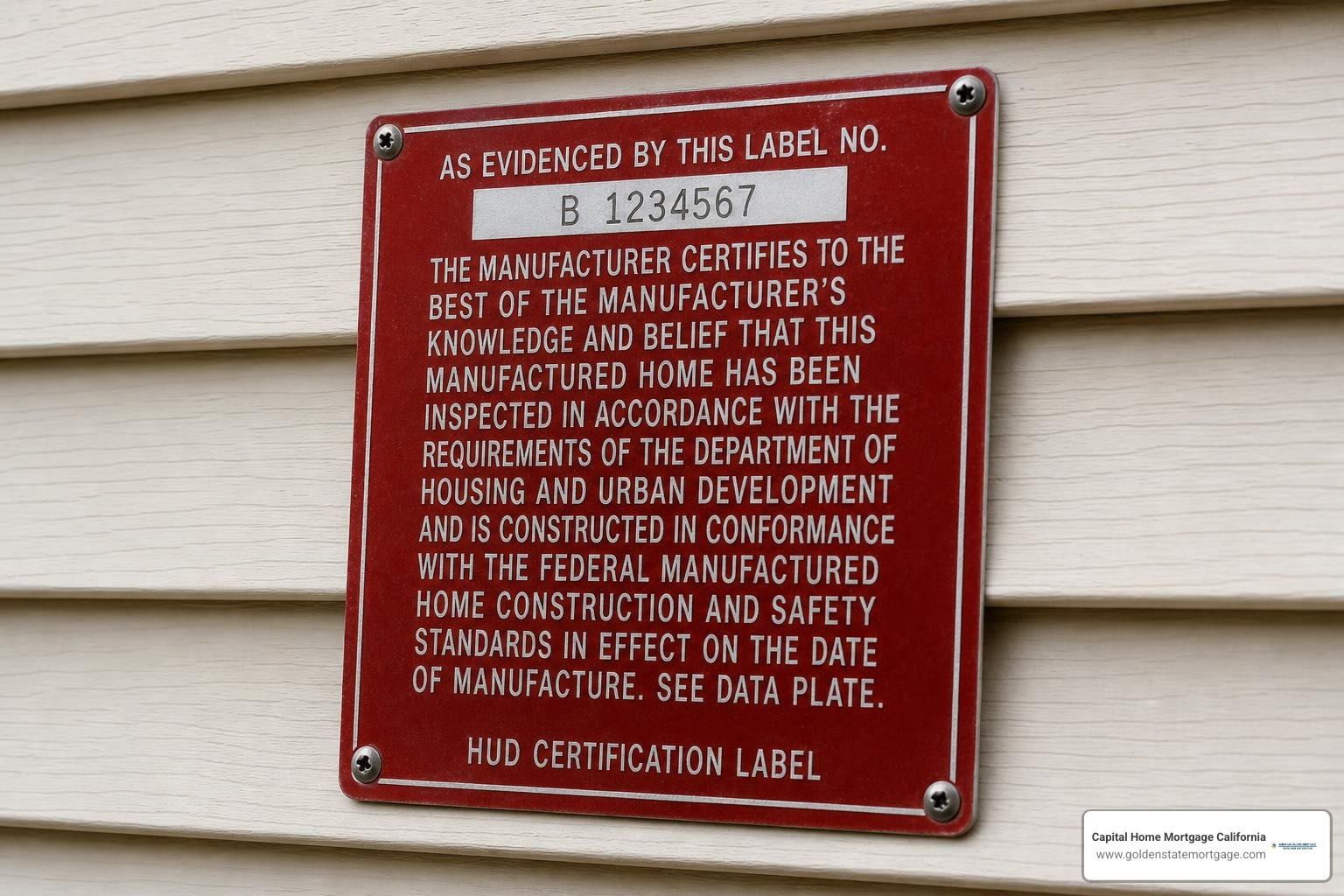
Before DPA funds are approved and released, manufactured housing properties must satisfy explicit engineering and regulatory benchmarks:
- HUD Certification Label & Data Plate: Every section of the home must retain its red metal HUD Certification Label on the exterior siding, along with an interior HUD Data Plate specifying wind, snow, and thermal zone ratings.
- Engineering Certification: A licensed professional engineer must inspect and certify that the home’s foundation complies with HUD Permanent Foundations Guide for Manufactured Housing standards.
- Flood Zone Restrictions: Properties located within designated FEMA Special Flood Hazard Areas (SFHA) face strict elevation criteria and mandatory flood insurance obligations to qualify for assistance.
Completing homebuyer education is another universal prerequisite. Programs like the CalHFA MyHome Assistance Program guidelines require at least one occupying homebuyer to finish an 8-hour HUD-approved course, such as eHome America, prior to closing.
| Assistance Type | Repayment Required? | Monthly Payment | Impact on DTI Ratio | Best For… |
|---|---|---|---|---|
| DPA Grant | No | $0 | None | Buyers wanting zero additional debt |
| Forgivable Second | Only if moved early | $0 | None | Long-term owner-occupants |
| Deferred Second | Yes (upon sale/refi) | $0 | None | Buyers needing maximum upfront capital |
Gathering Documents and Working With Approved Lenders
Securing down payment assistance for manufactured homes requires assembling key financial records early in the application process:
- Income Documentation: W-2 forms for the past 2 years, recent pay stubs covering 30 consecutive days, and federal tax returns.
- Asset Verification: 2 to 3 months of complete bank statements proving sufficient funds for earnest money deposits and buyer cash contributions.
- Property Title Records: Proof of land ownership or a signed purchase agreement covering both unit and real estate land, along with the title conversion application.
Working with an approved direct mortgage lender ensures that your DPA grant or second loan reservation is submitted simultaneously with your primary mortgage pre-approval.
Alternatives When DPA Is Unavailable
If a home fails property inspections or property titling restrictions prevent standard DPA qualification, consider these practical financing alternatives:
- Seller Concessions: FHA allows sellers to contribute up to 6% of the purchase price toward buyer closing costs and prepaid items.
- Gift Funds: Government-backed loans permit 100% of required down payment funds to come as documented financial gifts from family members.
- Resident-Owned Communities (ROCs): Buying inside a co-op or resident-owned manufactured home park can open doors to specialized local non-profit assistance funds designed specifically for land-lease communities.
Frequently Asked Questions About Manufactured Home Assistance
Can you get down payment assistance for a single-wide manufactured home?
Yes, but options depend on the program structure. National entities like the National Homebuyers Fund (NHF) exclude single-wide units entirely. However, FHA Title II government financing and select state Housing Finance Agency (HFA) programs allow single-wide financing—provided the home rests on owned land, is permanently installed, and is titled as real estate.
What credit score is needed to qualify for manufactured home down payment assistance?
While basic FHA rules accept scores as low as 580 with 3.5% down, applying down payment assistance raises credit score minimums. Most state HFA programs and approved DPA lenders require a minimum FICO score between 620 and 660 specifically for manufactured home property types.
What happens to a deferred second mortgage if you refinance or sell?
A deferred second mortgage (“silent second”) requires zero monthly payments during your tenure in the home. However, selling the home, transferring the deed, or refinancing your primary mortgage triggers full repayment of the outstanding secondary loan balance from your home equity proceeds.
Conclusion
Buying a home is one of the most significant financial milestones you will ever undertake, but saving thousands of dollars upfront does not have to stand in your way. By converting your manufactured home to real property and pairing it with tailored government or state programs, down payment assistance for manufactured homes can help you cross the homeownership finish line with complete peace of mind.
At Capital Home Mortgage California, our direct lending team specializes in navigating FHA, VA, USDA, and conventional loans layered with down payment assistance. We handle loan processing, underwriting, and DPA reservations in-house to deliver swift, predictable closings.
Ready to explore your financing options? You can check out local options like Santa Ana down payment assistance programs or contact our loan specialists today to get pre-approved!


