
USDA Home Loan Eligibility: A Fast Way to Check if You Qualify
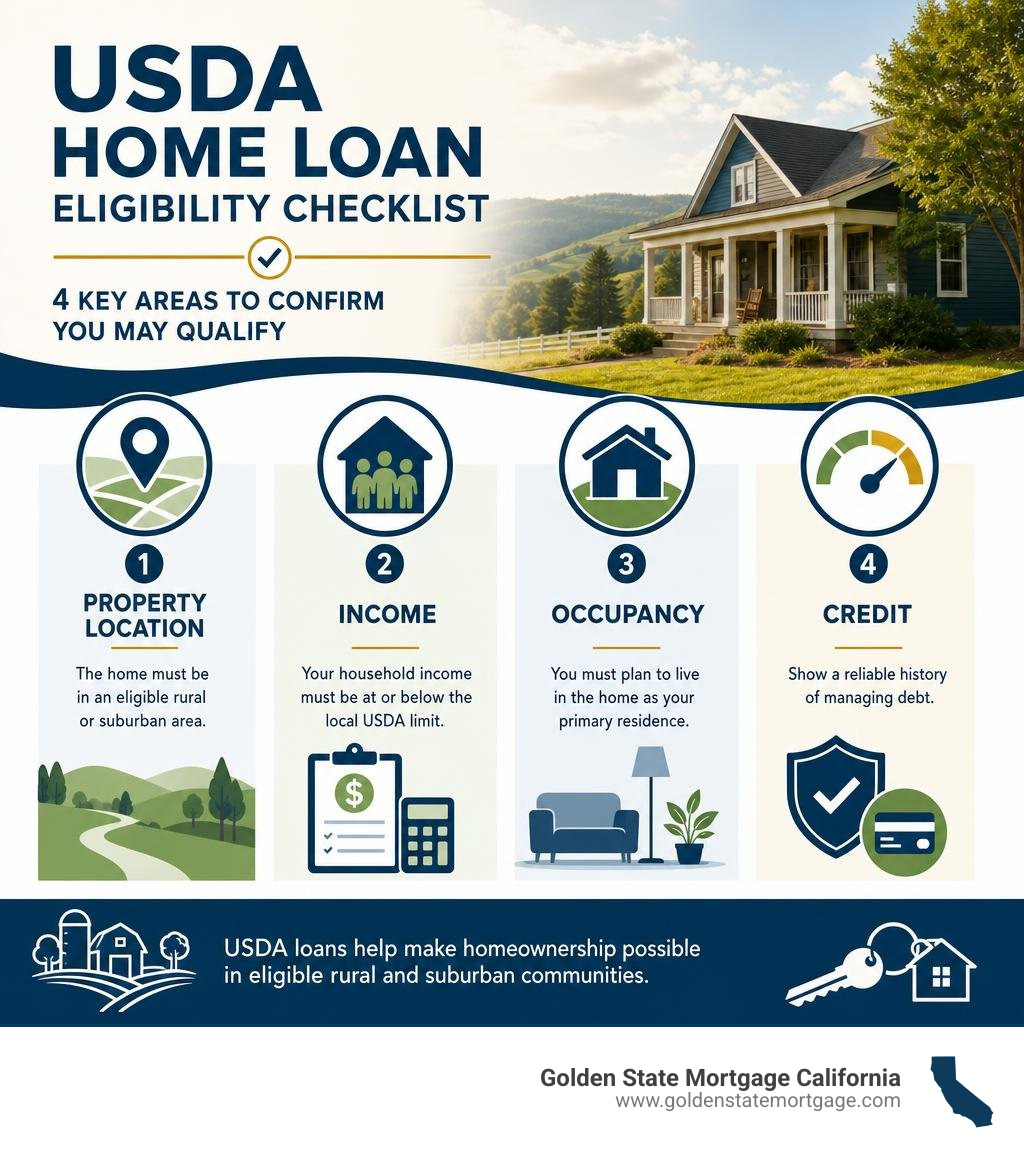
A USDA home loan can help eligible buyers purchase a primary residence in a qualifying rural or suburban area with no down payment. To see whether USDA loans home financing may work for you, check these three items first:
- Location: Confirm the home’s address appears in an eligible area on the USDA property map.
- Income: Make sure your total household income falls within the local USDA limit. Guaranteed loans generally allow income up to 115% of area median income.
- Occupancy and credit: Plan to live in the home full time, meet citizenship or eligible non-citizen rules, and show a reliable history of managing debt.
USDA Rural Development offers two main paths: Section 502 Guaranteed Loans through approved private lenders and Section 502 Direct Loans for qualifying low- and very-low-income households. Both can make homeownership more reachable, but their income rules, application process, rates, and repayment terms differ.
I’m Dale Gremillion, a Senior Loan Officer and Producing Branch Manager with more than 25 years of residential lending experience, including USDA loans home financing. I help California buyers compare USDA, FHA, VA, conventional, construction, and other mortgage options with a clear view of costs and qualification requirements.
Usda loans home word list:
Navigating USDA Loans Home Financing: Guaranteed vs. Direct Programs

Understanding the landscape of rural lending begins with recognizing that the United States Department of Agriculture (USDA) administers two distinct paths under its Single Family Housing umbrella. Authorized under Title V of the Housing Act of 1949, these programs exist to improve the quality of life and boost homeownership across rural and semi-rural America. Whether you are exploring options through our Homebuyers Guide to Department of Agriculture Loan Programs or consulting an approved lender, understanding these two branches is the first step toward getting your keys.
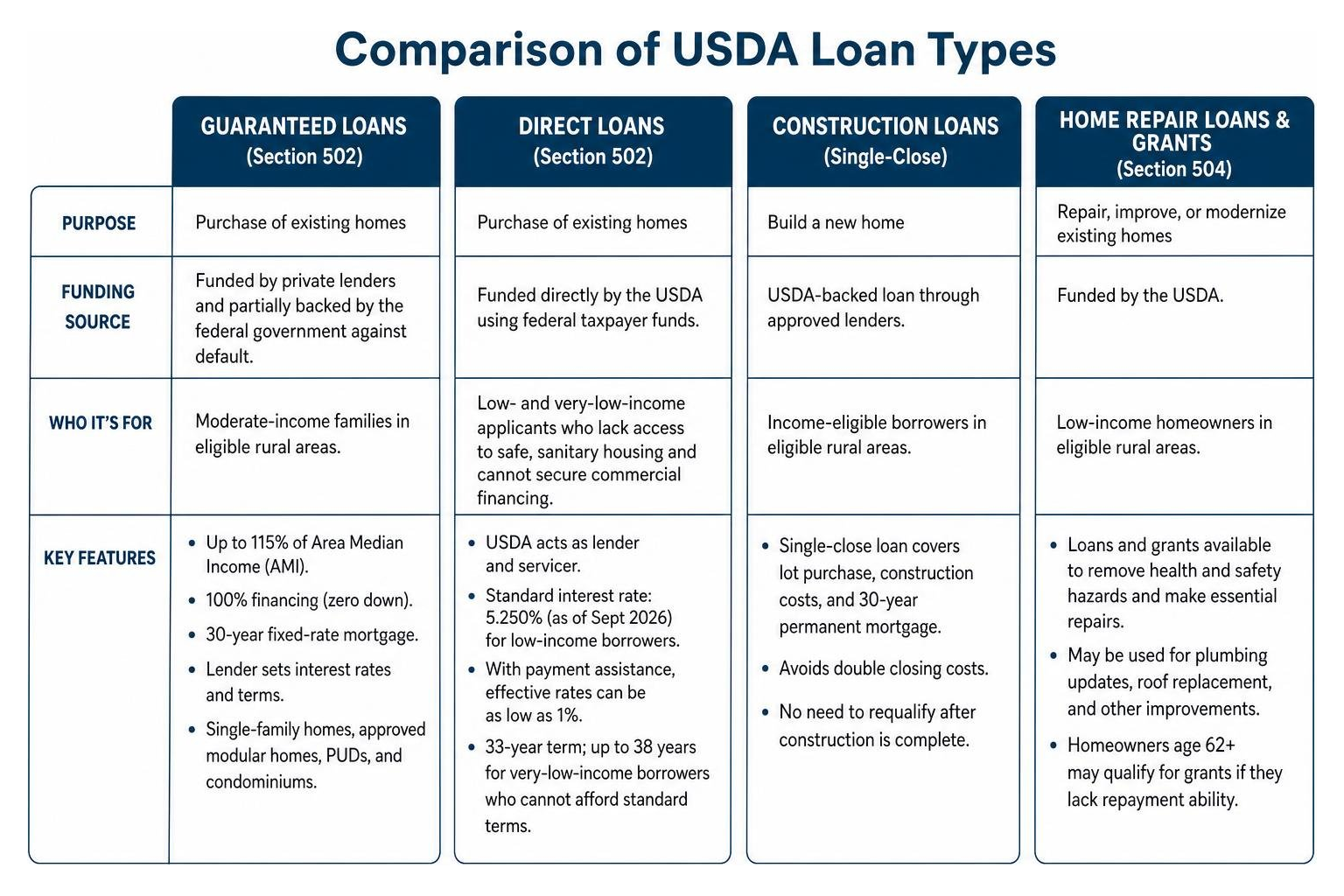
The fundamental difference lies in who funds the mortgage and which income bracket is being served:
- Guaranteed Loans (Section 502): Funded by private lenders, such as approved mortgage companies and banks, and partially backed by the federal government against default.
- Direct Loans (Section 502): Funded directly by the USDA using federal taxpayer funds, tailored specifically for low- and very-low-income applicants who lack access to safe, sanitary housing and cannot secure commercial financing.
Section 502 Guaranteed USDA Loans Home Buyers Use for Zero Down
The Section 502 Guaranteed Loan Program is the most popular choice for moderate-income families seeking 100% financing. Under this structure, private lenders issue a 30-year fixed-rate mortgage, and the federal agency provides a 90% loan note guarantee. This government safety net encourages lenders to offer competitive interest rates without demanding a down payment.
Key parameters of the Single Family Housing Guaranteed Loan Program include:
- Income Ceiling: Household earnings can reach up to 115% of the Area Median Income (AMI) for the county.
- Property Type: Single-family primary residences, including approved modular homes, PUDs, and condominiums.
- Lender-Driven Terms: Market interest rates are established by participating lenders rather than the government, allowing borrowers to shop for competitive terms.
Section 502 Direct USDA Loans Home Subsidy and Assistance Programs
For families with lower household earnings, the Section 502 Direct Loan Program provides an essential safety net. USDA Rural Development acts as the loan servicer and lender. As detailed in our breakdown of How the 502 Direct Loan Program Helps Low-Income Homebuyers, this program provides payment assistance—a specialized subsidy that temporarily reduces the mortgage payment to enhance repayment ability.
Standard terms outlined by the Single Family Housing Direct Home Loans guidelines include:
- Current Standard Interest Rate: As of September 2026, the baseline direct loan rate is 5.250% for low-income borrowers.
- Subsidized Interest Rate: With payment assistance applied, effective interest rates can drop as low as 1%.
- Extended Repayment Periods: While the standard term is 33 years, very-low-income buyers who cannot afford standard terms may qualify for a 38-year payback schedule.
USDA Construction and Home Repair Programs
Beyond purchasing existing properties, rural housing programs support building and substantial rehabilitation. Borrowers can utilize single-close construction loans, which roll the acquisition of a buildable lot, construction expenses, and the long-term 30-year permanent mortgage into a single transaction. This prevents duplicate closing costs and eliminates the need to requalify once the build finishes.
Additionally, existing low-income homeowners can access Section 504 Home Repair loans and grants to remove health and safety hazards, modernize plumbing, or replace failing roofs. Homeowners aged 62 and older may qualify for direct grants if they lack repayment ability for a repair loan.
USDA Loan Eligibility Requirements: Income, Location, and Credit Guidelines
Securing an approval requires meeting three core pillars: geographical eligibility, income parameters, and credit underwriting benchmarks. Reviewing Unlocking Rural Homeownership: USDA Loan Guidelines for California offers a helpful roadmap for matching state-level housing dynamics with federal criteria.
Rural Property Geographic Boundaries and Appraisals
To qualify, the target property must be located within an eligible rural footprint. The USDA defines these zones based on population density and distance from major urban centers. Many suburban pockets and bedroom communities located outside major cities remain eligible.
Properties must also pass a thorough appraisal inspecting for structural safety, sanitary living conditions, and functional utilities. Working mechanical systems, safe access to a public or private road, and clean water supplies are mandatory.
Household Income Caps and Median Area Limits
Income qualification for USDA financing considers the entire household’s earnings, not just the borrowers listed on the loan note. Anyone 18 or older residing in the home must document their income to ensure the total remains under the local program ceiling.
The USDA allows standard deductions from your gross earnings to help you meet the ceiling:
- $480 for each dependent child under age 18 or full-time student
- Documented childcare expenses for children under 12
- Medical expenses exceeding 3% of income for elderly households
Credit Score, DTI Ratios, and Underwriting Standards
Lenders look for a clear pattern of responsible debt management:
- Credit Scores: A 640 FICO score serves as the standard benchmark for automated underwriting approval via the Guaranteed Underwriting System (GUS). Borrowers with scores below 640 or non-traditional credit can still qualify through manual underwriting.
- Debt-to-Income (DTI) Ratios: Standard guidelines look for a 29% front-end ratio (housing costs divided by gross monthly income) and a 41% back-end ratio (total recurring debt divided by gross monthly income). Higher ratios are frequently approved when compensating factors, like healthy cash reserves, are present.
Comparing USDA Financing to Conventional, FHA, and VA Mortgages
Evaluating how USDA stacks up against other primary mortgage options clarifies which program best fits your financial situation:
| Loan Feature | USDA Guaranteed Loan | Conventional Loan | FHA Loan | VA Loan |
|---|---|---|---|---|
| Minimum Down Payment | 0% (Zero Down) | 3% to 5% | 3.5% | 0% (Zero Down) |
| Geographic Limits | Eligible rural/suburban areas only | Nationwide | Nationwide | Nationwide |
| Upfront Funding Fee | 1.00% guarantee fee | None | 1.75% Upfront MIP | 1.25% – 3.30% VA Funding Fee |
| Ongoing Mortgage Insurance | 0.35% annual fee | PMI (can be canceled at 80% LTV) | 0.55% annual MIP (typically life of loan) | None |
| Income Caps | Yes (115% of AMI) | None | None | None |
| Occupancy | Primary residence only | Primary, second home, investment | Primary residence only | Primary residence only |
Costs, Fees, and the USDA Loan Application Process

Upfront Guarantee Fees and Annual Mortgage Premiums
To maintain program operations without heavy taxpayer subsidies, USDA guaranteed loans include two fee components:
- Upfront Guarantee Fee: Equal to 1.00% of the loan amount. This fee is typically financed into the mortgage balance rather than paid out of pocket.
- Annual Fee: Equal to 0.35% of the remaining principal balance, calculated annually and broken into 12 equal installments added to your monthly mortgage statement.
Step-by-Step USDA Application and Approval Timeline
The road from application to closing generally takes 30 to 45 days:
- Pre-Qualification & Assessment: Review your household income against county caps and confirm the desired address falls in a qualifying area.
- Documentation Gathering: Compile two years of tax returns, 30 days of pay stubs, bank statements, and identification.
- Lender Underwriting: For guaranteed loans, our team submits your completed file through GUS for conditional underwriting. For direct loans, applicants submit a full Single Family Housing – 502 Application Package to their local Rural Development office.
- Agency Review: Once the lender clears internal conditions, the package is submitted to the USDA field office for its final Conditional Commitment.
- Closing: Final documents are signed, funds are distributed, and ownership transfers.
Frequently Asked Questions About USDA Home Loans
Do USDA loans require private mortgage insurance (PMI)?
No, USDA loans do not require conventional private mortgage insurance. Instead, the program charges a 1.00% upfront guarantee fee and a 0.35% annual fee. This structure makes USDA ongoing monthly mortgage insurance costs lower than standard FHA monthly premiums.
Can I buy land or build a house with a USDA loan?
Yes, eligible borrowers can utilize a USDA single-close construction loan to purchase land and finance the construction of a new home. Standalone land purchases are generally restricted unless tied to an immediate residential building project through an approved contractor.
What happens if my household income exceeds local USDA limits?
If your total household income surpasses the local 115% AMI limit, you will not qualify for a USDA loan. In these cases, low-down-payment conventional loans (3% down) or FHA loans (3.5% down) serve as strong alternatives with no geographic or maximum income restrictions.
Conclusion
USDA home loans provide an accessible, zero-down path to homeownership for buyers seeking a primary residence in qualifying rural and suburban neighborhoods. With manageable credit expectations, competitive fixed interest rates, and lower mortgage insurance fees than many alternatives, this program opens doors for individuals and families eager to establish roots.
At Golden State Mortgage, we guide you through every phase of the mortgage process with clear communication, dedicated in-house processing, and personalized lending solutions seven days a week. Contact our team today to verify your property address, calculate your household income limits, and explore your financing options.


