
Jumbo Loans: A Quick Way to Finance Above Local Loan Limits
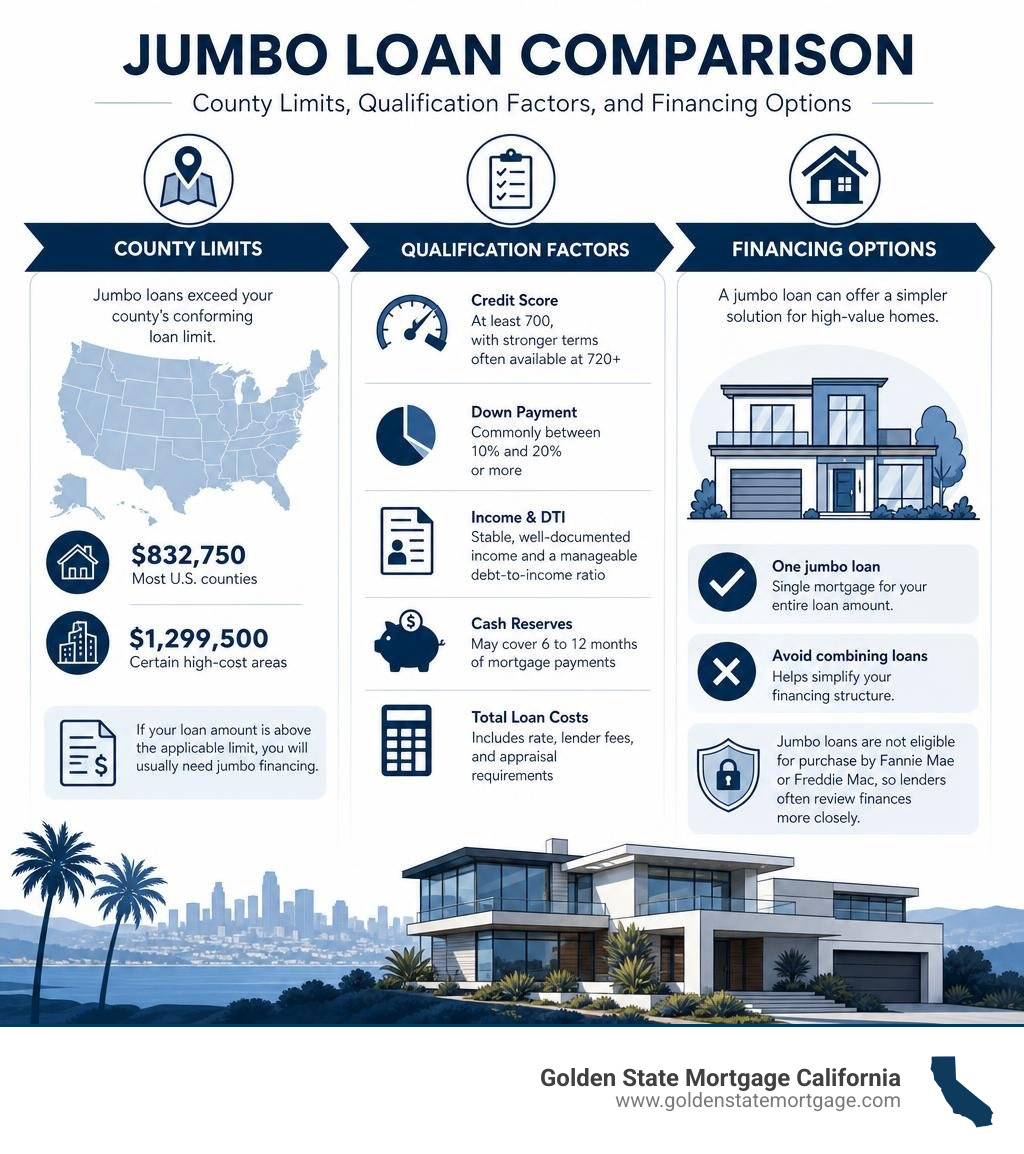
Jumbo loans are mortgages that exceed your county’s conforming loan limit. For 2026, that limit is $832,750 in most U.S. counties and can reach $1,299,500 in certain high-cost areas. If your loan amount is above the applicable limit, you will usually need jumbo financing rather than a standard conforming mortgage.
Before comparing options, check your county limit, then focus on the factors that most affect approval and pricing:
- A credit score of at least 700, with stronger terms often available at 720+
- A down payment commonly between 10% and 20% or more
- Stable, well-documented income and a manageable debt-to-income ratio
- Cash reserves that may cover 6 to 12 months of mortgage payments
- The full cost of the loan, including rate, lender fees, and appraisal requirements
For California buyers facing high home prices, a jumbo loan can keep financing simple by using one mortgage instead of combining multiple loans. But because these loans are not eligible for purchase by Fannie Mae or Freddie Mac, lenders often review your finances more closely.
I am Dale Gremillion, a Senior Loan Officer and Producing Branch Manager with more than 25 years in residential lending, including helping California buyers compare jumbo loans and other high-value financing options. The next sections break down the limits, qualification rules, costs, and alternatives so you can compare the right structure for your purchase.
Understanding Conforming Limits and What Defines Jumbo Loans
To understand how high-balance lending works, it helps to start with the Federal Housing Finance Agency (FHFA). Each year, the FHFA sets baseline dollar thresholds that dictate the maximum size of mortgages eligible for purchase by government-sponsored enterprises (GSEs), specifically Fannie Mae and Freddie Mac. When a loan amount falls within these government-mandated caps, it is known as a conforming mortgage.
When home values in competitive regions push mortgage amounts past these baseline figures, standard agency rules no longer apply. Any single-family residential loan that surpasses the FHFA limit falls into the non-conforming category. Because Fannie Mae and Freddie Mac cannot buy or guarantee these larger mortgages, private lenders step in to back them using their own balance sheets or private investor networks.
Baseline Limits and High-Cost Area Variations
For 2026, the national baseline conforming limit sits at $832,750 (up from $806,500 in 2025). However, dynamic real estate markets—such as Los Angeles, San Francisco, San Diego, San Jose, and Irvine—often feature home valuations that outpace national averages.
To accommodate regional home prices, the FHFA establishes higher caps for designated high-cost markets. In these areas, the ceiling rises substantially, reaching up to $1,299,500 for a single-family home (compared to $1,209,750 in 2025).
The table below highlights the operational differences between standard conforming programs and non-conforming financing:
| Feature | Conforming Mortgage | Jumbo Financing |
|---|---|---|
| GSE Guarantee | Backed by Fannie Mae / Freddie Mac | Non-conforming (Held in portfolio or privately securitized) |
| 2026 Single-Family Limit | Up to $832,750 (Baseline) | Exceeds local county limit (Up to $1,299,500+ in high-cost areas) |
| Minimum Credit Score | Often 620+ | Typically 700 to 740+ |
| Down Payment Minimums | As low as 3% to 5% | Usually 10% to 20%+ |
| Reserve Requirements | 0 to 2 months typical | 6 to 12 months of PITI |
| Appraisal Standard | Single appraisal | Often dual independent appraisals for higher values |
Understanding these distinctions ensures that you review realistic lending paths tailored to your local real estate market.
Jumbo Loans vs Conforming Mortgages
The primary difference between standard agency loans and larger financing programs lies in portfolio retention and secondary market mechanics. Conforming loans are packaged and sold directly to Fannie Mae and Freddie Mac, offering banks an immediate exit strategy and high liquidity.
Because non-conforming debt cannot be offloaded to GSEs, lenders must either hold the notes directly in their asset portfolios or package them through private securitization channels. This shifts credit risk directly to the funding institution.
Historically, this added balance-sheet risk meant private lenders charged a heavy interest rate premium. In recent years, however, intense competition and strong institutional appetite for prime credit borrowers have narrowed this pricing margin. Depending on market liquidity, checking our Rate Assumptions shows how high-balance pricing often trades within a fraction of standard conventional rates.
Core Eligibility Requirements and Qualifying Criteria

Because non-conforming mortgages involve larger capital outlays, underwriters apply manual scrutiny rather than relying solely on automated underwriting algorithms. Lenders focus heavily on risk mitigation to verify that borrowers possess the liquidity, recurring cash flow, and equity necessary to manage substantial monthly obligations over the long term.
Credit Score, Down Payment, and Reserve Thresholds for Jumbo Loans
Qualifying standards for high-balance financing center on three core pillars: creditworthiness, cash equity, and post-closing liquidity.
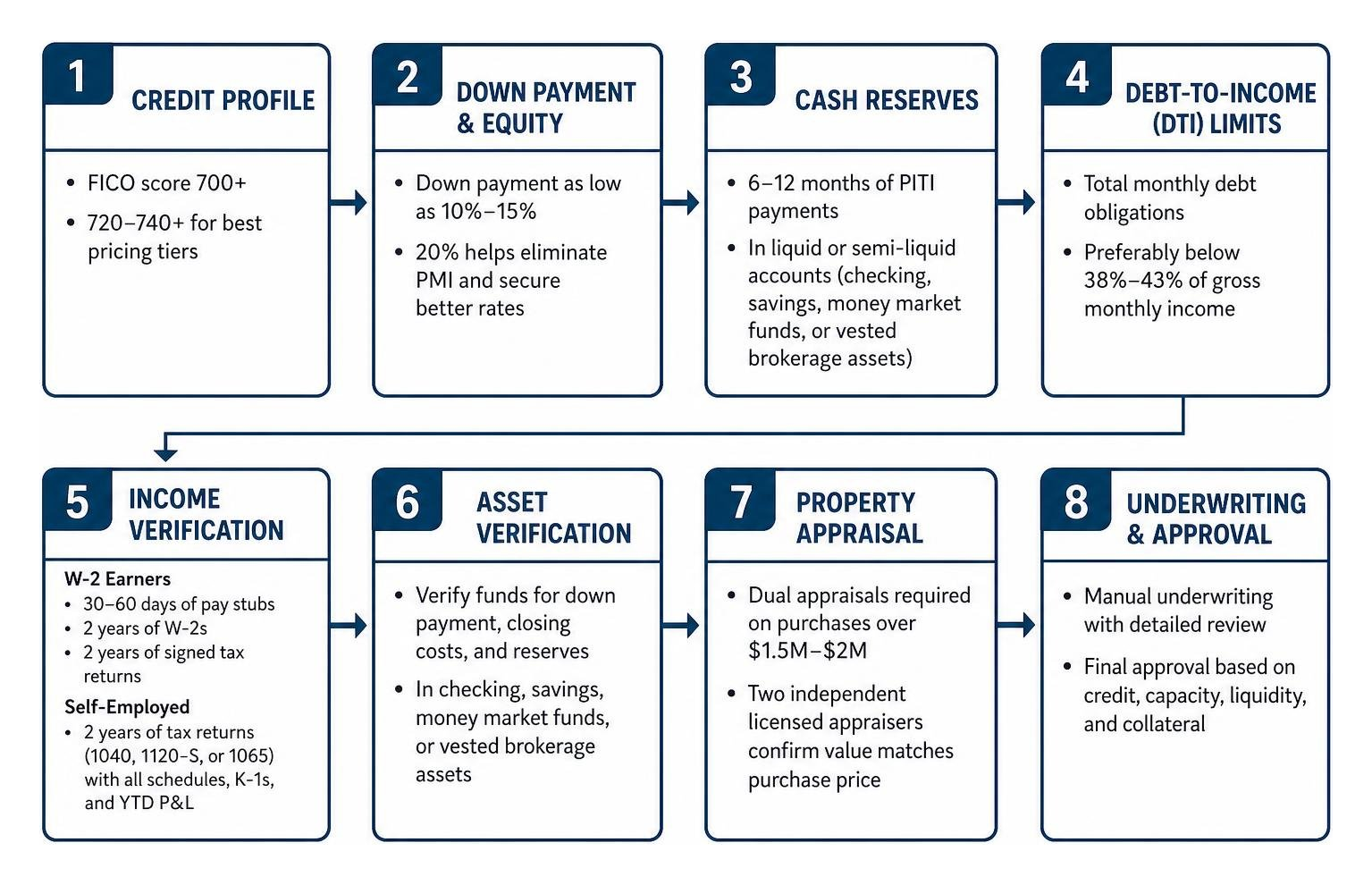
- Credit Score Thresholds: While a conventional buyer might secure financing with a 620 score, non-conforming programs generally require a FICO score of 700 or higher. To lock in the most competitive pricing tiers, aim for a score of 720 to 740+.
- Down Payment & Equity: The era of requiring an automatic 30% down payment has shifted. Well-qualified borrowers can now access specialized programs with down payments as low as 10% to 15%, though putting down 20% remains the most effective way to eliminate private mortgage insurance (PMI) and secure optimal interest rates.
- Post-Closing Cash Reserves: Underwriters require significant liquidity after accounting for your down payment and closing costs. Expect to document between 6 and 12 months of full Principal, Interest, Taxes, and Insurance (PITI) payments held in liquid or semi-liquid accounts (such as checking, savings, money market funds, or vested brokerage assets).
- Debt-to-Income (DTI) Limits: Strict debt ratios are enforced. Lenders prefer your total monthly debt obligations—including your proposed housing payment, vehicle notes, and revolving lines—to remain below 38% to 43% of your gross monthly income.
Income Verification and Dual Appraisal Standards
Documenting income on high-balance mortgages involves thorough validation:
- W-2 Earners: Expect to supply your most recent 30 to 60 days of consecutive pay stubs, two complete years of W-2 statements, and two years of signed federal tax returns.
- Self-Employed Professionals: Borrowers running their own businesses must provide two full years of individual and corporate tax returns (Forms 1040, 1120-S, or 1065), complete with all schedules, K-1s, and year-to-date profit-and-loss statements verified by an accountant.
Collateral assessment is equally rigorous. Because unique architectural designs, extensive acreage, and custom luxury amenities make finding comparable properties challenging, lenders frequently mandate dual appraisals on purchase transactions exceeding $1.5 million to $2 million. Two independent, licensed appraisers assess the property to confirm its valuation matches the contracted purchase price.
Weighing the Advantages, Disadvantages, and Tax Implications

Navigating non-conforming financing requires balancing purchasing leverage against carrying costs and federal tax rules.
Benefits and Drawbacks of Non-Conforming Financing
Financing a high-value purchase through a single mortgage provides convenience, but borrowers must weigh the operational trade-offs:
- Pros:
- Single-Mortgage Simplicity: Eliminates the administrative friction of coordinating multiple liens, distinct loan officers, and staggered closing deadlines.
- Competitive Pricing: Pricing spreads between agency mortgages and larger loans remain tight, allowing prime borrowers to secure competitive terms.
- Higher Purchasing Power: Allows buyers in premium markets to acquire desirable primary residences, secondary retreats, or luxury investments without depleting investment portfolios.
- Cons:
- Stricter Underwriting Standards: Requires flawless documentation, robust reserve buffers, and top-tier credit profiles.
- Higher Absolute Closing Costs: While settlement charges typically track between 2% and 6% of the loan amount, the absolute out-of-pocket costs are higher due to the larger principal balance.
- Dual Appraisal Fees: Paying for two certified appraisals increases upfront transaction expenses.
Mortgage Interest Deductions and Tax Rules
Under current IRS tax codes—reinforced by the One Big Beautiful Bill Act—the federal mortgage interest deduction is capped at $750,000 of qualified acquisition debt (or $375,000 if married filing separately) for residences purchased after December 16, 2017.
If you secure a $1,200,000 mortgage, the interest attributable to the first $750,000 of debt is eligible for itemized tax deduction, while the interest paid on the remaining $450,000 balance cannot be deducted. Consult a certified public accountant (CPA) or tax professional to model your exact after-tax borrowing costs.
Strategic Alternatives and Financing Pathways
A single non-conforming mortgage is not the only way to fund high-value real estate. Depending on your financial goals, you may want to evaluate alternative financing structures:
- Piggyback Financing (80-10-10 or 80-15-5 Loans): A popular strategy for bypassing high-balance requirements involves splitting financing into two distinct loans. A borrower takes out a primary conforming loan for 80% of the property value, a secondary home equity line of credit (HELOC) or fixed second lien for 10% to 15%, and provides the remaining balance as a cash down payment. This eliminates PMI and keeps the primary lien within GSE conforming thresholds.
- Cash-Out Restructuring: Existing homeowners looking to tap accrued home equity to purchase luxury property or consolidate liabilities can read our Refinancing – A Practical Guide to Comparing Cash Out Refinance Options to evaluate liquidity management strategies.
- Custom Ground-Up Builds: If you plan to build a custom luxury home exceeding standard agency caps, explore Construction Loans – A Comprehensive Guide to Construction Financing Loan Basics to secure interim financing that transitions seamlessly into permanent long-term debt.
Frequently Asked Questions About High-Balance Mortgages
How Do Interest Rates Compare to Conforming Mortgages?
Historically, larger loans carried noticeably higher interest rates than conforming loans. In today’s mortgage market, the pricing spread has narrowed considerably. Depending on secondary bond yields, investor liquidity, and borrower credit profiles, rate spreads between conventional and non-conforming financing often fluctuate within a modest 0.15% to 0.35% range.
Can First-Time Homebuyers Secure High-Balance Financing?
Yes. While first-time buyers face thorough underwriting, there is no statutory prohibition against taking out a larger mortgage on a first home purchase. If you demonstrate strong recurring income, substantial asset reserves, and an established credit history, you can qualify for non-conforming financing on your initial residential purchase.
Are Dual Appraisals Always Required by Lenders?
Not on every transaction. Dual appraisals are generally reserved for high-value properties—typically those exceeding $1.5 million or $2 million—or residences featuring unique architectural characteristics, large parcels, or limited local sales comps. For loans slightly above local conforming limits, a single comprehensive appraisal is often sufficient.
Conclusion
Securing financing for a high-value home requires an experienced approach, clear documentation, and a well-structured lending strategy. Whether you are purchasing an executive home in Fresno, a luxury property in Los Angeles, or a coastal retreat in San Diego, working with a dedicated direct lender ensures your transaction closes smoothly and on schedule.
Our team manages the entire process in-house—from initial application review through final underwriting—providing competitive pricing and dedicated support seven days a week. When you are ready to evaluate your financing options, start your application with Golden State Mortgage to build a custom lending plan for your next home purchase.


