
Start Your Agriculture Home Loan Application With the Right Checks
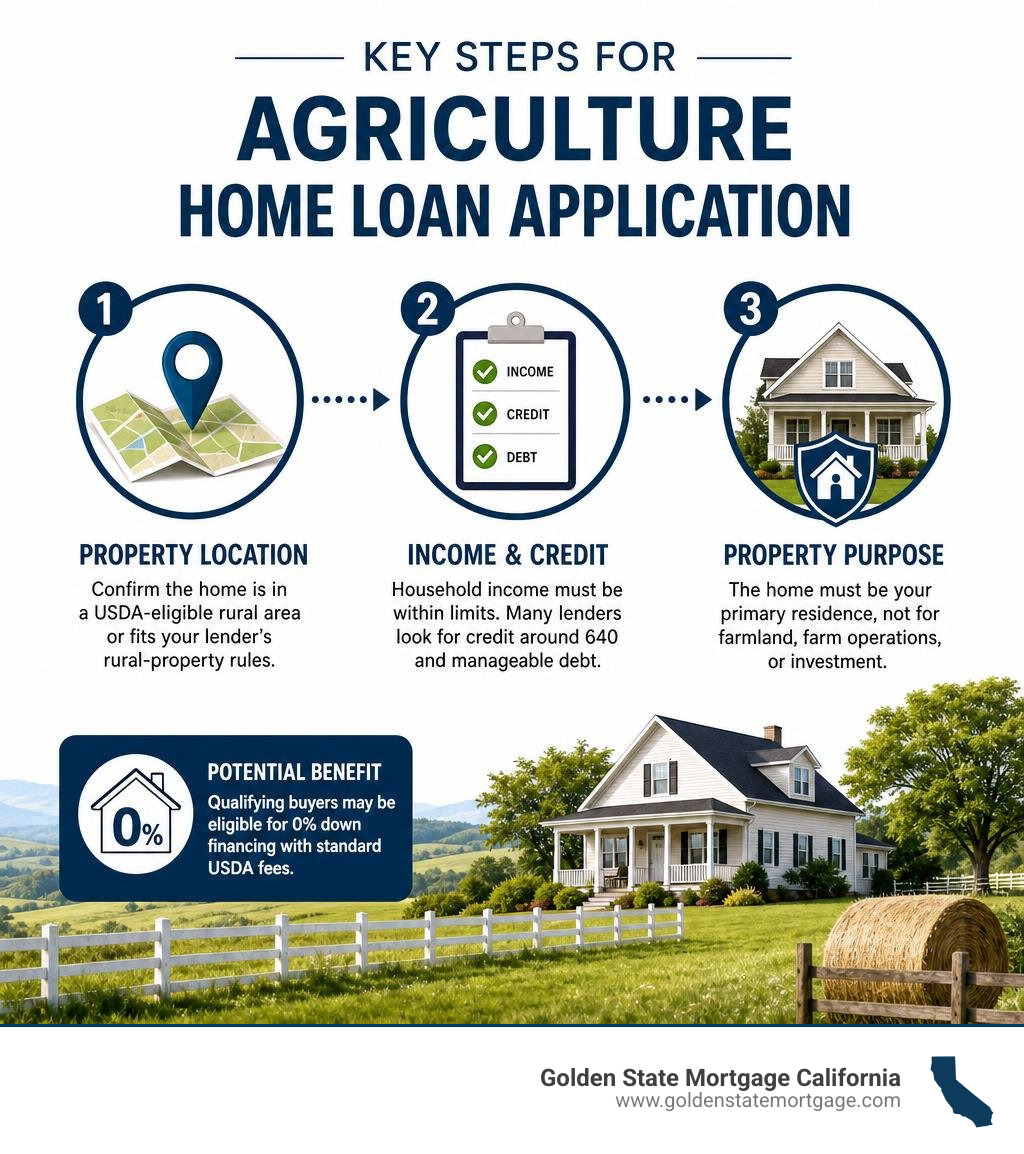
An agriculture home loan can help finance a primary home in an eligible rural area, including a rural property purchase, new construction, or certain repairs. To apply with less stress, start by checking these three items before you shop:
- Property location: Confirm the home is in a USDA-eligible rural area or fits your lender’s rural-property rules.
- Household income and credit: USDA guaranteed loans generally cap household income at 115% of the local median income. Many lenders look for credit around 640 and manageable monthly debt.
- Property purpose: A USDA home loan is for an owner-occupied residence, not for buying farmland, funding farm operations, or purchasing an investment property.
For qualifying buyers, USDA financing may offer 0% down, though it includes a 1% upfront guarantee fee and a 0.35% annual fee. California buyers should also know that a rural address does not automatically mean the property qualifies; income limits, property eligibility, appraisal standards, and the home’s intended use all matter.
I am Dale Gremillion, a Senior Loan Officer and Producing Branch Manager with more than 25 years of residential lending experience, including USDA, construction, conventional, FHA, VA, and agriculture home loan strategies. The next sections break down which rural financing path may fit your property and how to prepare a clean application.
Must-know agriculture home loan terms:
- USDA loan California requirements
- 502 direct home loan program
- California zero down mortgage
Understanding What an Agriculture Home Loan Entails

When people hear the term “agriculture home loan,” they often imagine buying a massive 500-acre commercial almond grove or financing an industrial dairy barn. In residential lending, an agriculture home loan generally refers to financing a single-family dwelling located in a designated rural or agricultural setting.
It is vital to distinguish between two distinct types of rural financing:
- Residential Rural Housing Loans: Administered by the USDA Rural Development (RD) division or private mortgage lenders, these loans are designed to finance primary residences for individuals and families living in rural communities. The focus is purely on the home and modest acreage for personal enjoyment.
- Commercial Farm Production Loans: Administered by the USDA Farm Service Agency (FSA) or specialized agricultural banks, these programs finance working farmland, heavy machinery, livestock, crop operating expenses, and commercial processing facilities.
If your goal is to buy a home with a small garden plot, a horse paddock, or simply plenty of open space away from city congestion, residential rural financing provides the structure you need. For qualified buyers, this can mean securing a primary home with no down payment needed: top California homebuyer loan programs often highlight USDA rural options because they eliminate the traditional 5% to 20% down payment barrier entirely.
Comparing Rural and Agricultural Residential Financing Programs
| Feature | USDA Section 502 Guaranteed | USDA Section 502 Direct | Conventional / Non-QM Rural Loan |
|---|---|---|---|
| Primary Purpose | Purchase, build, or refinance a primary rural home | Provide subsidized housing for low/very low-income buyers | Purchase rural residences, hobby farms, or acreage |
| Down Payment | 0% down | 0% down | Typically 3% to 20% down |
| Underwriting Source | Approved private lenders with USDA backing | USDA Rural Development offices directly | Private mortgage lenders and portfolio banks |
| Income Eligibility | Capped at 115% of Area Median Income (AMI) | Strict low- and very-low-income caps | No federal income caps; based on DTI ratios |
| Guarantee / PMI Fees | 1.00% upfront fee + 0.35% annual fee | Subsidized payment assistance available | Standard Private Mortgage Insurance (if <20% down) |
| Repayment Term | 30-year fixed rate | 33 to 38 years fixed rate | 15 or 30 years fixed or adjustable rate |
Key Financing Options for Rural and Agricultural Properties
Securing a mortgage on a rural property in California requires choosing the program that matches your household income and financial profile. Several government-backed and conventional pathways exist to support rural homeowners.
USDA Section 502 Guaranteed Loan Program
The Single Family Housing Guaranteed Loan Program | Rural Development is the most common rural mortgage used today. Under this structure, an approved private lender underwrites and issues the loan, while the federal government guarantees up to 90% of the balance against default.
Key advantages include:
- Zero Down Payment: 100% financing for the purchase price of the home.
- Competitive Interest Rates: Government backing allows lenders to offer lower interest rates than many standard conventional loans.
- Flexible Credit Standards: Automated underwriting typically approves clean files with credit scores of 640 and above.
USDA Section 502 Direct Housing Loans
For low- and very-low-income households unable to obtain financing through traditional mortgage channels, the government provides Single Family Housing Direct Home Loans in California. These loans are funded directly from the U.S. Treasury and serviced by the USDA. Qualifying borrowers can receive payment assistance subsidies that lower the effective interest rate down to as low as 1%, with extended loan terms reaching up to 33 or 38 years.
USDA Section 504 Home Repair Loans and Grants
Existing rural homeowners who need to make critical repairs or remove safety hazards can access the Section 504 Home Repair program.
- Repair Loans: Low-interest loans of up to $40,000 at a fixed 1% interest rate with repayment terms up to 20 years.
- Repair Grants: Grants capped at $10,000 for very low-income homeowners aged 62 or older, provided the funds are used to eliminate health and safety hazards or make the home accessible for household members with disabilities.
Combining Rural Mortgages with Down Payment Assistance
First-time buyers in California rural areas can also explore state and regional grant programs. Combining local municipal grants or down payment assistance programs with rural mortgage structures can help cover closing costs and appraisal fees, significantly lowering out-of-pocket expenses at the closing table.
Qualifying Guidelines and Requirements

Qualifying for rural housing finance requires meeting specific geographic, income, and property standards established by federal and lending guidelines.
Eligibility Criteria for an Agriculture Home Loan
To successfully qualify for rural residential financing, applicants must meet the following core criteria:
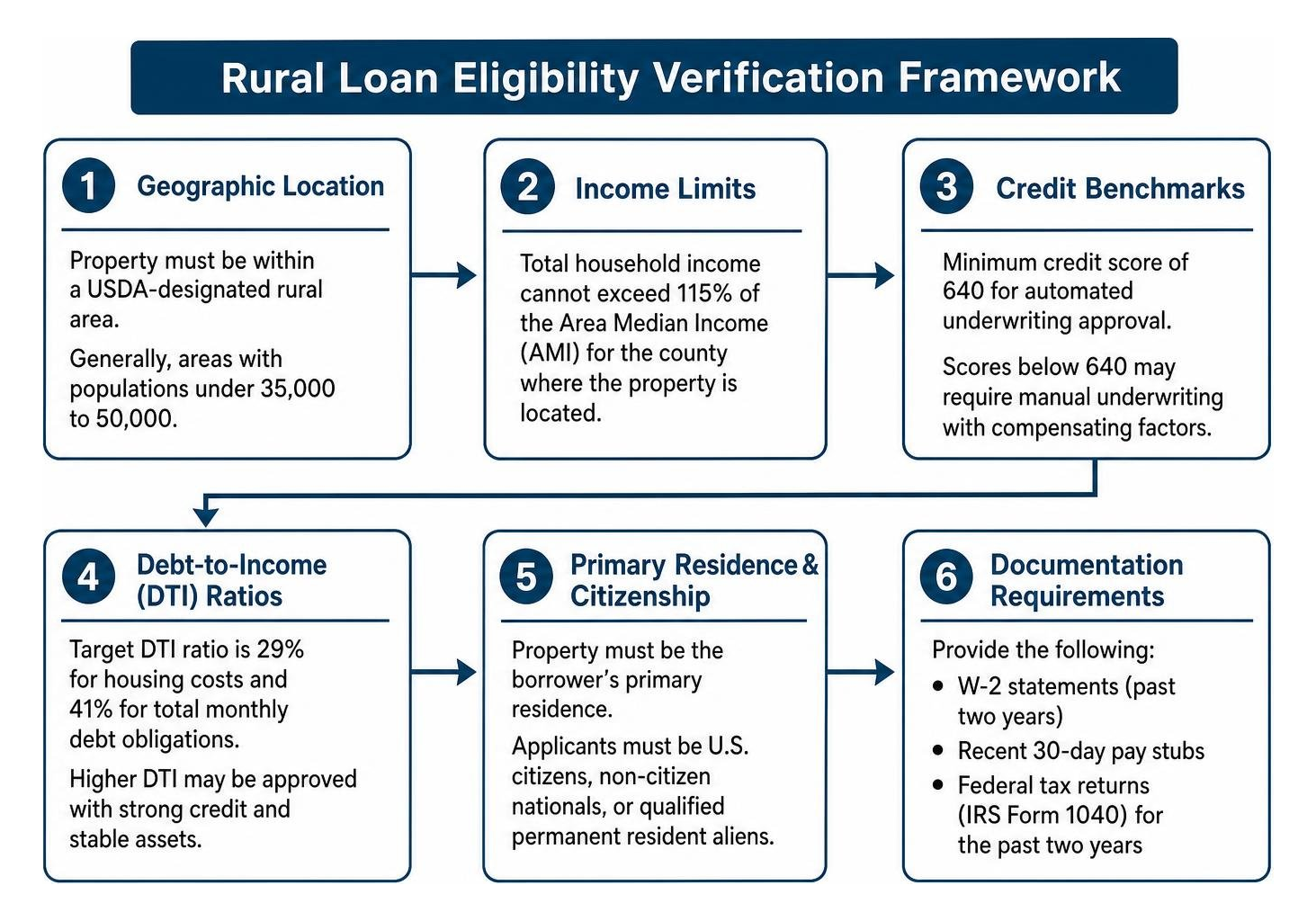
- Geographic Location: The subject property must be located within a designated rural area as defined by the USDA. The USDA generally classifies areas with populations under 35,000 to 50,000 as rural, which includes many outlying suburban communities, micropolitan areas, and agricultural regions throughout California (such as parts of the Central Valley, Riverside County, and rural Northern California).
- Income Limits: For guaranteed loans, total household income cannot exceed 115% of the Area Median Income (AMI) for the county where the property is located. Income limits consider all adult members living in the residence, regardless of whether they are listed on the loan note.
- Credit Benchmarks: While the USDA does not set a strict hard floor, a minimum credit score of 640 is the standard benchmark for automated underwriting approval. Borrowers with scores below 640 may require manual underwriting, requiring solid compensating factors like cash reserves or a track record of on-time rental payments.
- Debt-to-Income (DTI) Ratios: The standard target DTI ratio is 29% for housing costs and 41% for total monthly debt obligations. Higher DTI ratios can be approved through automated underwriting when supported by strong credit scores and stable assets.
- Primary Residence and Citizenship: The property must serve as the borrower’s primary residence. Applicants must be U.S. citizens, non-citizen nationals, or qualified permanent resident aliens.
Documents Needed for an Agriculture Home Loan Application
Having organized documentation ensures an efficient underwriting review. Prepare the following items when submitting your application:
- Income Verification: W-2 statements from the past two years, recent 30-day pay stubs, and federal tax returns (IRS Form 1040) covering the last two years.
- Agricultural / Self-Employed Income: If relying on agricultural land income, hobby farming earnings, or schedule F farm income, provide two years of business tax returns, year-to-date profit-and-loss statements, and proof of land tenure.
- Asset Statements: Last two to three months of checking, savings, and retirement account statements to verify reserve funds and closing cost coverage.
- Property Records: Purchase contract, property boundaries, preliminary title report, and county land-use zoning documentation verifying residential classification.
- Identity Verification: Government-issued photo identification and Social Security card or residency documentation.
Step-by-Step Application Process for Rural Financing
Navigating the mortgage process from pre-approval to funding involves clear, sequential steps:
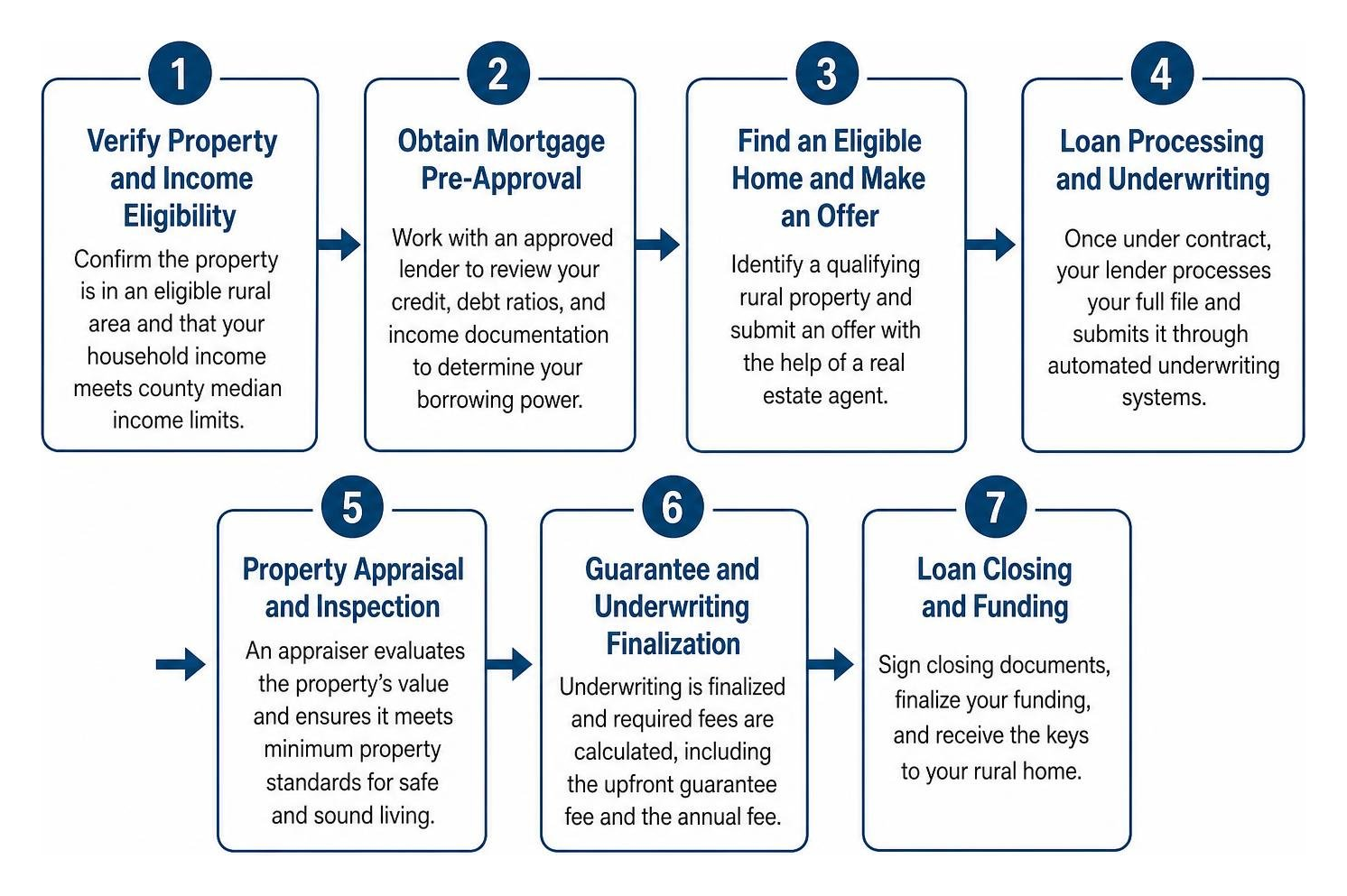
- Verify Property and Income Eligibility: Before viewing properties, consult the official USDA Rural Development mapping tool to verify that the target community is inside eligible geographic boundaries. Check your total household earnings against the county’s median income thresholds.
- Obtain Mortgage Pre-Approval: Partner with an approved direct mortgage lender to review your credit profile, debt ratios, and income documentation. A comprehensive pre-approval establishes your exact borrowing power.
- Find an Eligible Home and Make an Offer: Work with a real estate agent familiar with rural properties to identify qualifying single-family homes, manufactured homes on permanent foundations, or custom rural builds.
- Loan Processing and Underwriting: Once under contract, your lender processes your full file and submits it through automated underwriting systems.
- Property Appraisal and Inspection: A USDA-approved appraiser evaluates the property to verify fair market value and ensure the dwelling meets minimum property standards (safe structural integrity, adequate heating, clean potable water, and functioning septic/sewer systems).
- Guarantee and Underwriting Finalization: The lender finalizes underwriting and calculates required fees, including the 1.00% upfront guarantee fee (which can typically be financed into the loan balance) and the 0.35% annual fee factored into your monthly mortgage installment.
- Loan Closing and Funding: Sign the closing paperwork, finalize your funding, and receive the keys to your rural home.
Frequently Asked Questions About Rural Housing Finance
Can an agriculture home loan be used to purchase land or operating farms?
No. USDA Single Family Housing loans and residential rural mortgages cannot be used to purchase commercial farming operations, bare agricultural land, or income-producing commercial facilities. The dwelling must be residential in nature. While properties with acreage, barns, and outbuildings are acceptable, the property value must be primarily driven by the residential home rather than commercial agricultural production. Borrowers seeking to finance active commercial crop acreage or commercial livestock facilities should apply for Farm Ownership Loans through the USDA Farm Service Agency (FSA).
How long does it take to get approved and close on a rural property?
Standard rural housing loans through approved direct lenders typically close within 30 to 45 days. Turnaround times depend on the speed of the property appraisal, local title searches, and the submission of all required income verifications. Direct government-issued loans (such as Section 502 Direct loans) take longer due to direct agency processing queues.
Can you refinance an existing mortgage into a USDA rural loan?
You can refinance an existing USDA loan into a new USDA loan through streamlined or non-streamlined refinance options to secure a lower interest rate or adjust your loan term. However, federal guidelines do not permit refinancing a conventional, FHA, or VA mortgage into a USDA guaranteed loan.
Conclusion
Purchasing a home in California’s rural or agricultural communities offers open space, tranquility, and strong long-term value. With zero-down financing options, lower interest rates, and flexible credit guidelines, rural housing programs eliminate the financial barriers that hold many buyers back.
At Golden State Mortgage California, we make rural home financing straightforward and accessible. As a direct mortgage lender, our team handles processing in-house to ensure smooth, on-time closings backed by competitive rates, low fees, and personalized 7-day-a-week support. Whether you are buying your first home in the Central Valley, relocating to Northern California, or exploring options across our California locations, we are here to guide you every step of the way.
Connect with our lending specialists today to explore your rural financing and mortgage options and start your journey toward homeownership.


