
Understanding State vs. Local Assistance: Grants, Forgivable Liens, and Shared Appreciation
California first-time homebuyer grants and subordinate assistance programs can be expedited when a direct lender processes your primary mortgage and the assistance lien in-house, cutting approval wait times by coordinating underwriting, fund reservations, and closing documents under one roof. These programs fall into three distinct structural categories:
- True Grants: Outright gift funds that carry no repayment obligation and place no secondary lien on your property title.
- Deferred-Payment Subordinate Loans (Silent Seconds): Junior liens recorded against your property that require no monthly payments. Repayment of the original principal balance is deferred until you sell the home, transfer title, refinance the first mortgage, or cease occupying the property as your primary residence.
- Shared Appreciation Loans: Subordinate loans where the state or local housing authority contributes a percentage of your purchase price. In exchange, upon sale or refinance, you must repay the original principal plus a matching percentage of the home’s value appreciation.
- Forgivable Junior Liens: Subordinate mortgages that are forgiven incrementally or entirely after you satisfy a defined owner-occupancy period (typically 5 to 15 years).
As outlined in the California Housing Finance Agency Government Loan Program Handbook, state-backed subordinate financing must be paired with an approved 30-year fixed-rate primary mortgage. Exploring no down payment loan options across California gives you a clear picture of how zero-down strategies compare with state-backed subordinate financing structures.
| Program Name | Structure Type | Maximum Assistance Amount | Income Limit Framework | Repayment Trigger |
|---|---|---|---|---|
| CalHFA MyHome | Deferred Junior Lien | Up to 3.5% (FHA) or 3.0% (Conventional) | County-specific CalHFA limits ($153,000–$205,000+) | Sale, refinance, payoff, or change of occupancy |
| Forgivable Equity Builder (FEB) | Forgivable Junior Lien | Up to 10% of purchase price | 80% Area Median Income (AMI) | 100% forgiven after 5 years of continuous owner-occupancy |
| California Dream For All | Shared Appreciation Loan | Up to 20% (capped at $150,000) | 150% AMI (Moderate) or 80% AMI (Low) | Sale, refinance, or transfer: principal + 20% (or 15%) of appreciation |
CalHFA MyHome and Forgivable Equity Builder Mechanics
The CalHFA MyHome Assistance Program is California’s most consistent source of down payment support, having operated continuously since 2016. Under the CalHFA MyHome Assistance Program guidelines, eligible first-time buyers can receive a deferred-payment junior loan of up to 3.5% of the purchase price or appraised value when paired with a CalHFA FHA first mortgage, or up to 3% when paired with conventional, VA, or USDA financing.
For example, on a $600,000 home purchase using an FHA first mortgage, MyHome provides up to $21,000 to cover your required 3.5% minimum down payment. Because this is a silent second lien, it carries a low, simple interest rate with no monthly installments. The loan is recorded in second lien position behind your primary mortgage and cannot be used to pay off outside consumer debts.
By contrast, the CalHFA Forgivable Equity Builder (FEB) loan offers up to 10% of the purchase price as subordinate financing. The primary advantage of FEB is its full forgiveness structure: as long as you occupy the property as your principal residence for five full years, the entire loan balance is forgiven at a rate of 20% per year, functioning as a true retroactive grant.
However, qualifying for FEB requires a stricter income test: your household earnings must not exceed 80% of the Area Median Income (AMI) for the county in which the property is located. In most California counties, this caps qualifying household income between $103,000 and $130,000.
California Dream For All and First-Generation Preferences
The California Dream For All Shared Appreciation Loan offers up to 20% down payment assistance, capped at an absolute maximum of $150,000 per applicant. When the state first launched this program with $300 million in funding in 2023, high demand exhausted the entire allocation within 11 business days.
Under the updated statutory requirements established by AB-2387 statutory requirements for first-generation buyers, the program uses a voucher lottery system and enforces a strict first-generation homebuyer preference:
- First-Generation Requirement: At least one applicant on the loan must be a first-generation homebuyer, defined as someone who has not held an ownership interest in a residential property in the United States in the past three years and whose parents do not currently hold an ownership interest in a residential property in the United States (or did not hold ownership interest at the time of their death).
- Repayment Structure: If your household income is between 80% and 150% of the AMI, you repay the original 20% down payment loan plus 20% of the home’s total appreciation upon sale or refinancing. If your income is at or below 80% AMI, your shared appreciation repayment is discounted to 15% of the home’s appreciation.
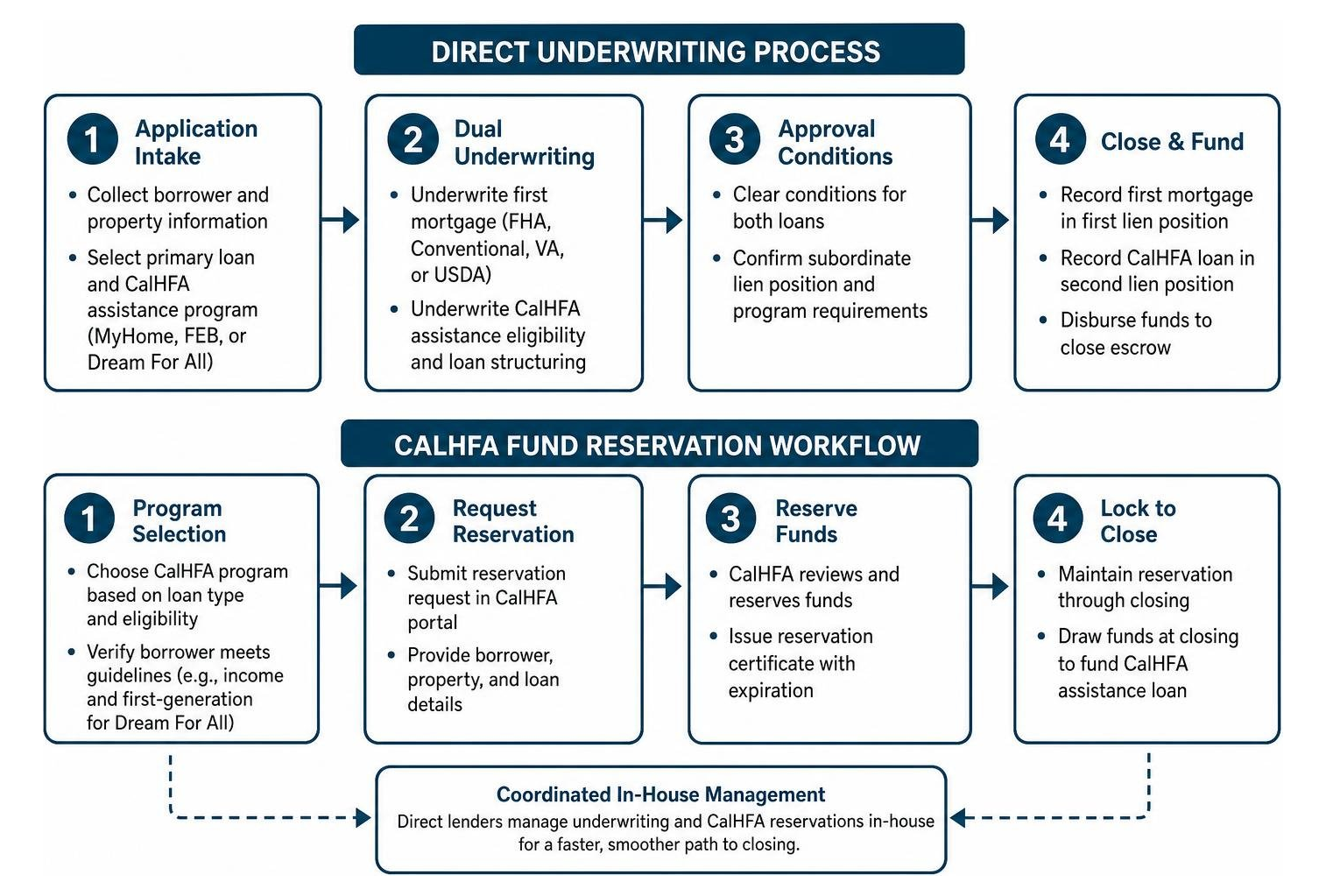
Navigating the California First Time Buyer Grant In-House Approval Process
Securing subordinate financing requires coordinating two distinct underwriting channels: your primary first mortgage and the secondary assistance lien. Direct lenders streamline this process by maintaining internal operations desks that manage document validation and fund reservations concurrently.
When reviewing broader state housing market trends, purchase timing and underwriting turn times become critical factors. CalHFA down payment assistance funds cannot be reserved indefinitely; your lender must lock your primary mortgage interest rate and submit a formal reservation package to the state master servicer only after you have an executed purchase contract.
How Lenders Handle a California First Time Buyer Grant In-House vs Third-Party Brokers
The primary difference between direct processing and standard third-party broker channels lies in operational authority and pipeline transparency:
- Direct File Control: A direct lender processes, underwrites, and prepares closing loan documents internally. Rather than sending your income documentation to an outside wholesale sponsor, an in-house underwriter validates both your primary agency guidelines (FHA, VA, Conventional) and the subordinate agency requirements simultaneously.
- Streamlined Subordinate Submissions: Subordinate liens from CalHFA or county housing authorities require separate compliance packages. Direct lenders coordinate subordinate title requirements, escrow instructions, and master servicer disclosures internally, reducing the administrative cycle by 10 to 15 business days.
- Manual Underwriting Flexibility: When a borrower’s credit score falls between 640 and 659, or their debt-to-income (DTI) ratio reaches programmatic maximums (such as 45% for credit scores under 700, or 50% for scores 700 and above), in-house underwriters review manual compensating factors directly, avoiding wholesale loan rejections.
The Real Cost of Layered Financing: Rates, Fees, and Resale Triggers
Subordinate financing provides accessible cash upfront, but borrowers should evaluate the associated long-term costs:
- Interest Rate Premiums: First-mortgage interest rates paired with CalHFA down payment programs are set directly by the agency and are typically 0.125% to 0.375% higher than standard market rates on non-assisted loans.
- Master Servicer and Compliance Fees: CalHFA and local housing authorities utilize designated master servicers (such as Lakeview Loan Servicing) that charge specialized administrative review and processing fees at close of escrow.
- Subordination Policies during Refinance: If mortgage market interest rates decline and you wish to refinance your first mortgage, you must obtain a formal subordination agreement from the junior lienholder (CalHFA or your local municipality). CalHFA generally permits subordination for a rate-and-term refinance, but subordinate liens must be paid off entirely if you execute a cash-out refinance.
- Occupancy Covenants: State and local assistance programs require the home to remain your primary residence. Converting the property into a rental or investment property accelerates the junior lien, triggering full repayment of the principal and any accrued appreciation.
Regional and Municipal Grant Programs You Can Stack
Statewide programs can often be paired with municipal and county down payment assistance initiatives, creating substantial layers of financial support. Understanding local funding allocations helps buyers identify additional sources of capital.

Buyers in Southern California can review local grants to afford San Diego properties to see how municipal funds combine with standard first mortgages. Similarly, exploring Santa Ana down payment assistance provides insight into how Orange County municipalities structure their local buyer programs.
Southern California: Riverside and San Diego County Programs
- Riverside County First-Time Home Buyer Program (HOME & PLHA): Administered through the Riverside County Housing and Workforce Solutions department, this program provides subordinate financing as outlined in the Riverside County HOME FTHB manual requirements.
- Assistance Amount: Up to 20% of the purchase price, capped at $100,000.
- Structure: Issued as a 0% interest silent second mortgage that converts into a fully forgiven grant after a 15-year affordability period, provided the owner maintains continuous occupancy without cash-out refinancing.
- Purchase Price Caps: Single-family residences up to $607,050; condominiums/townhomes up to $470,250.
- Income Caps: HOME funds target households at or below 80% AMI ($68,900 for 1 person to $129,900 for 8 persons), while PLHA funds accommodate households up to 120% AMI ($89,520 for 1 person to $168,720 for 8 persons).
- San Diego Housing Commission (SDHC) Assistance: As detailed by the San Diego Housing Commission programs, SDHC offers low-interest deferred-payment second loans and closing cost grants up to 17% of the purchase price for buyers earning at or below 80% of San Diego County’s AMI.
Northern and Central California: CalHOME and Bay Area Portals
- CalHOME Program: The California Department of Housing and Community Development distributes funds to local public agencies and non-profit developers under the CalHOME Program funding through local agencies. These agencies then issue deferred-payment subordinate loans to low- and very low-income first-time buyers for single-family homes and manufactured housing.
- City of San José Downpayment Assistance: Offers deferred silent second mortgages up to 30% of the purchase price for low-to-moderate-income families purchasing within city limits, repayable upon resale or transfer.
- Fresno County First-Time Homebuyer Program: Provides zero-interest, deferred second loans covering up to 20% of the purchase price for properties located in unincorporated county areas and participating small cities.
Strategic Combinations: Federal Mortgages, MCCs, and Down Payment Stacking
First-time buyers can optimize their financing by combining federal loan structures, down payment subordinate liens, and tax credits.

Reviewing our comprehensive guide to securing $25,000 homebuyer grants illustrates how different state and local funding sources can be stacked together.
Comparison of Primary Mortgage Platforms
- FHA Mortgages: Require a 3.5% down payment and allow credit scores down to 640 for CalHFA programs (660 to avoid manual underwriting). Best for buyers with moderate credit scores or higher debt ratios.
- VA Mortgages: Offer 0% down payment financing with no monthly mortgage insurance for eligible veterans and active-duty service members. CalHFA subordinate loans can be paired with VA financing to cover out-of-pocket closing costs.
- Conventional 97 (Fannie Mae HomeReady / Freddie Mac Home Possible): Require a 3% down payment and allow for cancellable private mortgage insurance (PMI) once you reach 20% home equity.
- California Mortgage Credit Certificate (MCC): An MCC allows a first-time buyer to convert 20% of their annual mortgage interest paid into a direct federal tax credit, capped at $2,000 per year. The remaining 80% of interest remains eligible for standard itemized deductions. Lenders can factor the $166 monthly tax credit directly into qualifying income calculations, lowering your debt-to-income ratio.
Note: You cannot stack CalHFA Dream For All with CalHFA MyHome or Forgivable Equity Builder on the same transaction, as Dream For All operates as a standalone subordinate equity product.
Step-by-Step Timeline to Secure Your California First Time Buyer Grant In-House
- Complete HUD-Approved Homebuyer Education: CalHFA and local programs require an 8-hour education course (via eHome America or a local HUD-approved counseling agency). The certificate is valid for one year.
- Obtain Direct Lender Pre-Approval: We verify your qualifying income against both primary agency limits and subordinate AMI thresholds.
- Execute Purchase Agreement with Assistance Contingency: Ensure your purchase offer includes a standard 21-to-30-day financing contingency that explicitly accounts for subordinate loan approvals.
- Lock First Mortgage and Reserve Assistance: Your loan officer locks the primary interest rate and enters the state or municipal reservation system to secure your down payment funds before allocations close.
- Underwriting and Subordinate Review: Our in-house processing team packages the primary and junior lien files simultaneously, coordinating property inspections, lead-paint disclosures, and title requirements.
- Loan Document Signing and Escrow Funding: Once the master servicer approves the subordinate package, final loan documents are issued and escrow closes within a standard 30-to-45-day window.
Common Mistakes That Disqualify Assistance Applications
- Calculating Income Using Lender Guidelines Instead of Program Rules: Standard mortgage underwriting uses “qualifying income,” while CalHFA and municipal programs calculate “total gross household income” for everyone occupying the residence over age 18, regardless of whether they are on the loan. Exceeding the county AMI limit by even one dollar disqualifies the file.
- Missing Program Allocation Deadlines: Waiting until escrow opens to check program availability can result in missed funding windows for limited-pool programs like Dream For All.
- Using Assistance Funds for Consumer Debt Payoffs: Subordinate program proceeds must be applied exclusively toward your down payment, allowable closing costs, or permanent interest rate buydowns. They cannot be used to pay off credit cards or auto loans at closing.
- Working with an Unapproved Lender: CalHFA and local housing agencies only accept reservation files from authorized participating lenders. Working with an unapproved originator requires restarting the underwriting process from scratch.
- Postponing Homebuyer Education: In-house underwriters cannot submit subordinate reservation packages without an active education completion certificate in the file.
Frequently Asked Questions About California Down Payment Grants
Can you combine CalHFA MyHome with local city or county down payment grants?
Yes. CalHFA permits “layered financing” where a buyer pairs a CalHFA first mortgage and MyHome second loan with a third subordinate lien from an approved city or county housing agency (such as San Diego Housing Commission or Riverside County HWS). The combined loan-to-value (CLTV) ratio can reach up to 105%, provided the local agency approves their junior lien position (typically third position).
What happens to a California forgivable grant if you sell or refinance early?
If you sell the home, transfer title, or execute a cash-out refinance before completing the required occupancy period (5 years for CalHFA Forgivable Equity Builder; 15 years for Riverside County HOME), the forgiveness schedule stops. For 5-year programs, forgiveness accrues at 20% annually; exiting in year three requires repaying the remaining unforgiven 40% balance.
What is the maximum household income limit to qualify for California assistance programs in 2026?
Income limits vary by county and program:
- CalHFA MyHome: Uses standard CalHFA county limits ranging from $153,000 to over $205,000 in higher-cost regions like Santa Clara, San Francisco, and Orange County.
- Forgivable Equity Builder: Capped strictly at 80% of the county’s Area Median Income (AMI), generally between $103,000 and $130,000.
- California Dream For All: Caps moderate-income households at 150% AMI (up to ~$193,000 depending on county) and low-income tiers at 80% AMI.
Conclusion
Securing down payment assistance in California’s competitive housing market requires matching the right program to your financial profile. Whether utilizing CalHFA MyHome, the Forgivable Equity Builder, or regional municipal grants, direct processing helps keep your application on schedule by managing primary and secondary loan requirements under one roof.
For an in-depth breakdown of available down payment resources, read The Ultimate Guide to $25,000 First Home Buyer Grants to explore your options and take the next step toward homeownership.


