
Can You Qualify for a 5 Percent Down Jumbo Loan?
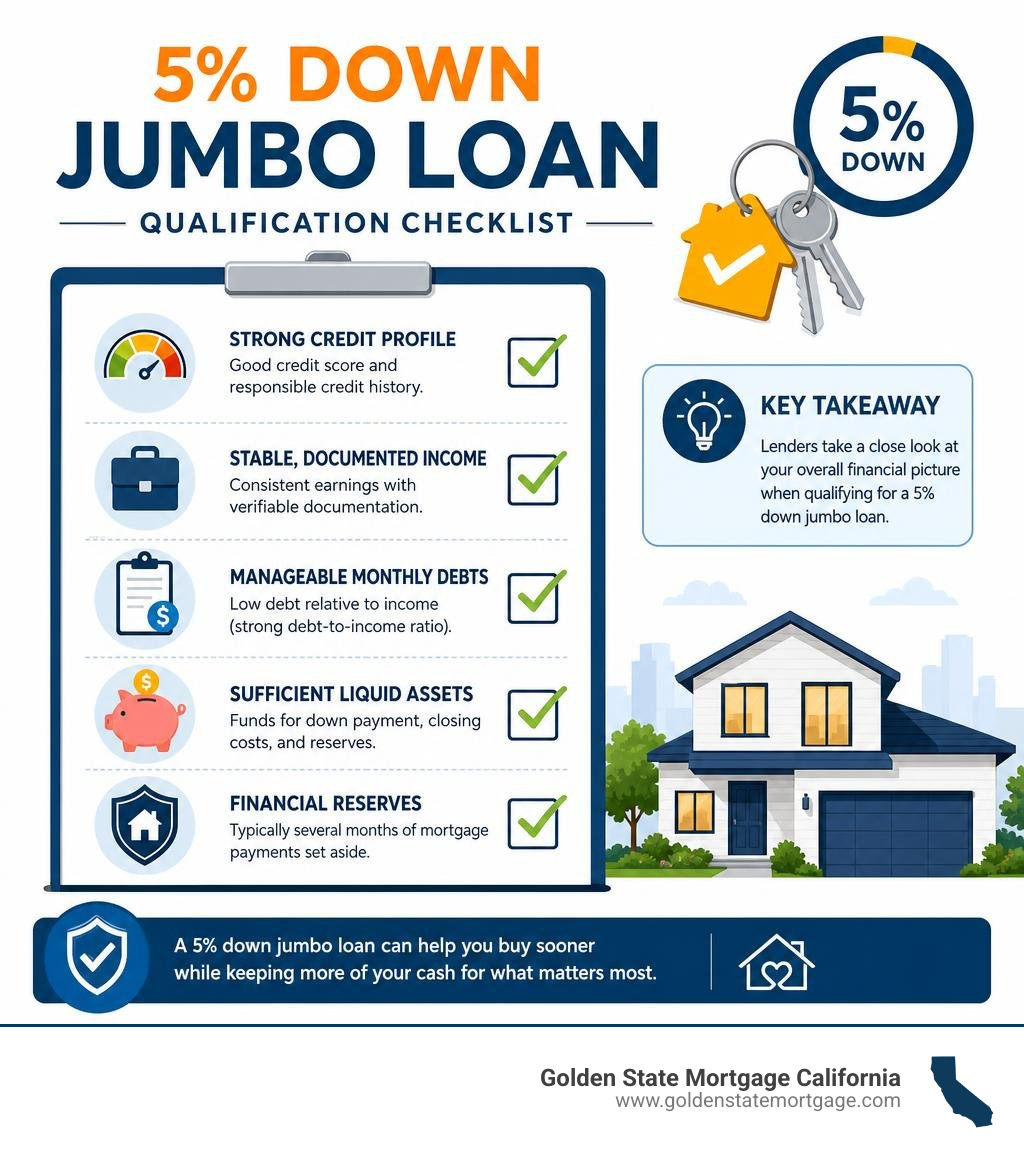
Yes, a 5 percent down jumbo loan is available through select portfolio lenders and credit unions, but approval is more demanding than for many standard mortgages. To improve your chances, start with a strong credit profile, documented and stable income, manageable monthly debts, and enough liquid assets to cover the down payment, closing costs, and usually several months of mortgage payments after closing.
In 2026, a loan becomes jumbo when it exceeds the local conforming limit: $832,750 in most U.S. counties and up to $1,249,125 in designated high-cost areas. That matters in many California markets, where a $1 million-plus purchase can require jumbo financing even with a sizable down payment.
A low-down-payment jumbo can help you buy without putting hundreds of thousands of dollars into the property upfront. Some programs do not charge separate monthly PMI, but lenders may price that risk into the rate and will look closely at your full financial picture.
I am Dale Gremillion, a Senior Loan Officer and Producing Branch Manager with more than 25 years of residential lending experience, including jumbo and low-down-payment financing. I help California buyers evaluate whether a 5 percent down jumbo loan fits their income, assets, and long-term goals.
Understanding Conforming Limits vs. Jumbo Financing in 2026
The median U.S. home price gained 32% between the second quarter of 2020 and the fourth quarter in 2024, pushing real estate values to new highs across California. For homebuyers in competitive markets—from San Diego and Los Angeles to San Francisco and San Jose—staying under traditional financing thresholds is often difficult.
To understand why jumbo financing matters, it helps to distinguish between conforming and non-conforming loans:
- Conforming Loans: These mortgages meet guidelines established by the Federal Housing Finance Agency (FHFA) and can be purchased by Fannie Mae or Freddie Mac. In 2026, the baseline conforming loan limit is $832,750 for a one-unit single-family home. In designated high-cost locales (such as Orange County, the Bay Area, and Los Angeles County), the ceiling rises to $1,249,125.
- Jumbo Mortgages: Any single-family residential loan that exceeds the conforming boundary for its specific county is classified as non-conforming or “jumbo.” Because Fannie Mae and Freddie Mac do not back these mortgages, lenders hold them in their own portfolios or sell them directly to private investors on the secondary market.
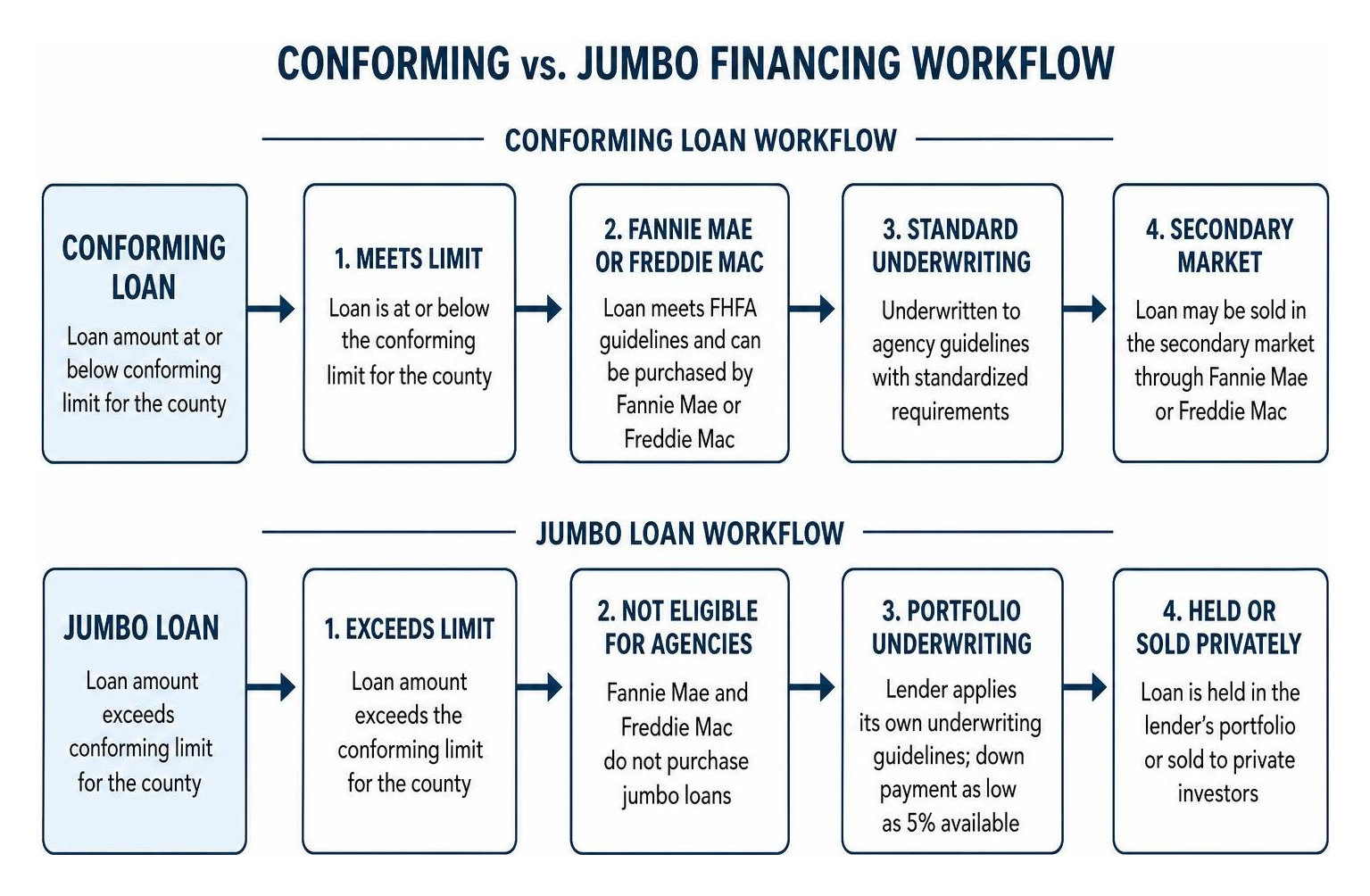
Because jumbo loans carry balance levels that conventional agencies will not insure, individual lenders establish their own underwriting guidelines. Some traditional retail institutions enforce strict 20% down payment minimums, but forward-thinking portfolio lenders offer options requiring as little as 5% down.
For a complete breakdown of financing structures, check out our comprehensive guide on what is a jumbo loan.
How to Qualify for a 5 Percent Down Jumbo Loan
Securing a luxury property with only 5% upfront requires clear documentation of your financial strength. Because the lender absorbs higher initial leverage, manual underwriting is standard practice.

Key qualification factors include:
- Debt-to-Income (DTI) Thresholds: Most low-down jumbo programs prefer a maximum back-end DTI ratio of 43%, though select portfolio programs consider ratios up to 45% for borrowers with substantial asset reserves.
- Qualifying Household Income: Because loan amounts on a 5% down jumbo loan routinely sit between $800,000 and $2,000,000+, qualifying requires sufficient, predictable, and verified cash flow. Lenders review two consecutive years of W-2 statements, recent paystubs showing year-to-date earnings, and two full years of personal (and corporate, if self-employed) tax returns.
- Employment Stability: Underwriters look for at least a two-year consistent track record within the same industry or professional line of work.
- Portfolio Common-Sense Underwriting: Many non-conforming portfolio lenders review applications using a holistic approach, allowing strong compensating factors—like high liquidity or low consumer debt—to offset isolated underwriting exceptions.
Credit Score and Asset Requirements for a 5 Percent Down Jumbo Loan
Putting 5% down on a high-balance mortgage requires strong credit health and clear post-closing liquidity:
- Credit Scores (FICO): Most lenders require a minimum median FICO score of 700 to 720. For transactions exceeding $1.5 million, prime pricing and approval typically require a 740+ score.
- Post-Closing Reserves: Most jumbo lenders require six to twelve months of reserves after closing. Reserves are documented liquid or semi-liquid funds remaining in your accounts after paying the down payment and closing costs. For example, if your total monthly housing obligation—comprising principal, interest, taxes, and insurance (PITI)—is $7,000, a six-month reserve mandate requires showing at least $42,000 in seasoned assets.
- Liquid and Investment Asset Sourcing: Acceptable reserve sources include checking accounts, savings accounts, money market funds, certificates of deposit (CDs), and vested public equities. Retirement accounts (such as 401ks, traditional IRAs, or Roth IRAs) generally qualify as reserves, though underwriters typically discount their vested balance by 30% to 40% to account for potential tax and early-withdrawal penalties.
Private Mortgage Insurance and Structuring Options
When purchasing a home with less than 20% down on a conventional loan, borrowers typically pay monthly private mortgage insurance (PMI). In the jumbo market, low-down-payment options are structured differently:
- Lender-Paid Mortgage Insurance (LPMI) / Zero-PMI Non-Conforming: Many portfolio lenders waive monthly PMI on low-down jumbo products. The lender absorbs the default risk and factors it directly into the interest rate note, keeping your monthly payment clean and consolidated without an added PMI line item.
- Piggyback Second Mortgages (80-15-5 Structure): In this configuration, you obtain a first mortgage for 80% of the purchase price, a simultaneous second mortgage (such as a Home Equity Line of Credit or fixed-rate second lien) for 15%, and supply a 5% cash down payment. This eliminates PMI on the first mortgage and keeps the primary loan balance within lower risk thresholds.
Comparing 5% Down Jumbo Financing to Other Low-Down-Payment Options
Before moving forward with a 5% down jumbo structure, compare it against alternative low-down programs:
| Feature | 5% Down Jumbo Loan | High-Balance FHA Loan | VA Loan (Full Entitlement) |
|---|---|---|---|
| Minimum Down Payment | 5% | 3.5% | 0% |
| Maximum Loan Limit | Up to $1.5M – $2M+ | Capped at county high-cost ceiling ($1,249,125 max) | No statutory cap for eligible veterans |
| Mortgage Insurance | Often zero monthly PMI or LPMI | Upfront MIP (1.75%) + Monthly MIP for life of loan | Zero monthly PMI (VA funding fee applies) |
| Credit Score Target | Typically 700 to 740+ | Typically 580 to 620+ | Typically 620+ |
| Post-Closing Reserves | 6 to 12 months PITI | Minimal (0 to 3 months) | Minimal (0 to 2 months) |
You can learn more about finding the right loan product for your situation by reading our detailed overview of jumbo loans with 5% or 10% down and browsing our complete suite of mortgage programs.
Benefits and Potential Risks of Low-Down Jumbo Loans

Purchasing real estate with 5% down offers clear financial flexibility, but it requires balancing advantages against leverage risks:
- Capital Preservation and Diversification: Tying up 20% on a $1.5 million California purchase requires a $300,000 cash outlay before closing fees. With a 5% down payment ($75,000), you keep $225,000 working in diversified investment portfolios, emergency funds, or business ventures.
- Lower Equity Buffer: Entering a transaction with 95% leverage means less built-in protection against localized price corrections.
- Larger Monthly Obligation: Financing 95% of a luxury home results in a higher monthly PITI payment and more cumulative interest paid over the life of the loan. Review our published rate assumptions to see how different balances and interest tiers affect long-term amortization schedules.
Key Advantages of Choosing a 5 Percent Down Jumbo Loan
- Exemption from Conventional LLPAs: Conforming Fannie Mae and Freddie Mac loans assess mandatory Loan-Level Price Adjustments (LLPAs) based on credit scores and loan-to-value ratios. Jumbo loans are exempt from agency LLPAs, which can allow high-tier borrowers to secure competitive rates even at higher loan-to-value amounts.
- Maintaining Liquid Reserves: Instead of emptying savings to satisfy a 20% down requirement, you can keep your liquid capital intact in tax-advantaged accounts or high-yield vehicles.
- Expanded Buying Power in Fast-Moving Markets: Rather than delaying a purchase for years to accumulate a massive cash down payment, qualified buyers can secure a home today while values appreciate.
Frequently Asked Questions About Low-Down Jumbo Mortgages
How much income is required for a 5% down jumbo loan on a $1.2 million home?
For a $1,200,000 purchase price with 5% down ($60,000), the loan balance is $1,140,000. Assuming an illustrative interest rate of 6.75%, property taxes at 1.25%, and standard homeowner insurance, the total monthly PITI payment is approximately $8,850. To maintain a back-end DTI ratio under 43% with modest revolving consumer debt ($500/month), the household requires an annual qualifying income of roughly $260,000 to $275,000.
Do all mortgage lenders offer 5 percent down jumbo options?
No. Many commercial retail banks only offer jumbo loans starting at 10.01%, 15%, or 20% down. To find true 5% down jumbo products, borrowers often work with direct wholesale lenders and specialized mortgage brokers with access to portfolio loan channels. Visit our blog to keep up with current high-balance lending shifts.
Can gift funds be used toward the 5% down payment and reserves?
Most jumbo programs require the borrower to contribute the minimum 5% down payment directly from their own seasoned personal funds. However, bona fide gift funds from an immediate family member are often permitted to cover closing costs or supplement post-closing reserve requirements, provided an executed gift letter and complete donor paper trails are submitted.
Conclusion
A low-down-payment jumbo loan provides a practical pathway to luxury homeownership throughout California without depleting liquid savings. By pairing high-leverage financing with strong credit and structured post-closing reserves, you can purchase high-value real estate while keeping your broader investment capital intact.
At Golden State Mortgage California, our direct lending platform and experienced team provide custom underwriting solutions tailored to your unique financial profile across California markets.
Ready to review your qualification options or lock your rate today? Check our live rate feed template to review current market indicators, and connect with our team to explore custom financing options with Golden State Mortgage.


