
Understanding the HECM Program and How It Works
Created under Section 255 of the National Housing Act via the Housing and Community Development Act of 1987, the hecm program was established to help senior homeowners convert accumulated home equity into liquid resources. Unlike a traditional forward mortgage—where you make monthly payments to build equity—a reverse mortgage pays you. As you receive payments or draw against a line of credit, interest and fees accrue, increasing the loan balance over time while your equity decreases.
Because the hecm program is federally insured through the FHA, it carries safeguards not always found in private loans. The most notable safeguard is its non-recourse feature. If the loan balance grows to exceed the home’s market value when the property is sold, neither you nor your heirs are personally liable for the remaining balance; the FHA Mutual Mortgage Insurance (MMI) fund covers the difference.
Historically, adjustable-rate HECMs were tied to the London Interbank Offered Rate (LIBOR). However, following LIBOR’s official expiration on June 30, 2023, HUD transitioned all adjustable-rate HECMs to the Chicago Mercantile Exchange (CME) Term Secured Overnight Financing Rate (SOFR) index. To understand how these loans compare to traditional options, review the breakdown below or check out Investopedia’s HECM definition.
| Feature | HECM Reverse Mortgage | Traditional Forward Mortgage |
|---|---|---|
| Monthly Principal & Interest | Optional/None required | Mandatory each month |
| Loan Repayment | Deferred until home is sold or permanently vacated | Begins immediately upon closing |
| Government Backing | Insured by the FHA | Varies (FHA, VA, Conventional) |
| Borrower Liability | Non-recourse (capped at home’s appraisal value) | Recourse (borrower personal liability) |
| Equity Impact | Equity decreases over time | Equity increases over time |
Who Qualifies for the HECM Program?
Eligibility for the hecm program is governed by federal rules to protect older homeowners. To qualify:
- Age Requirement: The youngest borrower or eligible non-borrowing spouse must be at least 62 years old.
- Primary Residence: The home must be your principal residence, where you live for the majority of the calendar year.
- Property Types: Eligible single-unit residences, 2-to-4 unit owner-occupied properties, HUD-approved condominiums, and manufactured homes meeting FHA construction guidelines qualify.
- HUD-Approved Counseling: You must complete a mandatory counseling session with a HUD-approved reverse mortgage counselor to review payment options, tax impacts, and long-term costs.
- Financial Assessment: Introduced in 2015, lenders conduct a financial assessment evaluating credit history and cash flow to verify your ability to pay recurring property charges like real estate taxes, hazard insurance, and HOA dues.
How HECM Loan Amounts Are Calculated
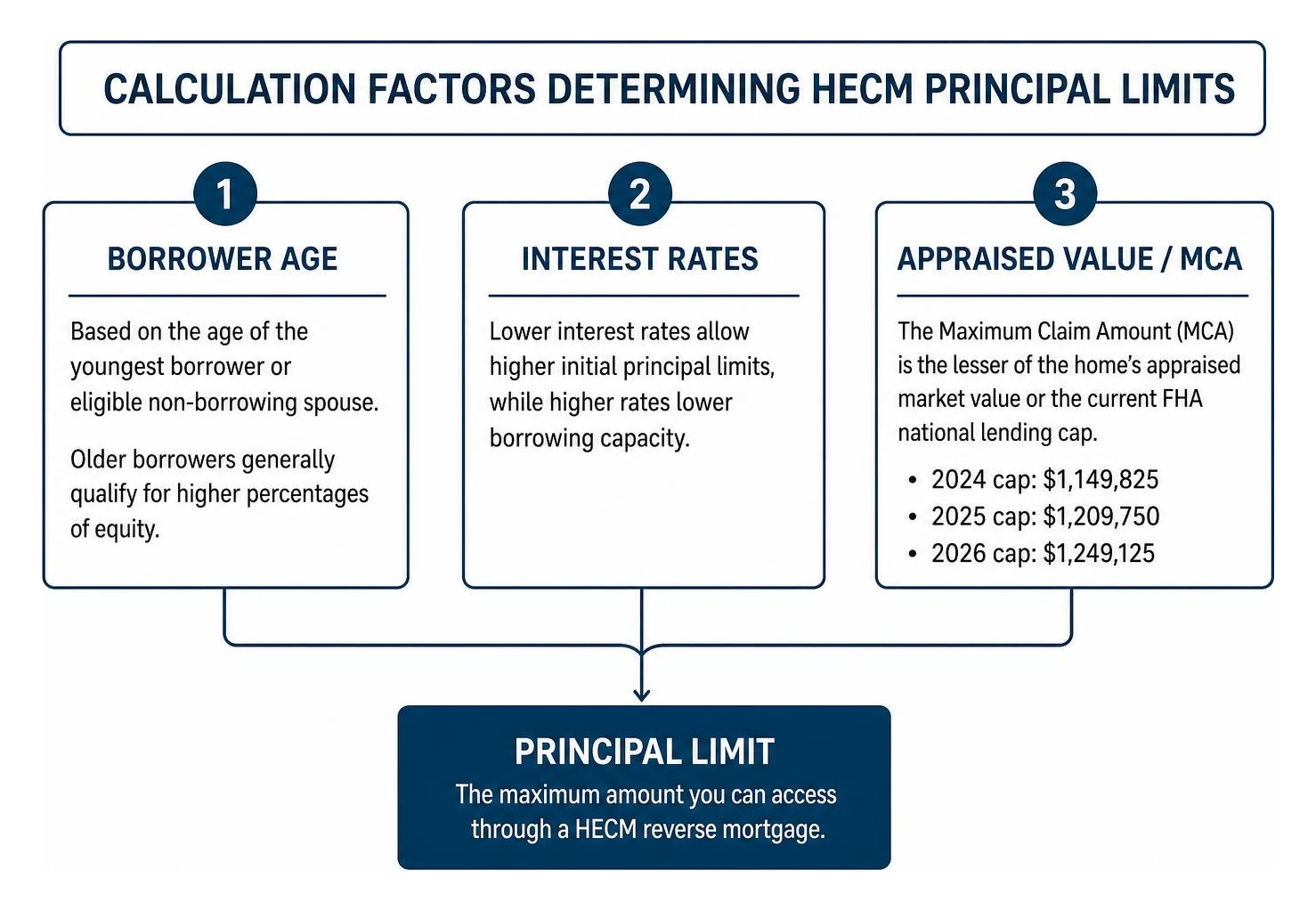
The maximum amount of money you can access through a HECM is called the Principal Limit. It is calculated using a formula that takes three main inputs into account:
- Borrower Age: Based on the age of the youngest borrower or eligible non-borrowing spouse. Older borrowers generally qualify for higher percentages of equity.
- Interest Rates: Lower interest rates allow higher initial principal limits, while higher rates lower borrowing capacity.
- Appraised Value / MCA: The Maximum Claim Amount (MCA) is the lesser of the home’s appraised market value or the current FHA national lending cap. In 2024, the cap was $1,149,825; in 2025, it increased to $1,209,750; and for 2026, the maximum claim amount sits at $1,249,125.
HECM Program Payment Options and Disbursement Rules
The hecm program offers flexible payout structures to match varied financial needs:
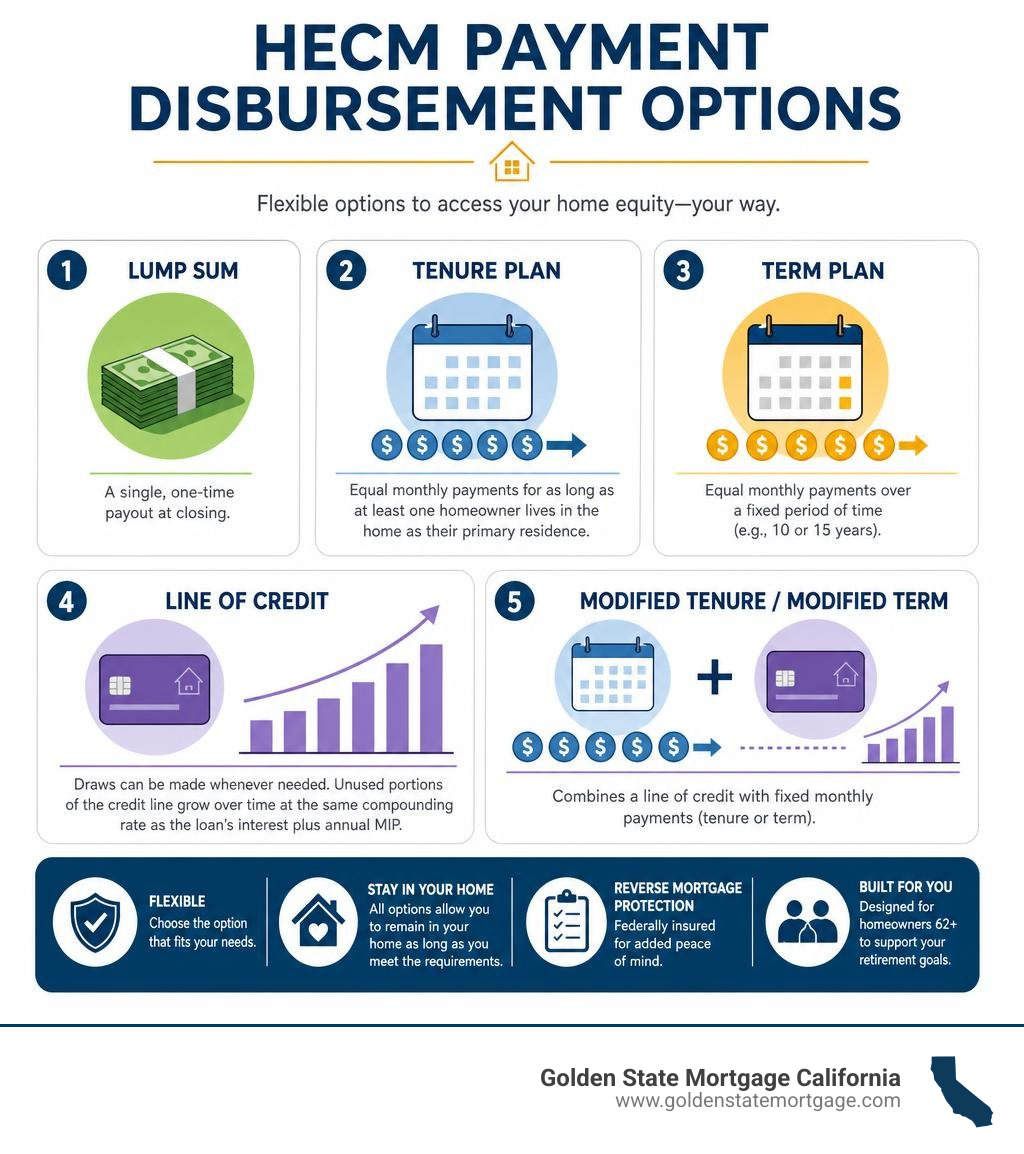
- Lump Sum: A single, one-time payout at closing. This option carries a fixed interest rate, but payouts in the first 12 months are capped.
- Tenure Plan: Equal monthly payments for as long as at least one borrowing homeowner lives in the property as a primary residence.
- Term Plan: Equal monthly payments over a fixed period of time (e.g., 10 or 15 years).
- Line of Credit: Draws can be made whenever needed. Unused portions of the credit line grow over time at the same compounding rate as the loan’s interest plus annual MIP, giving you access to more equity in later years.
- Modified Tenure / Modified Term: Combines a line of credit with fixed monthly payments (tenure or term).
Under FHA rules, initial loan disbursements during the first 12 months are restricted by the “60% Rule.” You can access only up to 60% of your principal limit during the first year, unless mandatory obligations (such as paying off an existing forward mortgage) exceed that limit, in which case you can draw enough to pay off those costs plus an additional 10% of the principal limit.
Borrower Obligations, Costs, and Spousal Protections
While reverse mortgages eliminate monthly debt service, maintaining your home remains essential. You retain full title to your property, meaning you are responsible for paying real estate taxes, hazard insurance premiums, flood insurance (where required), and homeowners association (HOA) fees on time. You must also maintain the home in good repair.

Failing to pay property charges or abandoning primary residence status triggers a technical default. As of March 2016, over 89,000 HECM loans were in technical default for unpaid property taxes or insurance. To prevent defaults, lenders can create a Life Expectancy Set-Aside (LESA) during underwriting, withholding part of your available loan proceeds into an escrow-like account specifically to pay taxes and insurance throughout your lifetime.
Understanding HECM Program Costs
HECM loans involve specific administrative fees and insurance premiums:
- Upfront Mortgage Insurance Premium (MIP): A mandatory FHA fee set at 2% of the Maximum Claim Amount.
- Annual MIP: A recurring fee of 0.5% accrued annually on the growing loan balance.
- Origination Fees: Lenders charge origination fees capped by law—2% of the first $200,000 of home value, plus 1% of the value above $200,000, with an overall cap of $6,000.
- Third-Party Costs: Standard appraisal fees, title search fees, recording costs, and servicing charges capped at $30–$35 per month.
Protections for Non-Borrowing Spouses
In the past, if a borrowing spouse passed away or entered a care facility, non-borrowing spouses faced immediate loan repayment requirements or foreclosure. HUD updated its rules to protect eligible non-borrowing spouses. If married at closing, a non-borrowing spouse can remain in the home under a “deferral period” without repaying the loan balance, provided they establish legal ownership or occupancy rights and maintain all tax, insurance, and maintenance duties. For more details on official safeguards, visit the HUD HECM Resource Page.
Loan Repayment, Risk Mitigation, and Avoiding Exploitation
A hecm program loan becomes due and payable when:
- The last surviving borrower (or eligible non-borrowing spouse) passes away.
- The property is sold or title is transferred.
- The borrower ceases occupying the home as a principal residence for more than 12 consecutive months (including health-related institutional stays).
- The borrower defaults on tax, insurance, or property maintenance covenants.
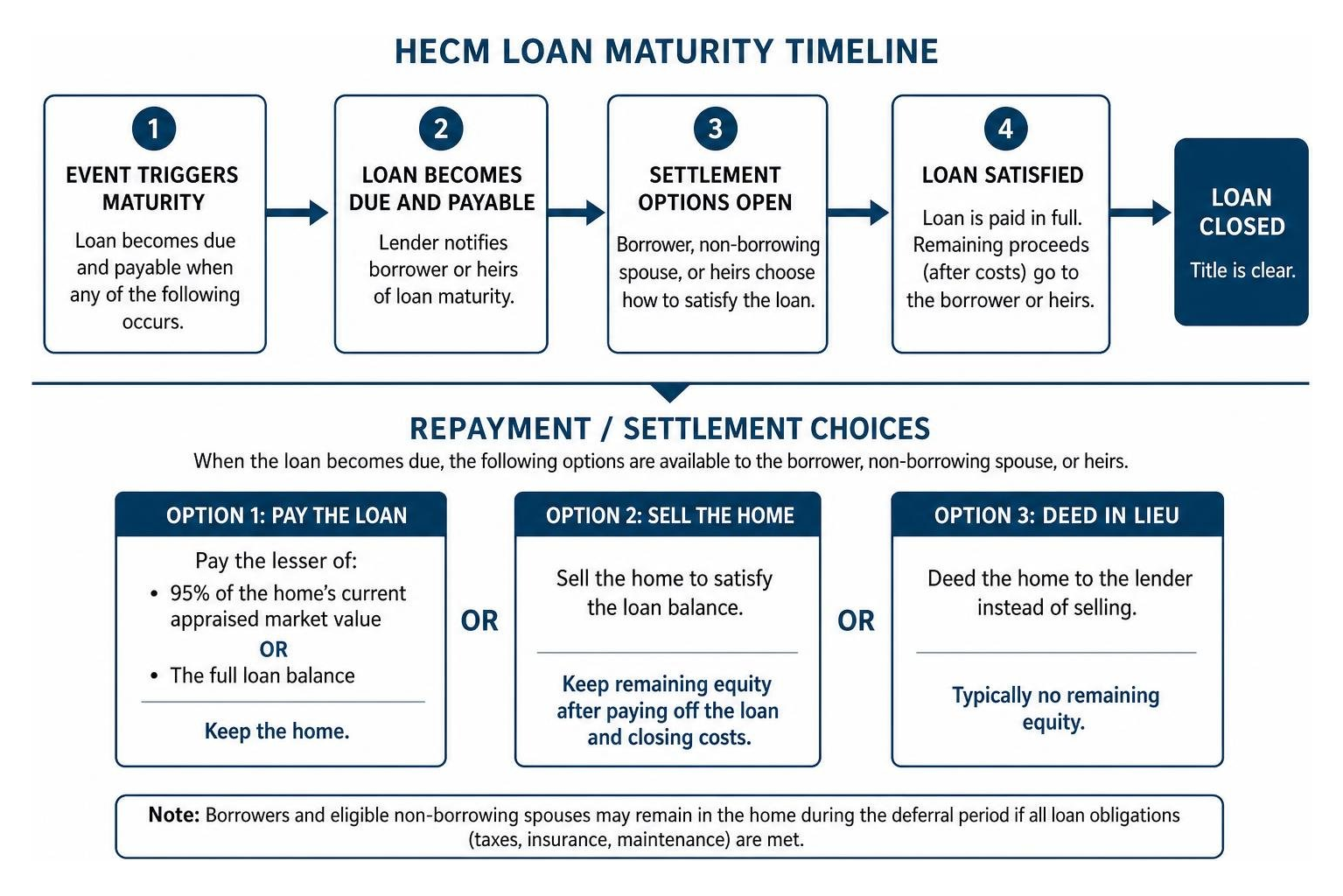
When a HECM becomes due, borrowers or heirs have defined settlement options. Heirs can choose to satisfy the mortgage balance by paying 95% of the home’s current appraised market value or the full loan balance—whichever is lower—or sell the property to satisfy the balance and keep remaining equity.
Preventing Senior Financial Exploitation
Because reverse mortgages involve equity conversion, older homeowners can sometimes be targeted by predatory individuals or misleading schemes.

Be alert to warning signs:
- Unsolicited contractors suggesting you apply for a reverse mortgage to fund home repairs.
- Financial planners pushing high-risk investments financed via reverse mortgage credit draws.
- Anyone charging fees for basic program information that HUD provides free of charge.
If you suspect predatory practices, review legal resources or read about combating reverse mortgage abuse in California.
Financial Status and Stability of the HECM Program
The hecm program has undergone operational adjustments to preserve financial backing. A HUD study analyzing 533,894 HECM loans between 2000 and 2020 revealed that the FHA experienced net losses of approximately $10.4 billion over that period, primarily from 2006 to 2010 loan cohorts. In FY 2016, actuarial reviews estimated the HECM portfolio held a negative economic value of $7.7 billion.
To restore fund stability, HUD implemented mandatory financial assessments in 2015, established the first-year 60% draw cap, adjusted upfront MIP premiums, and phased out the expiring LIBOR benchmark in favor of the CME Term SOFR index. Annual HECM originations shifted from a peak of nearly 115,000 in FY 2009 to approximately 26,500 in FY 2024, reflecting tighter risk criteria.
Frequently Asked Questions About Reverse Mortgages
What happens to a HECM loan when the borrower passes away?
When the primary borrower dies, the loan balance becomes due. Heirs receive formal notice from the servicer detailing available options. Heirs can sell the property to pay off the mortgage balance, retain any remaining home equity, or purchase the home by satisfying the lesser of the full debt balance or 95% of its appraised market value. If the home balance exceeds market value, the FHA non-recourse insurance policy reimburses the lender for the deficit.
Can a HECM loan be used to purchase a new home?
Yes, through the HECM for Purchase (H4P) program. This feature lets homeowners aged 62 or older buy a new primary residence using a single transaction. Payout proceeds from the reverse mortgage cover a portion of the purchase price, while cash on hand covers the remaining down payment and closing costs. This helps buyers relocate, downsize, or move closer to family without incurring monthly mortgage payments.
What happens if a borrower falls behind on property taxes or insurance?
Failing to pay taxes or hazard insurance puts the loan into technical default. Servicers issue written notices demanding immediate resolution. If you cannot catch up, the servicer may advance funds to pay the taxing authority or insurance carrier, adding those amounts to your principal loan balance and requiring a structured repayment plan. Unresolved property charge defaults can lead to foreclosure. To mitigate risk, lenders can establish a LESA account at closing to automate future payments.
Conclusion
The hecm program gives California homeowners aged 62 and older a flexible way to tap into home equity, supplement retirement savings, cover medical expenses, or lower monthly overhead costs. However, evaluating loan structures, compounding interest, upfront mortgage insurance fees, and ongoing property charge requirements requires careful review.
At Capital Home Mortgage California, we help California homeowners navigate home equity options. Our loan team provides clear, end-to-end guidance to help you select a strategy tailored to your long-term goals. Whether you are exploring reverse mortgage options, looking to refinance, or evaluating senior loan solutions, visit Golden State Mortgage today to connect with our mortgage professionals.


