
A Department of Agriculture Home Loan Can Make Zero-Down Homeownership Possible
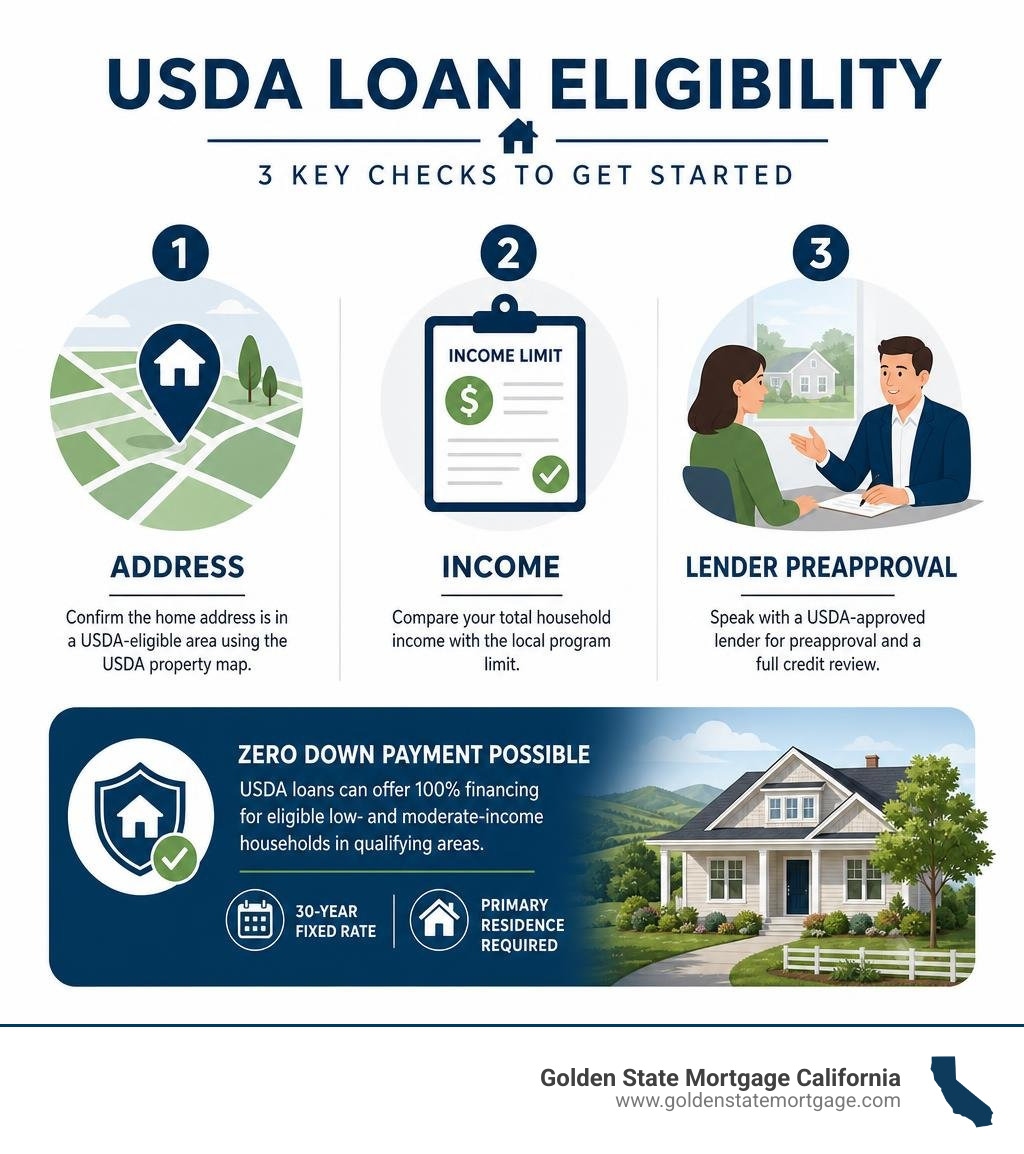
A Department of Agriculture home loan, commonly called a USDA loan, can help eligible buyers purchase a primary home with no down payment in qualifying rural and many suburban areas. To see whether it may fit your plans, start with these three checks:
- Confirm the home address is in a USDA-eligible area using the USDA property map.
- Compare your total household income with the local program limit.
- Speak with a USDA-approved lender for preapproval and a full credit review.
Most buyers use the USDA Section 502 Guaranteed Loan Program. A private lender makes the mortgage, while the USDA guarantees 90% of the loan balance to the lender. That support can make 100% financing possible for qualified low- and moderate-income households. USDA guaranteed loans are 30-year fixed-rate mortgages, and the home must be your primary residence.
For California buyers facing high home prices and limited savings for a down payment, the important detail is that “rural” does not always mean remote. Some smaller cities, towns, and suburban-edge communities may qualify. Eligibility depends on the specific address, household income, credit profile, debts, and the property’s condition.
I am Dale Gremillion, a Senior Loan Officer and Producing Branch Manager with more than 25 years of residential lending experience, including Department of Agriculture home loan programs. I help California buyers compare USDA, FHA, VA, conventional, and construction financing so they can make a clear, practical choice.
Department of agriculture home loan vocab to learn:
- 502 direct home loan program
- USDA loan California requirements
What Is a Department of Agriculture Home Loan and How Does It Work?
A USDA home loan is a government-backed mortgage program designed to improve the economy and quality of life in rural and semi-rural American communities. Administered by the United States Department of Agriculture through Rural Development, these loans offer a path to homeownership for low- to moderate-income households who might struggle to save a large down payment.
The cornerstone of the residential initiative is the Single Family Housing Guaranteed Loan Program. Under this program, the USDA does not actually lend you the money directly. Instead, private approved mortgage lenders issue the loan, while the USDA provides a 90% loan note guarantee against default. This backing allows lenders to extend 100% financing—meaning zero down payment—to qualifying borrowers.
Section 502 Guaranteed Loans come exclusively as 30-year fixed-rate mortgages. The program is subsidy-neutral; borrower guarantee fees fund program operations rather than taxpayer dollars. Borrowers must occupy the acquired property as their primary residence, as investment properties and vacation homes are strictly prohibited.
Eligible Property Types and Allowable Uses of Funds

USDA financing accommodates a wide variety of modest, decent, safe, and sanitary dwellings. Eligible property types include:
- Single-family detached existing homes
- New construction properties
- Qualified condominiums and planned unit developments (PUDs)
- Modular homes
- Qualifying manufactured homes affixed permanently to an approved foundation
Loan proceeds can cover more than just the purchase price. Borrowers can finance essential site preparation costs (such as driveways, walks, grading, and sod installation), customary closing costs, and conveyed household appliances. For homeowners seeking to repair existing residences, Rural Development also manages specialized initiatives like Section 504 home repair grants and loans.
Pros and Cons of USDA Financing
Understanding the trade-offs of a USDA-backed mortgage helps ensure it aligns with your long-term financial goals.
Pros:
- Zero Down Payment: Finance up to 100% of the property’s appraised value.
- Competitive Interest Rates: Government backing allows lenders to offer attractive fixed market rates.
- Lower Mortgage Fees: The upfront and monthly fees are often lower than traditional FHA mortgage insurance premiums.
- No Prepayment Penalties: You can pay down or sell the property at any time without financial penalties.
Cons:
- Geographic Restrictions: The home must be situated in a USDA-designated rural or suburban area.
- Income Caps: Total household income cannot exceed 115% of the area median income.
- Life-of-Loan Annual Fee: Unlike conventional private mortgage insurance (PMI), the annual fee remains for the life of the loan.
- Primary Residence Only: You cannot purchase income-producing properties or secondary vacation homes.
Understanding USDA Direct vs. Guaranteed Home Loans
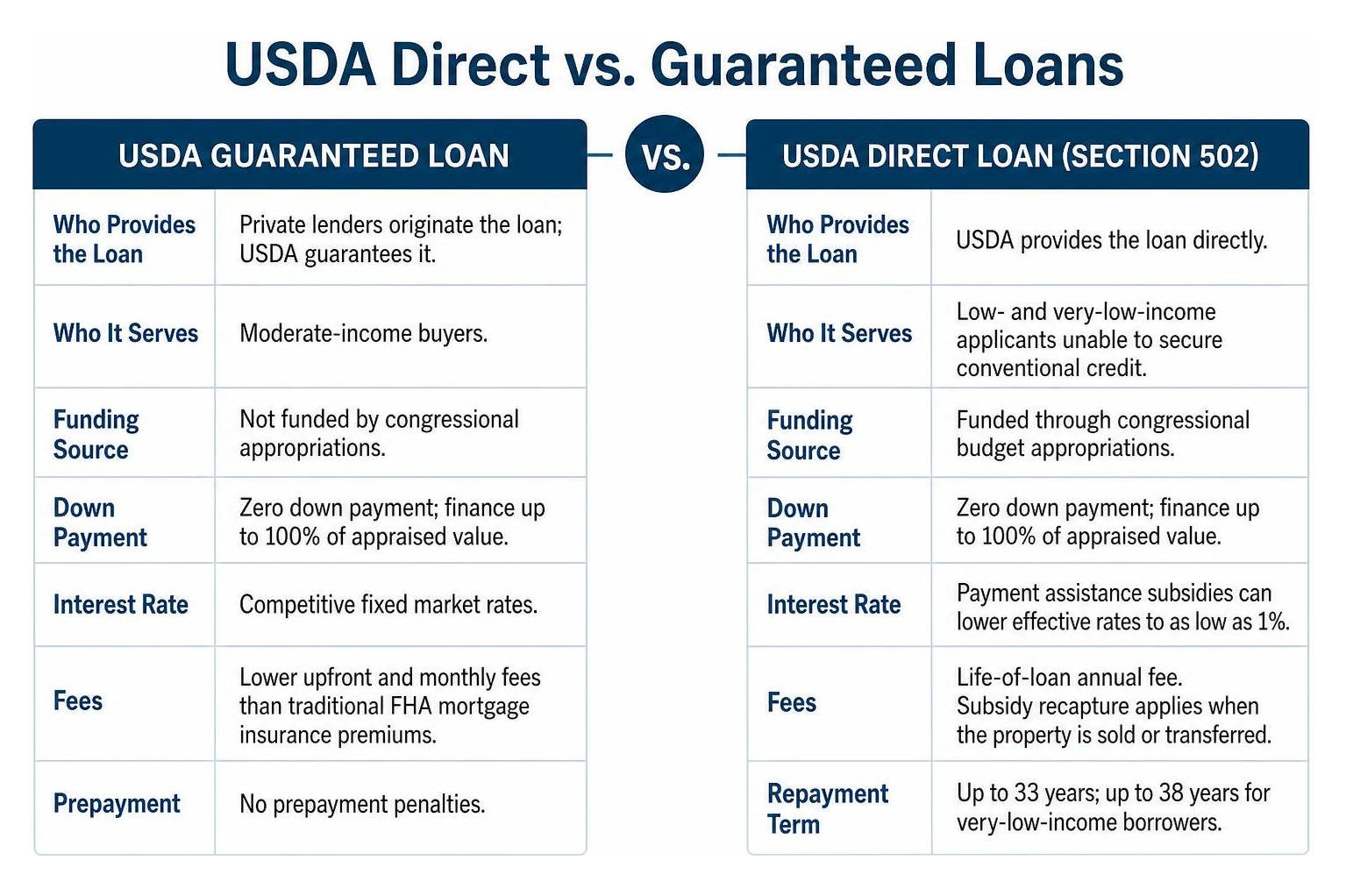
The USDA single-family residential umbrella splits into two distinct programs: Guaranteed Loans and Direct Loans.
While the Guaranteed program relies on private lenders to originate mortgages for moderate-income buyers, the Section 502 Direct program is funded directly through congressional budget appropriations. It serves low- and very-low-income applicants who are unable to secure conventional credit elsewhere.
Through the Single Family Housing Direct Home Loans program, the government provides payment assistance subsidies that can temporarily lower effective interest rates down to as low as 1%. Repayment terms standardly run up to 33 years, extending to 38 years for very-low-income borrowers to ensure affordability. However, borrowers must agree to subsidy recapture, meaning any payment subsidies received must be repaid when the property is sold or transferred.
USDA Section 504 Home Repair Loans and Grants
For existing very-low-income homeowners who need to eliminate health and safety hazards, the Section 504 Home Repair program offers direct government support:
- Repair Loans: Up to $40,000 with a fixed 1% interest rate and repayment terms up to 20 years.
- Senior Grants: Up to $10,000 for homeowners aged 62 and older who lack the ability to repay a loan, provided the funds address urgent hazards.
- Combined Assistance: Qualified applicants can combine loans and grants for up to $50,000 in total repair support.
USDA Home Loan Eligibility and Requirements
Qualifying for a Department of Agriculture Home Loan: Income, Credit, and Property Criteria
To qualify for a Section 502 Guaranteed loan, your household must meet specific underwriting standards:
- Income Limits: Household earnings cannot exceed 115% of the Area Median Income (AMI). The USDA evaluates the combined income of all adult household members, regardless of whether they are listed on the loan note.
- Credit Evaluation: The USDA does not set a statutory minimum credit score, but lenders utilize the Guaranteed Underwriting System (GUS) to evaluate risk. A credit score benchmark of 640 or higher allows for streamlined automated approvals, whereas lower scores require full manual underwriting.
- Debt-to-Income (DTI) Ratios: Standard guidelines suggest a 29% front-end ratio (housing payment to income) and a 41% back-end ratio (total monthly debt payments to income). Higher DTIs may be approved with strong compensating factors.
- Community Property Rules: In community property states like California, a non-purchasing spouse’s recurring monthly debts must be factored into the overall DTI calculation.
Geographic Boundaries and County Loan Limits

To be eligible, the property must sit within designated rural areas as defined by Rural Development. Pockets of suburban areas on the edges of metropolitan markets frequently meet USDA rural criteria.
While the baseline nationwide standard county loan limit is $419,300, high-cost regions receive substantial upward adjustments. For example, in competitive California housing markets like Santa Cruz County, the loan maximum reaches $970,800. Review our detailed overview on Unlocking Rural Homeownership: USDA Loan Guidelines for California to evaluate regional limits across the state.
Comparing USDA Loans to FHA, VA, and Conventional Mortgages
Choosing the right mortgage depends on your down payment funds, credit profile, and target home location.
| Feature | USDA Guaranteed Loan | FHA Loan | VA Loan | Conventional Loan |
|---|---|---|---|---|
| Minimum Down Payment | 0% | 3.5% | 0% | 3% to 5% |
| Upfront Fee | 1.00% Guarantee Fee | 1.75% Upfront MIP | 1.25% – 3.30% Funding Fee | None |
| Ongoing Mortgage Insurance | 0.35% Annual Fee (Life of loan) | 0.55% Annual MIP (Life of loan) | None | PMI (Cancellable at 20% equity) |
| Geographic Restriction | USDA-eligible areas only | Nationwide | Nationwide | Nationwide |
| Income Limits | Max 115% AMI | None | None | None (except specialized programs) |
| Typical Credit Minimum | 620–640 | 580 | 580–620 | 620 |
Step-by-Step Application and Fee Breakdown
How to Apply for a Department of Agriculture Home Loan Step by Step
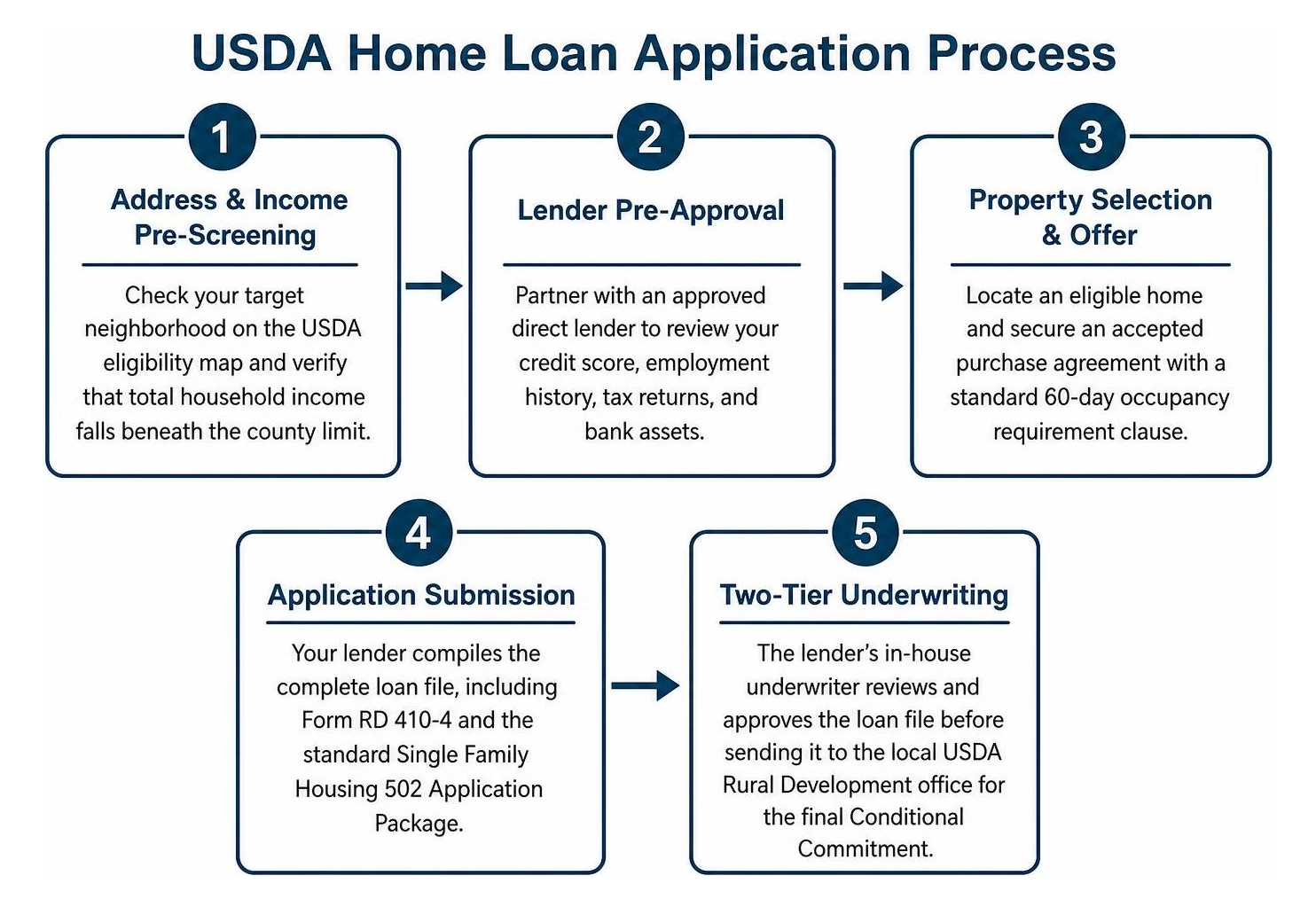
- Address & Income Pre-Screening: Check your target neighborhood on the USDA eligibility map and verify that total household income falls beneath the county limit.
- Lender Pre-Approval: Partner with an approved direct lender to review your credit score, employment history, tax returns, and bank assets.
- Property Selection & Offer: Locate an eligible home and secure an accepted purchase agreement with a standard 60-day occupancy requirement clause.
- Application Submission: Your lender compiles the complete loan file, including Form RD 410-4 and the standard Single Family Housing 502 Application Package.
- Two-Tier Underwriting: The lender’s in-house underwriter reviews and approves the loan file before sending it to the local USDA Rural Development office for the final Conditional Commitment.
- Closing: Once the agency issues the commitment, loan documents are signed, funds disburse, and you receive your keys.
Interest Rates, Guarantee Fees, and Closing Costs
USDA loans feature two mandatory program fees:
- Upfront Guarantee Fee: 1.00% of the total loan amount, which can be financed directly into the loan balance.
- Annual Fee: 0.35% of the remaining principal balance, billed monthly as part of your regular mortgage payment.
Borrowers can negotiate seller concessions up to 6% of the sales price to cover third-party settlement charges, title fees, and property taxes, minimizing out-of-pocket expenses at closing.
Frequently Asked Questions about USDA Loans
Can you refinance an existing mortgage into a USDA home loan?
You can refinance an existing USDA mortgage into a new USDA loan using standard or Streamline Assist refinance programs to lower your interest rate. However, you cannot refinance a conventional or FHA mortgage into a USDA loan.
How long does it take to close on a USDA loan?
A USDA loan typically closes in 30 to 45 days. The timeline includes initial processing and underwriting by your private mortgage lender, followed by a final review by the regional USDA Rural Development office.
Does the USDA offer grants to purchase residential land or farms?
The USDA does not offer residential land purchase grants. Homebuyers seeking to purchase vacant land must do so in conjunction with a single-close construction-to-permanent loan for a primary residence. Agricultural operators and commercial ranchers can explore direct farm credit programs through the Farm Service Agency.
Conclusion
The USDA home loan program remains one of the few zero-down financing options available to modern homebuyers, opening doors to affordable homeownership in qualifying suburban and rural communities. Working with an experienced, approved direct mortgage lender ensures your application moves smoothly through automated underwriting and agency commitment.
To explore current rates, verify county eligibility, or begin your mortgage pre-approval, connect with our lending team at Golden State Mortgage California today.


