
What the 502 Direct Home Loan Program Can Do for Low-Income Homebuyers
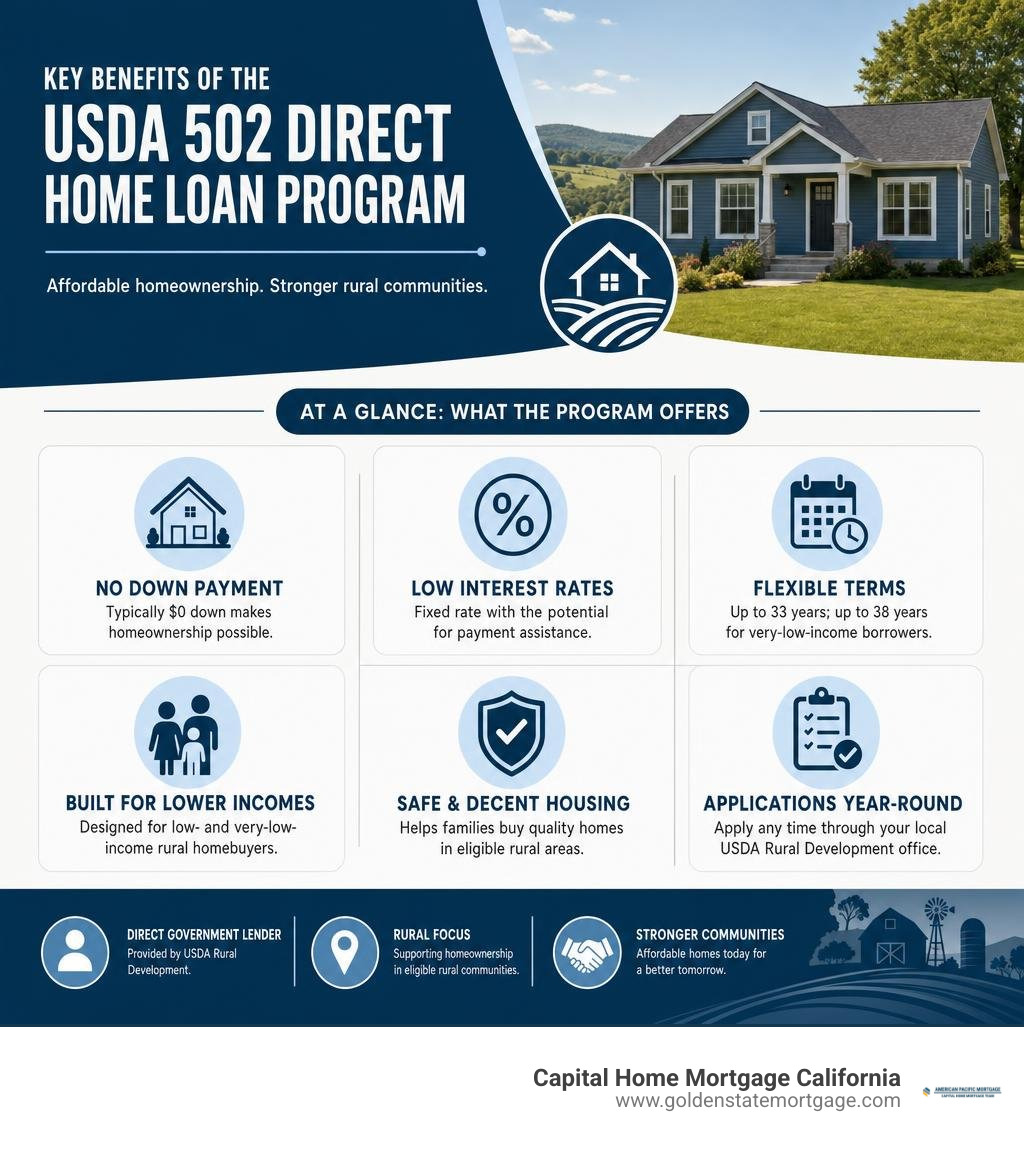
The 502 direct home loan program is a federal mortgage program run by the USDA that helps low- and very-low-income buyers purchase safe, decent housing in eligible rural areas — often with no down payment and interest rates as low as 1%.
Here’s what you need to know at a glance:
| Feature | Details |
|---|---|
| Who runs it | USDA Rural Development (direct government lender) |
| Who it’s for | Low- and very-low-income rural homebuyers |
| Interest rate | Fixed at 5.250% (effective August 1, 2026); can drop to 1% with subsidies |
| Down payment | Typically $0 |
| Loan term | Up to 33 years; up to 38 years for very-low-income borrowers |
| Income limits | Below 80% of Area Median Income (AMI); 50% AMI for very-low-income |
| Application | Year-round through local USDA Rural Development offices |
For millions of Americans, the path to homeownership runs straight through a conventional bank — and straight into a wall. Credit requirements, down payments, and high interest rates put traditional mortgages out of reach for many low-income households, especially in rural communities. The Section 502 Direct Loan Program was designed specifically to close that gap, offering government-backed financing that meets buyers where they are financially.
I’m Dale Gremillion, a Senior Loan Officer and Producing Branch Manager at Capital Home Mortgage California with over 25 years of residential mortgage lending experience, including deep expertise in USDA programs like the 502 direct home loan program. Whether you’re exploring this program for the first time or trying to understand if it’s the right fit, I’ll walk you through everything you need to know.
Understanding the 502 Direct Home Loan Program and How It Works
Authorized under Title V of the Housing Act of 1949 and governed by Federal Code regulations under 7 CFR Part 3550, the 502 direct home loan program provides direct home financing to low- and very-low-income households. Unlike conventional mortgages or private lending programs, this initiative uses direct funding from the federal government to ensure affordable housing is accessible in qualified rural communities.
The program’s overarching mandate is to assist families without decent, safe, and sanitary housing who cannot obtain a standard mortgage from commercial sources on reasonable terms. Through Single Family Housing Direct Home Loans | Rural Development, the federal government provides direct capital alongside payment assistance subsidies that adjust monthly obligations to match what lower-income families can realistically afford.
Who Operates the 502 Direct Home Loan Program?
The Single Family Housing Direct program is operated directly by USDA Rural Development (USDA RD), a specialized agency within the United States Department of Agriculture.
Because it is a direct lending program, the federal government acts as the actual mortgage lender. Funds are allocated annually by Congress under federal budget authorizations running from October 1 through September 30. Applications are submitted to, underwritten by, and serviced through local USDA Rural Development field offices across the country.
Payment Assistance Subsidies and Recapture Provisions
The primary engine driving affordability within the Section 502 Direct framework is payment assistance. Payment assistance is a temporary government subsidy that effectively lowers the borrower’s monthly mortgage payment.
When payment assistance is applied:
- The borrower’s baseline interest rate (currently 5.250% effective August 1, 2026) can be reduced down to an effective floor of 1%.
- The borrower’s required monthly payment for principal, interest, taxes, and insurance (PITI) is set to the higher of:
- 24 percent of the borrower’s adjusted annual household income; or
- Principal and interest (P&I) calculated at a 1 percent interest rate on the USDA loan, plus real estate taxes and homeowners insurance (T&I).
It is important to understand that payment assistance is subject to a statutory subsidy recapture provision. When the borrower eventually sells the property, transfers the title, or no longer occupies the home as their primary residence, all or a portion of the total payment assistance received over the life of the loan must be repaid to the USDA out of the home’s equity. This mechanism ensures that federal assistance serves as a stepping stone to homeownership while recycling taxpayer funds back into the program for future rural buyers.
Borrower and Property Eligibility Guidelines
To qualify for a Section 502 direct loan, both the applicant and the selected property must fulfill strict statutory criteria.
Income Limits and Deduction Calculations
To be eligible, an applicant’s adjusted household income must not exceed the designated “low-income” threshold established for the specific county in which the home is located. Low income is generally defined as income between 50% and 80% of the Area Median Income (AMI), whereas “very low income” falls below 50% of AMI. Statutorily, at least 40 percent of all direct funds appropriated each year must be designated to assist very-low-income families.
To ensure fairness, USDA calculates adjusted annual income by taking gross household income and applying specific legal deductions:
- Dependent Deduction: A flat deduction of $480 for each household member who is 17 years old or younger, a full-time student over 18, or a disabled family member (excluding the primary applicant or spouse).
- Child Care Expenses: Unreimbursed expenses for the care of children 12 and under, enabling a household member to work or pursue higher education.
- Elderly Household Medical Deductions: Unreimbursed medical or disability assistance expenses exceeding 3% of gross annual household income for households where the primary applicant or spouse is 62 years of age or older, or disabled.
The table below outlines the core differences between low-income and very-low-income program categories:
| Threshold Category | Area Median Income (AMI) Level | Extended Repayment Option | Annual Funding Target Allocation |
|---|---|---|---|
| Low-Income | 50% to 80% of local AMI | Up to 33 Years | Up to 60% of appropriated program funds |
| Very-Low-Income | Below 50% of local AMI | Up to 38 Years | Minimum 40% of appropriated program funds |
Beyond income thresholds, applicants must:
- Lack decent, safe, and sanitary housing.
- Demonstrate an inability to obtain commercial credit elsewhere on reasonable terms.
- Be a U.S. citizen, legal permanent resident, or qualified non-citizen.
- Possess the legal capacity to incur loan obligations and demonstrate a willing ability to repay debt.
- Occupy the property as their primary residence.
Eligible Fund Uses for a 502 Direct Home Loan Program
Funds provided through a Section 502 Direct loan can be used for several distinct purposes aimed at securing safe, long-term rural housing:
- Purchasing an existing single-family residence in an eligible rural location.
- Constructing a new modest dwelling on a suitable lot.
- Repairing, renovating, or modernizing an existing home to meet federal health, safety, and energy efficiency guidelines (including International Energy Conservation Code standards).
- Relocating an existing residential dwelling to an eligible site.
- Installing necessary infrastructure, such as site preparation, water connections, and sewage disposal systems.
Properties financed under this program must be modest in design, size, and cost, falling within local Area Loan Limits. Furthermore, the property cannot be designed or used for income-producing activities or farming operations.
Rates, Terms, and Zero Down Payment Financing
The standard fixed interest rate for Single Family Housing Direct home loans is set by USDA based on market conditions and stands at 5.250% (effective August 1, 2026). When modified by monthly payment assistance, this rate drops as low as 1%.
Standard loan features include:
- Zero Down Payment: No down payment is required for most applicants. If an applicant holds non-retirement liquid assets above specified program thresholds, they may be asked to contribute a portion toward closing.
- 33-Year Term: Standard repayment term for low-income buyers.
- 38-Year Extended Term: Eligible very-low-income buyers who cannot afford the monthly payments under a standard 33-year term can have their term extended to 38 years to further lower monthly payments.
- 30-Year Cap for Manufactured Homes: Permanently affixed manufactured housing units meeting Federal Manufactured Home Construction and Safety Standards are limited to a 30-year repayment term.
Program terms provide unmatched flexibility compared to typical commercial lending channels, as reflected in guidelines for state-level operations such as Single Family Housing Direct Home Loans in Texas | Rural Development, Single Family Housing Direct Home Loans in Indiana | Rural Development, Single Family Housing Direct Home Loans in Oregon | Rural Development, and Single Family Housing Direct Home Loans in New Jersey | Rural Development.
How to Apply for a USDA Direct Loan
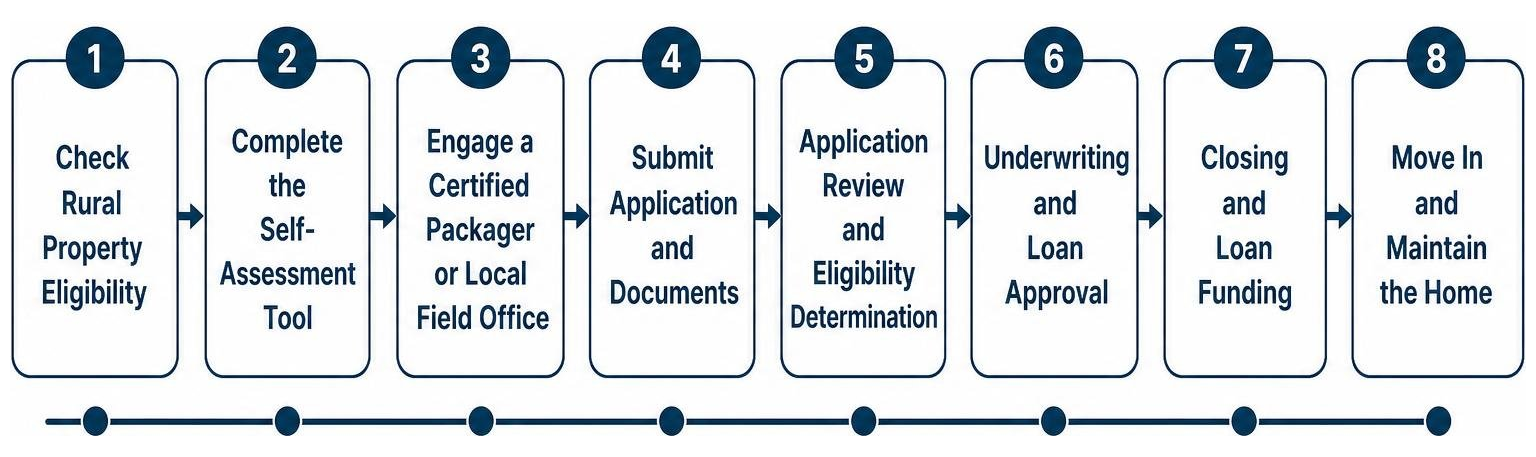
Navigating the application path for a Section 502 Direct loan involves clear procedural steps designed to establish eligibility before formal underwriting begins:
- Check Rural Property Eligibility: Confirm the target address falls within an authorized rural area using the official USDA Income and Property Eligibility web portal.
- Complete the Self-Assessment Tool: Utilize the online Single Family Housing Direct Self-Assessment tool to perform an initial check on household income deductions, debt ratios, and estimated loan amounts.
- Engage a Certified Packager or Local Field Office: Applicants can assemble their application package independently or work with certified loan application packagers and non-profit intermediaries who ensure the file meets HB-1-3550 specifications.
- Review Form RD 3550-23: Review the official Applicant Orientation Guide to understand borrower rights, payment rules, and subsidy recapture terms.
- Submit Application & Await Processing: Applications are accepted year-round on a continuous basis. File processing timeframes vary depending on local USDA staff availability and annual budget releases.
Frequently Asked Questions about Section 502 Direct Loans
What is the difference between direct and guaranteed loans?
While both programs are part of USDA’s housing initiative, they serve different income levels and operate through distinct lending mechanisms:
- Section 502 Direct Loans: The government acts directly as the lender. Target buyers are low- and very-low-income households (income under 80% or 50% of AMI). Payment assistance subsidies are available to buy down interest rates to 1%.
- Section 502 Guaranteed Loans: Private lenders (such as banks and approved mortgage companies) issue the mortgage, while USDA guarantees a portion against default. Target buyers are moderate-income households earning up to 115% of AMI. Subsidies lowering the interest rate to 1% are not available under guaranteed loans.
Historical demographic data highlights these distinct roles: direct loan borrowers have recorded average annual household incomes around $28,600, whereas guaranteed loan recipients average $54,200.
Is there an application deadline for the 502 Direct Loan?
No, there is no single calendar deadline to apply for a 502 direct home loan program mortgage. USDA Rural Development accepts applications on a continuous basis throughout the year. However, because funding is tied to federal appropriations during the fiscal budget cycle (October 1 to September 30), local field offices may experience periodic funding pauses while awaiting new seasonal budget allocations.
Can I use a 502 Direct Loan for income-producing property?
No. Program regulations under 7 CFR Part 3550 strictly prohibit using direct loan funds for properties designed for income-producing activities, commercial operations, or working farm acreage. Properties must be modest single-family residential dwellings occupied exclusively as the borrower’s primary home.
Conclusion
The Section 502 Direct Home Loan Program remains one of the most effective tools for low-income buyers striving to achieve long-term financial stability through homeownership in qualified rural communities. By pairing zero down payment requirements with flexible 33- to 38-year terms and interest rates that can drop to 1% through payment assistance, it removes traditional financial barriers.
At Capital Home Mortgage California, we understand that finding the right loan program can feel overwhelming. If your income or home choice falls outside direct federal limits, or if you want to compare direct government assistance with competitive commercial, government-backed, or non-conforming loan products across California, our experienced lending team is available 7 days a week to guide you home.


