
What a Cash Out Refinance Means for Your Home Equity
A cash out refinance replaces your current mortgage with a larger new loan, pays off the old loan, and gives you the remaining amount in cash at closing.
- Your available cash depends on your home’s value, current mortgage balance, closing costs, and loan program limits.
- Conventional loans generally allow a new loan up to 80% of the home’s value. FHA and VA rules can differ.
- Cash-out rates often run about 0.25% to 0.50% higher than standard rate-and-term refinance rates.
- The cash can be used for many purposes, but using home equity for renovations or high-interest debt may be less risky than using it for short-term spending.
This option can create useful funding from equity, but it also resets your mortgage, adds closing costs that often range from 2% to 5% of the new loan amount, and may replace a low existing rate with a higher one. The right choice depends on the total cost of the new loan, not just the cash you receive or the monthly payment.
I’m Dale Gremillion, a Senior Loan Officer and Producing Branch Manager with more than 25 years of residential lending experience across conventional, FHA, VA, jumbo, reverse, and construction loans. I help California homeowners compare each cash out refinance option in clear, practical terms before moving forward.
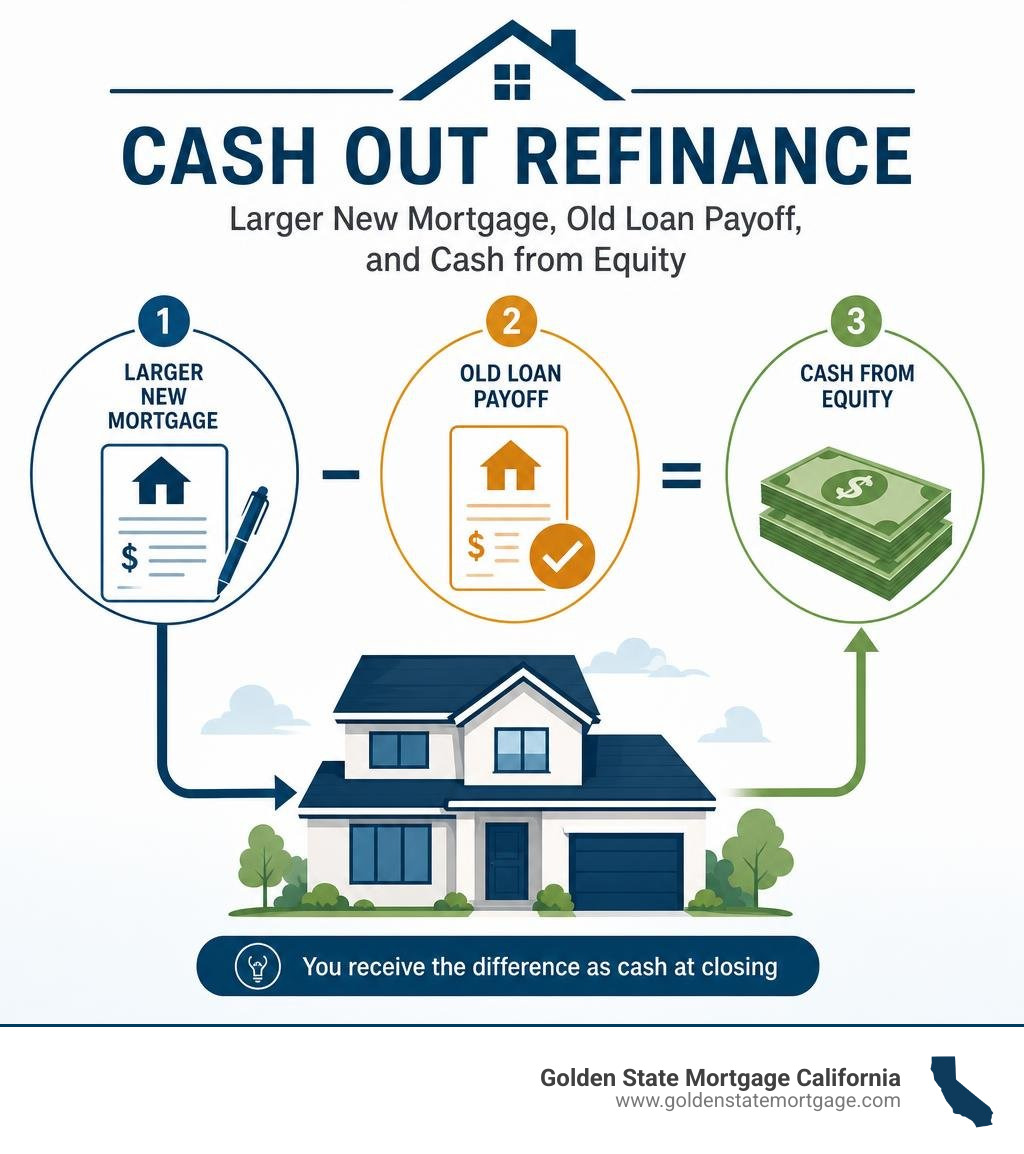
Understanding How a Cash Out Refinance Works
When you undertake a cash out refinance, you are replacing your existing primary mortgage with an entirely new primary mortgage. Unlike taking on a second loan, such as a home equity line of credit (HELOC) or a home equity loan, a cash-out refinance pays off your initial home loan in full. The remaining balance—minus closing fees and escrow setup—is disbursed directly to you in a lump sum at closing.
Because this transaction creates a new first-position lien on your property, mortgage underwriters must evaluate your full financial profile according to standard industry guidelines, such as those set by Fannie Mae, Freddie Mac, the Federal Housing Administration (FHA), or the Department of Veterans Affairs (VA).
Core Eligibility and Fannie Mae Guidelines
Qualifying for a cash out refinance requires meeting specific credit, equity, and underwriting criteria:
- Existing Mortgage Seasoning: Under Fannie Mae guidelines, any existing first mortgage being paid off through a cash-out refinance must be at least 12 months old, measured from note date to note date.
- Title Ownership Tenure: At least one borrower must have been on title to the property for a minimum of six months prior to the disbursement date, unless a specific legal or guideline exception applies.
- Credit Score & Debt-to-Income (DTI): Most conventional programs require a minimum credit score of 620, though higher scores yield significantly lower interest rates. While DTI caps generally range between 43% and 45%, Desktop Underwriter (DU) loan casefiles with a DTI ratio exceeding 45% require at least six months of verified financial reserves.
- Property Market Listing Restrictions: If your home was recently listed for sale, it must be officially taken off the market on or before the disbursement date of the new loan.
When evaluating how to utilize your proceeds, underwriting guidelines draw clear boundaries regarding acceptable and ineligible uses.
Acceptable Uses for Cash-Out Proceeds:
- Extracting home equity for discretionary cash funds or personal reserves
- Paying off existing first mortgages and subordinate liens
- Consolidating high-interest credit card debt, personal loans, or medical balances
- Funding value-adding home repairs, capital improvements, or remodels
- Remitting proceeds directly to student loan servicers to eliminate educational debt
Ineligible Uses and Transactions:
- Attempting to refinance property subject to temporary interest rate buydowns
- Rolling unpaid Property Assessed Clean Energy (PACE) loans into the refinance when property equity is insufficient
- Utilizing cash-out refinancing to pay off installment land contracts
If you are paying off educational debt, Fannie Mae offers a student loan cash-out refinance exception. By remitting proceeds directly to the student loan servicer at closing, the standard Loan-Level Price Adjustment (LLPA) surcharge is waived. In these cases, cash back paid directly to the borrower cannot exceed the greater of 1% of the new loan balance or $2,000.
Delayed Financing Exception and Ownership Rules
Under standard guidelines, homeowners must own a property for six months before refinancing to extract equity. However, the delayed financing exception allows buyers who purchased a property with cash or liquid assets—without taking on mortgage debt—to execute a cash out refinance immediately without waiting out the six-month tenure rule.

To qualify for delayed financing, you must provide clear documentation showing:
- An arms-length purchase transaction backed by a recorded trustee deed or settlement statement.
- The exact liquid asset sources (bank statements, investment accounts) used to purchase the home.
- Proof that no prior mortgage financing was used to acquire the property.
Other notable title exceptions permit immediate cash-out refinancing before six months of ownership, including properties acquired through inheritance or legal divorce settlements. Additionally, ownership continuity is preserved if a property was held under an LLC or an inter vivos revocable trust, provided the borrower maintains majority ownership or primary beneficiary status.
Comparing Loan-to-Value Limits and Interest Rates
Your total cash payout is primarily dictated by your property’s Loan-to-Value (LTV) cap. LTV represents the percentage of your home’s appraised value that a lender is willing to finance.
Maximum LTV Limits Across Mortgage Programs
LTV caps vary based on the loan program and the occupancy type of the property:
- Conventional Mortgages: Capped at a maximum of 80% LTV for primary single-family residences.
- FHA Loans: Allow up to 85% LTV for primary residence cash-out transactions.
- VA Loans: Allow eligible veterans and service members to access up to 100% of their home’s appraised value.
- Investment Properties: Conventional cash-out refinances on investment properties are restricted to 70%–75% LTV, carry higher credit score thresholds (typically 680+), and require 6 to 12 months of post-closing financial reserves.
The True Cost of Cash Out Refinance Interest Rates
Lenders view cash-out transactions as higher risk than simple rate-and-term refinances because you are increasing your overall principal balance. As a result, cash-out borrowers face a rate premium, typically paying interest rates between 0.25% and 0.50% higher than standard refinance products due to Loan-Level Price Adjustments (LLPAs).
Data indicates that in 2025, 78.7% of all refinancers paid above the most competitive rate available for their credit profile, resulting in an average overpayment of $2,462 annually. This rate penalty was even higher for VA borrowers, with 81% overpaying on cash-out refinances due to a lack of rate comparison. Reviewing Current Cash-Out Refinance Rates and evaluating diverse Mortgage Programs helps ensure you do not overpay for your loan.
Closing costs for a cash-out refinance generally range between 2% and 5% of your total loan balance. These costs cover origination fees, home appraisals, title insurance, and escrow reserves.
Evaluating Cash-Out Equity Options vs. HELOCs and Home Equity Loans
A cash out refinance is not the only mechanism for accessing built-up equity. Second-lien products allow you to borrow against your home without disturbing your primary mortgage.
Second Liens vs. Primary Mortgage Replacement
- Home Equity Line of Credit (HELOC): A variable-rate second mortgage that functions like a credit card secured by your home. You draw funds as needed during an initial draw period (typically 10 years) and pay interest only on what you borrow before entering a principal-and-interest repayment period.
- Home Equity Loan: A second mortgage that provides a lump-sum payout at a fixed interest rate with fixed monthly payments over a 5- to 30-year term.
- Cash-Out Refinance: A replacement of your first mortgage with a new, larger loan at a single fixed or adjustable rate.
Because a cash-out refinance acts as a primary first mortgage, lenders hold lower default risk than second-position liens. Consequently, first-mortgage cash-out interest rates are generally lower than HELOC or home equity loan rates. However, if your existing first mortgage holds a historically low interest rate (for example, below 5%), replacing the entire balance with a higher current market rate can be far more expensive overall than taking out a smaller, higher-rate second lien.
Choosing the Right Option for Your Cash Out Refinance
To determine whether a cash-out refinance or a secondary lien makes financial sense, evaluate your rate preservation options and calculate your break-even point.
In 2025, 64% of cash-out refinance volume was used for debt consolidation or home improvement projects. The table below outlines how these options compare:
| Loan Option | Interest Rate Structure | Lien Position | Ideal Usage Scenario | Primary Advantage | Key Risk Factor |
|---|---|---|---|---|---|
| Cash-Out Refinance | Fixed or Adjustable (Single Loan) | First Lien | Replacing entire loan balance when market rates are favorable; major long-term renovations | Single monthly payment; lower rate than second liens | Resets amortization schedule; higher closing costs |
| HELOC | Variable Rate | Second Lien | Ongoing expenses; emergency reserves; phased home remodels | Flexible drawing; only pay interest on drawn cash | Rate can increase over time; variable payments |
| Home Equity Loan | Fixed Rate | Second Lien | One-time fixed expenditure when preserving a low primary mortgage rate | Preserves low first-mortgage rate; fixed monthly cost | Second higher monthly payment; shorter repayment term |
For more deep dives into structured borrowing, explore our Mortgage Education resources.
Hidden Costs, 2026 Tax Rules, and Strategic Timing
Hidden Risks: Amortization Resets and Debt Recidivism
Beyond closing fees and rate surcharges, a cash out refinance introduces two major financial risks:
- The Amortization Reset Problem: Refinancing into a new 30-year term resets your loan schedule back to month one. During the early years of a mortgage, approximately 70% to 75% of your monthly payment goes toward interest rather than principal reduction. Even if your new interest rate looks comparable, restarting the 30-year clock can add tens of thousands of dollars in long-term interest costs over the life of the loan. Choosing a shorter term, such as 15 or 20 years, helps mitigate this reset risk.
- Debt Recidivism: Industry metrics show that 29% of borrowers who consolidate high-interest credit card debt into a mortgage accumulate equal or higher credit card balances within three years. Replacing unsecured credit card debt with a loan secured by your home converts non-collateralized liabilities into a lien against your property, raising your risk of foreclosure if future financial hardships occur.
IRS Guidelines and Smart Equity Uses
Under IRS Publication 936, the tax rules governing cash-out refinances remain strict. Interest on cash-out proceeds is deductible only if the funds are used exclusively to buy, build, or substantially improve the primary residence securing the loan, up to a total debt threshold of $750,000.
If you use cash-out proceeds to consolidate debt, buy a vehicle, pay college tuition, or cover personal expenses, that portion of the interest is non-deductible. Always keep detailed receipts, contracts, and payment records for any capital improvement project to support tax deductions. To verify your math before applying, run a Cash-Out Refinance Calculator to confirm your net cash disburse and break-even point, and browse our Homeowner Resources.
Frequently Asked Questions About Extracting Home Equity
What is the maximum LTV limit for extracting home equity?
Maximum LTV limits depend on the loan program governing your refinance:
- Conventional Loans: 80% LTV maximum for primary residences; 70%–75% LTV for investment properties.
- FHA Loans: 85% LTV maximum for primary residences.
- VA Loans: Up to 100% LTV for eligible veteran borrowers.
How long does the refinancing process take to close?
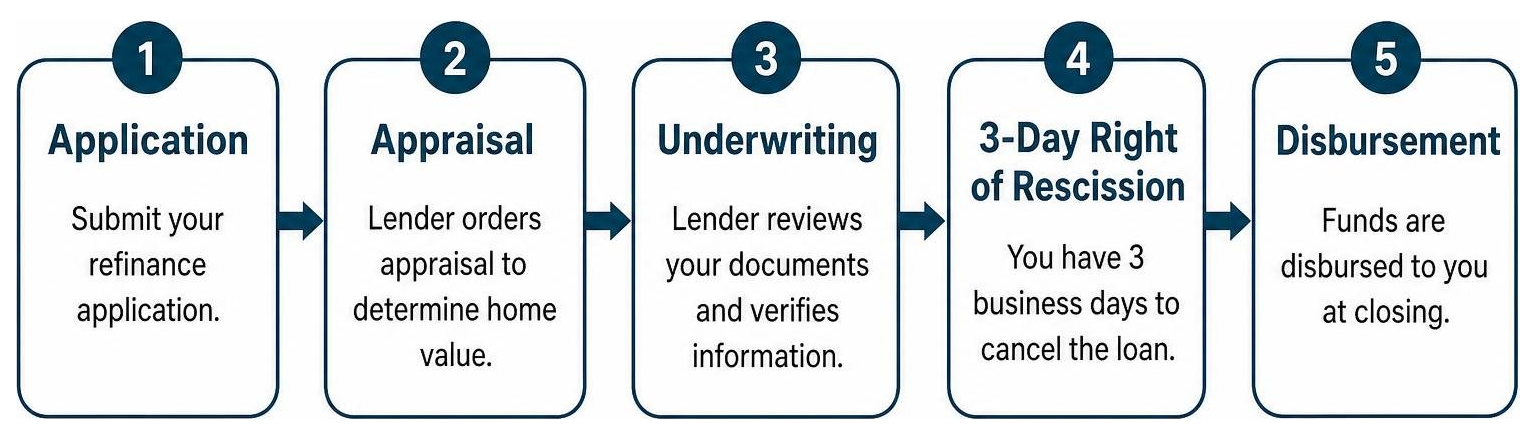
The standard cash-out refinance process takes between 30 and 45 days from application to closing. Once final loan documents are signed, federal law enforces a mandatory 3-day right of rescission period for primary residences. This cooling-off window gives you three business days to cancel the loan before funds are officially disbursed.
Is interest on equity proceeds tax-deductible in 2026?
Yes, but only for funds used to buy, build, or substantially improve the home securing the mortgage under IRS Publication 936. Capital improvements must add capital value, prolong the property’s life, or adapt it to new uses (such as room additions, roof replacements, or kitchen remodels). Proceeds used for personal expenses or debt consolidation are not tax-deductible.
Conclusion
A cash out refinance offers a practical structure for converting built-up equity into working capital for home additions, major repairs, or high-interest debt consolidation. However, extracting home equity requires balancing upfront closing fees, loan-level price adjustments, and potential amortization resets against your overall financial goals.
At Golden State Mortgage California, we guide homeowners across California through clear cost comparisons to secure optimal loan terms tailored to their financial objectives. Contact Golden State Mortgage today to evaluate your equity, compare loan options, and review current cash-out refinance structures.


