
Buy a Fixer-Upper With an FHA Loan in California
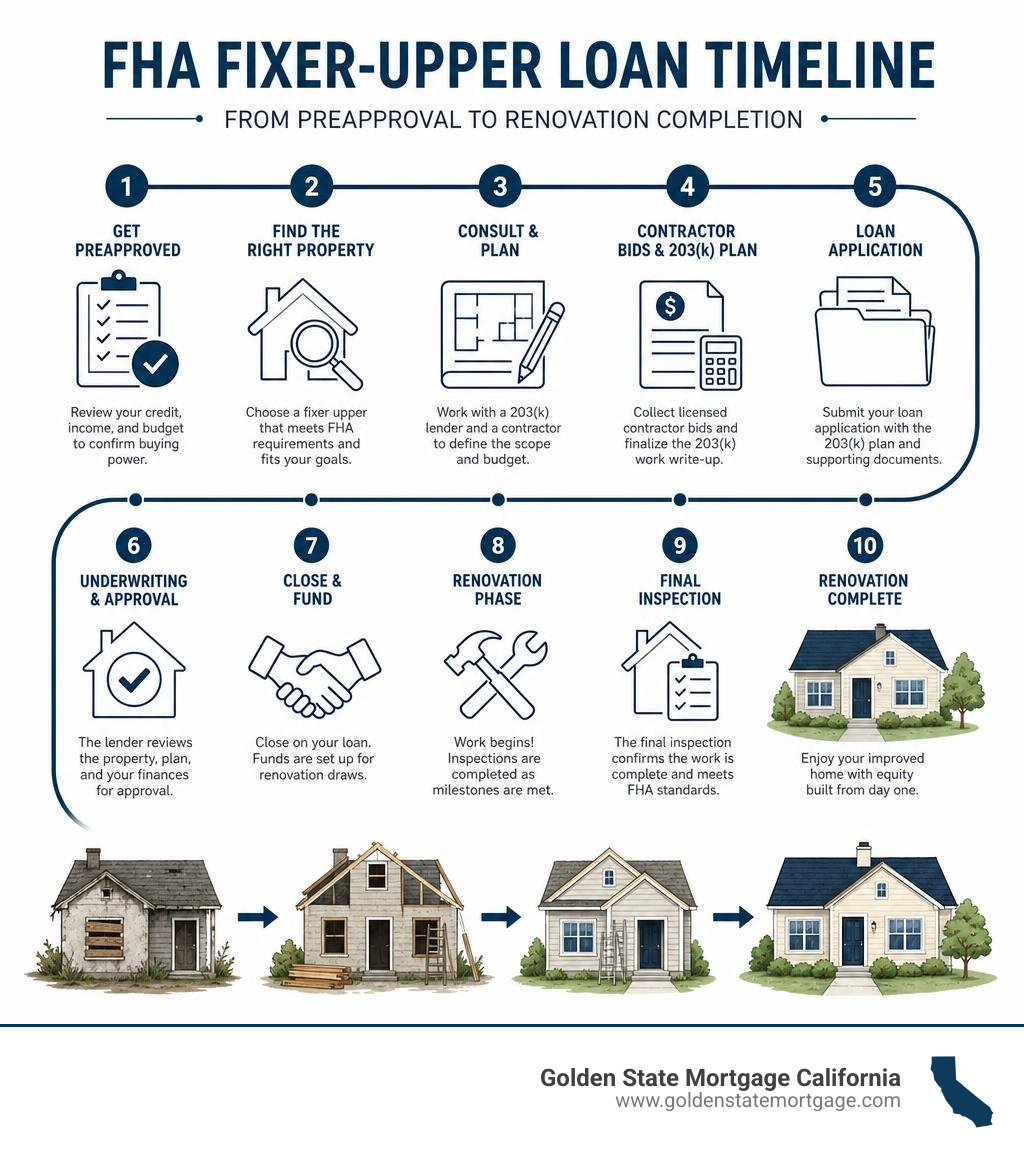
Buying a fixer upper with FHA loan financing is possible through an FHA 203(k) rehabilitation mortgage. It lets eligible owner-occupant buyers combine the home’s purchase price and approved repair costs into one loan. To get started, choose a lender that offers 203(k) loans, get a detailed inspection, collect licensed contractor bids, and confirm the total project fits within local FHA loan limits.
For many buyers, the appeal is clear: a dated or damaged home may cost less than a move-in-ready property in the same neighborhood. With qualifying credit, FHA financing can require as little as 3.5% down. The loan is based partly on the home’s expected value after the approved work is complete, not only its current condition.
This is not a shortcut around renovation risk. FHA 203(k) loans require more planning, paperwork, contractor oversight, and time than a standard FHA mortgage. But they can provide one structured way to fund needed work such as roofing, HVAC, plumbing, electrical repairs, flooring, kitchens, and bathrooms without relying on a separate personal loan or draining savings after closing.
I am Dale Gremillion, a Senior Loan Officer and Producing Branch Manager with more than 25 years of residential lending experience across FHA, conventional, VA, USDA, jumbo, reverse, and construction financing. I help California buyers understand the moving parts of buying a fixer upper with FHA loan financing so they can choose a realistic path from offer to completed home.
Understanding the FHA 203(k) Rehabilitation Mortgage Program

When you tour an older California property with cracked tile, peeling paint, or a failing HVAC unit, a standard purchase mortgage won’t work. The Federal Housing Administration (FHA) enforces strict Minimum Property Standards (MPS). If a home has safety, security, or structural deficiencies, a standard FHA 203(b) mortgage will stall until the seller makes necessary repairs before closing—something bank owners and distressed sellers rarely agree to do.
This is where the Federal Housing Administration’s Section 203(k) program steps in. The HUD 203(k) framework solves the habitability dilemma by bundling two financial transactions into one primary mortgage. It covers the purchase price of the real estate plus the budgeted costs of rehabilitation.
Instead of handing the renovation capital directly to the borrower at closing, the lender places the repair funds into an interest-bearing rehabilitation escrow account. These funds are disbursed to licensed contractors in structured stages as specific milestones pass inspection. For California buyers searching for high-upside properties in Los Angeles, San Diego, San Francisco, or Sacramento, exploring established guidelines for FHA purchase options and specialized renovation loans creates opportunities to build forced equity in neighborhoods that might otherwise be unaffordable.
Limited 203(k) vs. Standard 203(k): Choosing the Right Structure
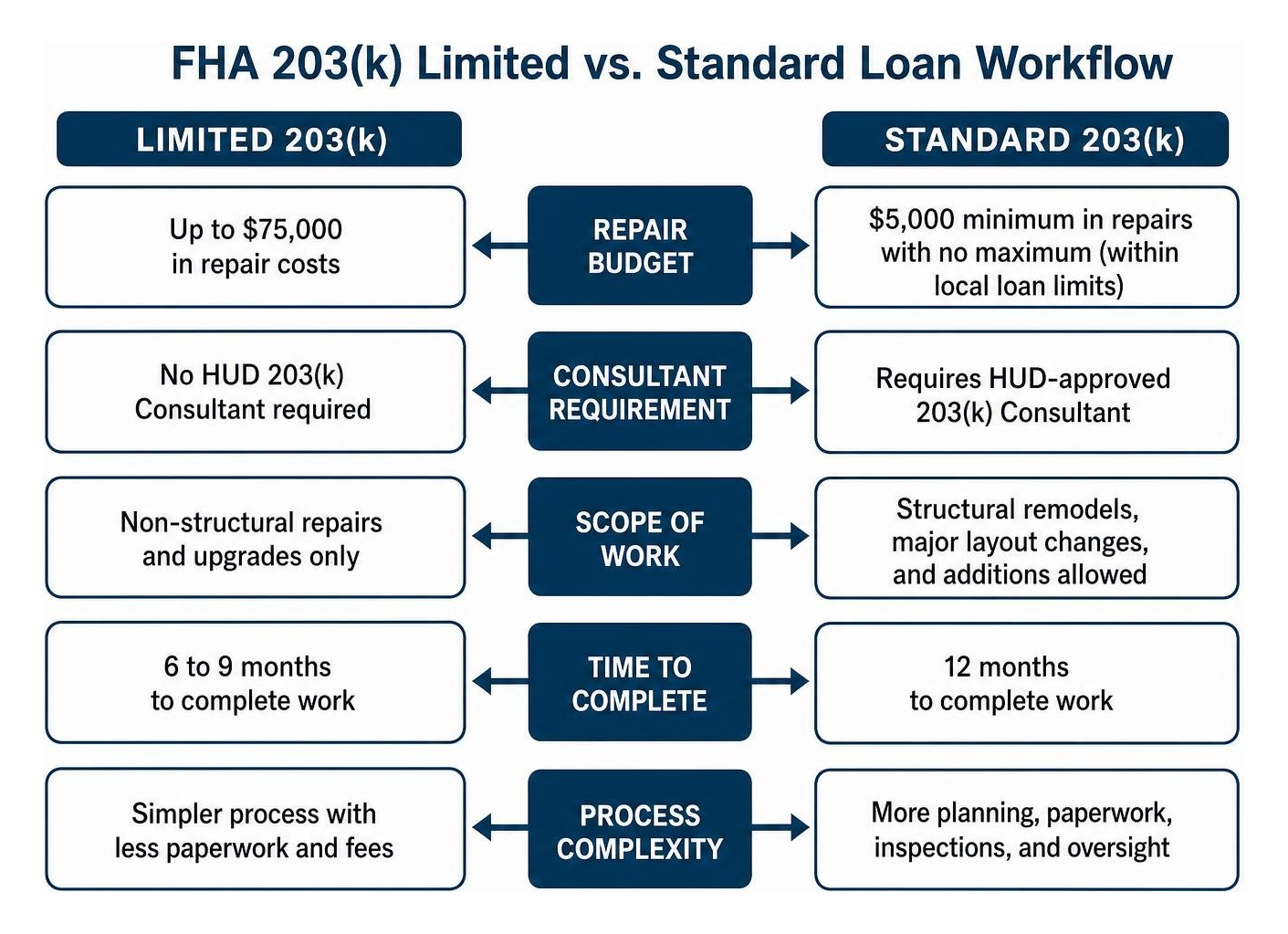
The FHA 203(k) program is split into two tracks: the Limited 203(k) and the Standard 203(k). Understanding the operational differences between these options is essential before writing a purchase offer.
- Limited 203(k): Designed for minor remodeling and non-structural upgrades. HUD allows repair budgets up to $75,000. This program does not require the mandatory involvement of an independent HUD 203(k) Consultant, which streamlines the paperwork, shortens closing windows, and reduces upfront processing fees. The work must be non-structural (no moving load-bearing walls or room additions) and completed within 6 to 9 months post-closing.
- Standard 203(k): Reserved for extensive structural remodeling, major layout alterations, home additions, or homes requiring a minimum of $5,000 in repairs with no maximum dollar cap (up to local county loan limits). The Standard 203(k) requires a designated HUD-approved 203(k) Consultant. This specialist inspects the site, writes a formal Work Write-Up and cost specification package, manages contractor draw inspections, and oversees the 12-month construction window.
Eligible Renovations and Excluded Luxury Additions
The FHA 203(k) loan is designed to make properties safe, modern, and energy-efficient. It covers a wide scope of residential improvements:
- Structural and System Upgrades: Roof replacements, structural alterations, chimney repairs, and foundation stabilization.
- Mechanical Systems: Complete electrical rewiring, plumbing re-piping, and HVAC installation.
- Modernization & Aesthetics: Full kitchen and bathroom remodels, drywall replacement, flooring, interior/exterior painting, and new siding.
- Health & Safety Improvements: Lead-based paint abatement, mold remediation, and subfloor rebuilding.
- Accessibility & Efficiency: ADA-compliant modifications, storm windows, thermal insulation, and energy-efficient solar water heaters.
Excluded Luxury Additions: HUD rules explicitly forbid using 203(k) escrow funds for purely recreational or luxury additions. You cannot finance the construction of a new in-ground swimming pool, hot tub, tennis court, exterior fire pit, or outdoor kitchen. However, if a property has an existing, non-functioning swimming pool that poses a safety hazard, funds may be used to repair or permanently fill it.
The Strategic Process of Buying a Fixer Upper with FHA Loan Financing

Securing a renovation mortgage requires coordination across multiple parties: the buyer, loan officer, real estate agent, general contractor, and appraiser.
Eligibility and Minimum Requirements for Buying a Fixer Upper with FHA Loan Programs
Qualifying for an FHA 203(k) loan follows the fundamental financial benchmarks of the broader FHA lending framework:
- Down Payment: A minimum down payment of 3.5% of the total acquisition cost (purchase price + renovation budget) for borrowers with a credit score of 580 or higher. For credit scores between 500 and 579, HUD requires a 10% down payment.
- Debt-to-Income (DTI) Ratios: The baseline qualifying debt-to-income ratio is typically capped around 43%, though it may be approved up to 45% or higher with strong compensating factors like verified cash reserves.
- Mortgage Insurance Premiums (MIP): Like all standard FHA financing, 203(k) loans require an Upfront Mortgage Insurance Premium (UFMIP) of 1.75% of the base loan amount (which can be financed into the mortgage), along with an annual MIP (typically 0.55% for 30-year terms) paid monthly.
- Primary Residence Mandate: The property must serve as the borrower’s primary residence. Pure real estate investors cannot use the FHA 203(k) program to flip properties. However, buyers can use the loan on 2-to-4 unit multi-family properties, living in one unit while renting the remaining units out to offset mortgage obligations.
If you are just beginning your home-buying journey, learning about available resources for first-time home buyers and reviewing our broader selection of mortgage programs will help you determine your total purchasing capacity.
Appraisal Mechanics: Assessing the After-Repair Value (ARV)
A key advantage of the FHA 203(k) is the appraisal methodology. In standard home purchases, an appraiser evaluates the property strictly in its as-is condition. For an uninhabitable fixer-upper, an as-is appraisal could come in well below the contract price or fail FHA safety standards entirely.
Under the 203(k) program, the appraiser reviews:
- The purchase contract.
- The detailed contractor bid package and architectural specifications.
- The HUD consultant’s official work write-up (for Standard 203k loans).
The appraiser then calculates the home’s projected After-Repair Value (ARV) based on comparable sales of updated homes in the immediate neighborhood. The maximum loan amount is calculated based on the lesser of:
- The purchase price plus actual renovation costs (including fees and contingency reserves).
- 110% of the After-Repair Value.
For California borrowers, loans are subject to local FHA county limits. For 2026, single-family FHA loan limits range from baseline low-cost regions up to the high-cost ceiling of $1,249,125 in major metropolitan areas such as Los Angeles, Orange County, San Francisco, and San Jose.
Managing Escrow Draws, Contractor Milestones, and Financed Payments
Once the loan closes, repair funds are held in escrow and managed under strict draw rules:
- Contingency Reserves: Lenders add a mandatory 10% to 20% contingency reserve to the renovation budget. This reserve acts as a safety buffer for unexpected costs discovered during demolition, like hidden water damage or outdated knob-and-tube wiring. Unused contingency funds are applied to the principal balance once work is completed.
- Disbursement Draws: For Limited 203(k) loans, the lender may disburse 50% of the material costs upfront, with the remaining 50% paid upon final completion and inspection. For Standard 203(k) loans, funds are disbursed in up to five separate draws tied directly to physical inspections.
- Financing Monthly Mortgage Payments: If a major Standard 203(k) renovation makes the home completely uninhabitable during construction, borrowers can finance up to six months of monthly mortgage payments (Principal, Interest, Taxes, and Insurance – PITI) directly into the total loan amount. This keeps you from paying both rent and a mortgage simultaneously while work is underway.
FHA 203(k) vs. Conventional Renovation Financing Options
While the FHA 203(k) loan is one of the most accessible renovation loans available, it is not the only product on the market. Conventional programs like the Fannie Mae HomeStyle Renovation and Freddie Mac CHOICERenovation loans offer alternative structures for buyers with higher credit scores. Existing homeowners might also consider how to cash out your home equity to build your dream space as an alternative financing strategy.
| Loan Feature | FHA 203(k) Rehabilitation | Fannie Mae HomeStyle | Freddie Mac CHOICERenovation |
|---|---|---|---|
| Minimum Down Payment | 3.5% (Credit Score ≥ 580) | 3% – 5% (Primary Residence) | 3% – 5% (Primary Residence) |
| Minimum Credit Score | 580 (500 with 10% down) | 620 – 680 | 620 – 660 |
| Maximum Renovation Amount | Up to County Loan Limit | Up to 75% of As-Completed Value | Up to 75% of As-Completed Value |
| Eligible Properties | 1-4 Units, Primary Residence | 1-4 Units, Second Homes, Investors | 1-4 Units, Second Homes, Investors |
| Luxury Upgrades Allowed? | No (No pools, outdoor kitchens) | Yes (Pools, landscaping, ADUs) | Yes (Pools, luxury additions) |
| Mortgage Insurance | Upfront MIP (1.75%) + Monthly MIP | Standard PMI (Cancellable at 20% equity) | Standard PMI (Cancellable at 20% equity) |
| Consultant Required? | Yes, for Standard 203(k) (>$75k) | Lender Discretion / Large Projects | Lender Discretion / Large Projects |
Key Risks and Smart Precautions When Buying a Fixer Upper with FHA Loan Escrows
Financing a fixer-upper requires careful management. Here are the main risks and how to avoid them:
- Strict DIY Restrictions: The FHA 203(k) program does not permit sweat equity or unverified DIY labor. All work must be performed by licensed, insured, and bonded general contractors who can supply verifiable references, W-9s, and detailed line-item cost estimates.
- Timeline Extensions: Renovation projects often encounter unexpected permit delays or supply chain backlogs. While HUD requires work to begin within 30 days of closing and wrap up within 6 to 12 months, unexpected delays must be communicated immediately to the lender to avoid frozen escrow accounts.
- Contractor Cash Flow Friction: Because 203(k) escrow funds are released in arrears after verified draw inspections, contractors must have sufficient working capital to buy initial materials and pay sub-crews. Make sure your general contractor has reviewed and agreed to FHA draw schedules before signing contracts.
Frequently Asked Questions About FHA Fixer-Upper Loans
Can I do the renovation work myself with an FHA 203(k) loan?
In almost all circumstances, no. FHA 203(k) guidelines require all proposed repairs and renovations to be completed by licensed, insured, and background-vetted contractors. In rare cases where an applicant is a licensed general contractor by trade, lenders may consider permitting self-contracted work for actual material costs only—labor costs cannot be paid to the borrower.
What happens if the renovation costs exceed the original budget?
To protect buyers from unexpected cost overruns, FHA 203(k) loans include a built-in 10% to 20% contingency reserve within the financed escrow balance. If unexpected structural, electrical, or plumbing issues arise after demolition, the contractor and borrower submit a formal Change Order request to the lender to draw funds from this contingency reserve.
How long does it take to close and complete renovations on an FHA fixer-upper?
Due to the additional documentation required—including detailed contractor bids, specialized appraisals, and HUD consultant write-ups—closing an FHA 203(k) loan typically takes 45 to 60 days, compared to 30 days for a standard mortgage. After closing, work must start within 30 days and be finished within 6 months for a Limited 203(k) or up to 12 months for a Standard 203(k).
Conclusion
Buying a fixer-upper with an FHA loan is a proven way to bypass bidding wars on move-in-ready properties and build meaningful equity. By combining your purchase and renovation costs into a single mortgage with just 3.5% down, you can turn an outdated house into a customized home designed to your tastes.
Navigating contractor draw schedules, as-completed appraisals, and FHA guidelines requires a direct lender with deep renovation loan experience. At Golden State Mortgage, our team provides in-house processing, dedicated 7-day-a-week support, and personalized guidance to help California buyers across Los Angeles, San Diego, San Jose, San Francisco, Sacramento, and beyond finance and complete their fixer-upper projects smoothly. Reach out today to explore your options.


