
Equity Loans for Home Improvements: Turn Your Home’s Value Into Your Dream Space
Using an equity loan for home improvements is one of the most cost-effective ways California homeowners can fund a renovation — without selling, moving, or draining savings.
Here’s a quick overview of what you need to know:
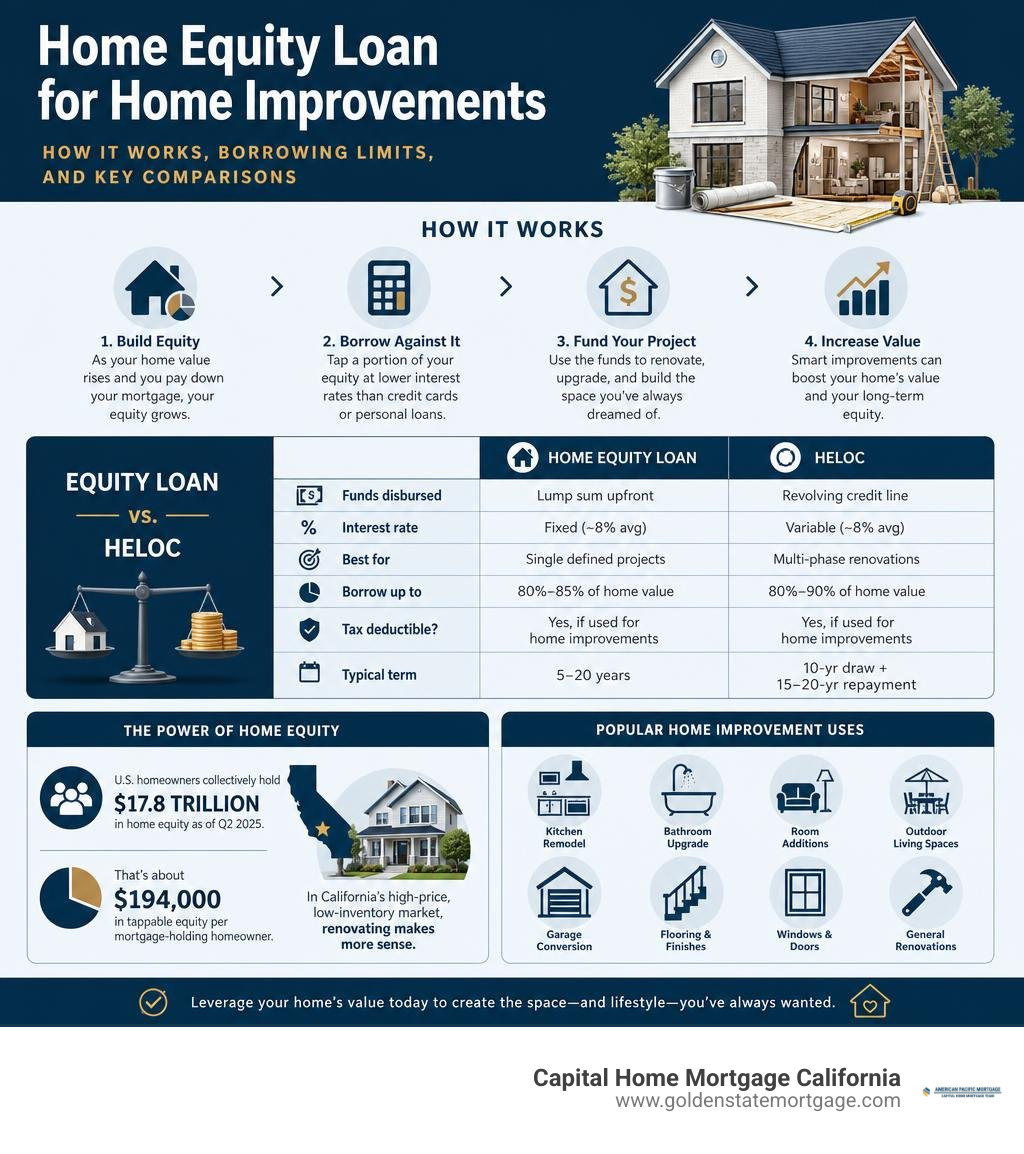
| Feature | Home Equity Loan | HELOC |
|---|---|---|
| Funds disbursed | Lump sum upfront | Revolving credit line |
| Interest rate | Fixed (~8% avg) | Variable (~8% avg) |
| Best for | Single defined projects | Multi-phase renovations |
| Borrow up to | 80%–85% of home value | 80%–90% of home value |
| Tax deductible? | Yes, if used for home improvements | Yes, if used for home improvements |
| Typical term | 5–20 years | 10-yr draw + 15–20-yr repayment |
The core idea is simple: you’ve built equity in your home, and you can borrow against it at much lower interest rates than credit cards or personal loans. With U.S. homeowners collectively holding $17.8 trillion in home equity as of Q2 2025 — averaging about $194,000 in tappable equity per mortgage-holding homeowner — there’s real borrowing power sitting in the walls around you.
And in California’s high-price, low-inventory market, many homeowners are choosing to renovate instead of relocate. That makes understanding your equity financing options more important than ever.
I’m Dale Gremillion, Senior Loan Officer and Producing Branch Manager at Capital Home Mortgage California, with over 25 years of experience in residential mortgage lending. I’ve helped hundreds of California homeowners navigate the equity loan for home improvements process — from calculating tappable equity to closing the right loan for the right project. In the sections below, I’ll walk you through everything you need to make a confident, informed decision.
Understanding How Home Equity Financing Works for Remodeling
Before diving into contractor quotes and material samples, it helps to understand the financial engine behind your project. At its basic core, equity is the difference between what your property is worth on the market today and what you still owe on your mortgage.
When home prices rise, your equity grows automatically. Over recent years, California real estate has seen significant appreciation across major metros from Los Angeles and San Diego to San Jose, San Francisco, and Sacramento. To stay updated on how home values affect your equity position, check out What’s Happening with California Real Estate Prices in 2025?.
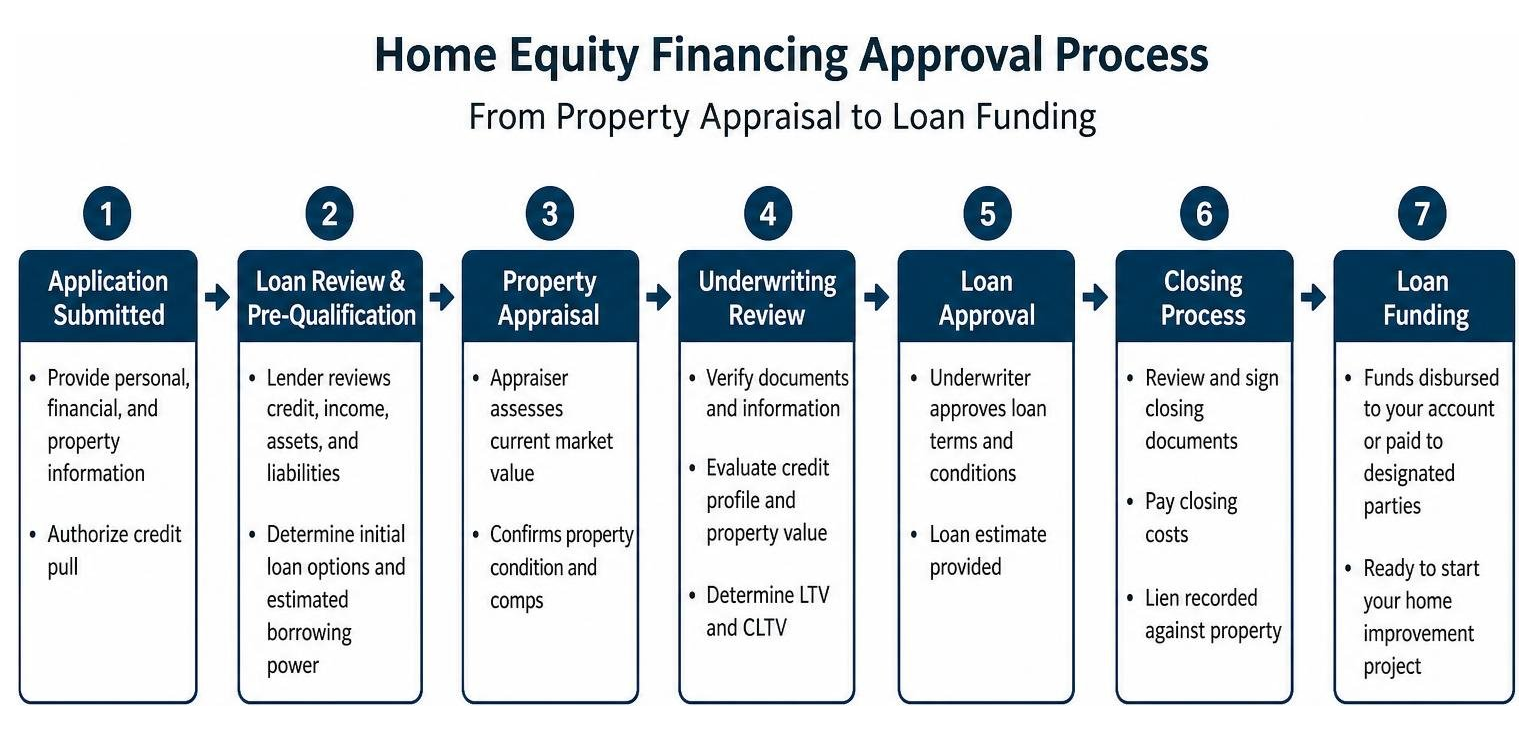
When you apply for equity financing, lenders look at your property’s total value, your current mortgage balance, and your credit profile to establish two key metrics: Loan-to-Value (LTV) and Combined Loan-to-Value (CLTV).
Calculating Your Available Tappable Equity
While your total home equity might sound like a massive number, lenders require you to keep an equity cushion (usually 15% to 20% of your home’s value) untouched. The remaining amount you can actually access is called your tappable equity.
To calculate your tappable equity, use this simple formula:
- Take your home’s current estimated fair market value.
- Multiply that value by the maximum allowed Combined Loan-to-Value limit (typically 80% to 85%).
- Subtract your current outstanding primary mortgage balance.
For instance, if your property in Irvine or Riverside appraises for $800,000 and your mortgage balance is $450,000:
- 80% of Appraised Value: $800,000 × 0.80 = $640,000
- Minus Existing Mortgage: $640,000 – $450,000 = $190,000 in Tappable Equity
This $190,000 represents the total maximum amount you could secure with an equity loan for home improvements.
Borrowing Limits and Loan-to-Value (LTV) Caps
While standard limits cap total combined debt at 80% to 85% CLTV, select loan programs allow up to 90% CLTV for borrowers with strong credit scores (typically 740+) and low Debt-to-Income (DTI) ratios.
Your ultimate borrowing limit depends on several underwriting factors:
- Credit Score Tiers: Higher credit scores unlock lower interest rates and higher CLTV allowances.
- Debt-to-Income (DTI) Ratio: Most lenders require your total monthly debt obligations (including the new equity loan) to stay at or below 43% of your gross monthly income.
- Property Valuation: A professional home appraisal establishes the definitive market value used in all calculations.
- Loan Limits: Equity borrowing lines and second mortgages can range anywhere from $10,000 up to $500,000 or more depending on property backing and income.
Choosing the Right Equity Loan for Home Improvements
Selecting the right second mortgage structure is essential to keeping your home project on budget. There are two primary ways to access home equity without refinancing your existing primary mortgage: a fixed-rate home equity loan and a variable-rate Home Equity Line of Credit (HELOC).
| Loan Feature | Fixed Home Equity Loan | HELOC | Unsecured Credit Card |
|---|---|---|---|
| Disbursement | Single Lump Sum | Revolving Access | On-Demand Credit |
| Interest Type | Fixed APR | Variable (Prime + Margin) | Variable High APR |
| Average APR | ~7.3% – 8.5% | ~7.0% – 8.5% | ~19.98% |
| Repayment Term | 5 to 20 Years | 10-Yr Draw / 15-20-Yr Repay | Revolving |
| Collateral | Primary Residence | Primary Residence | None |
Why Choose a Fixed Home Equity Loan for Home Improvements?
A traditional home equity loan delivers your capital in a single lump sum right at closing. It carries a fixed interest rate, which guarantees that your monthly payment will remain identical for the entire life of the loan — whether your term is 5, 10, 15, or 20 years.
This structure works best when you have a clear, precise contractor quote for a single defined project, such as installing a brand-new roof, expanding a master suite, or remodeling a kitchen. Because the interest rate is locked, you never have to worry about shifting market rates raising your monthly expenses halfway through your loan term. For a complete look at funding options, review this helpful Financing options guide.
Evaluating HELOC vs. Equity Loan for Home Improvements
A Home Equity Line of Credit (HELOC) functions more like a high-limit credit card backed by your home’s value. Instead of taking all the money at once, you receive an open line of credit for a set timeframe — usually a 10-year “draw period.” During this draw period, you can borrow, pay down, and re-borrow money as needed, often paying interest only on the exact funds you have drawn.
Once the 10-year draw period ends, the line freezes and converts into a 15- to 20-year principal and interest repayment period.
HELOCs are ideal for:
- Multi-phase remodeling projects spanning several months or years.
- Homeowners managing unexpected repair costs or scope changes.
- DIY renovators who purchase materials incrementally over time.
Because HELOC interest rates are variable and tied to the Wall Street Journal Prime Rate, monthly payments can fluctuate over time based on macroeconomic interest rate moves.
Maximize Your Renovation ROI and Tax Advantages

When you take out an equity loan for home improvements, you are reinvesting your home equity back into your property to build future asset value. However, not all remodeling projects generate the same Return on Investment (ROI).
High-ROI Renovations That Increase Property Value
According to industry remodeling cost-versus-value studies, property value returns can range anywhere from 30% to over 200% depending on project type and local market trends in California. For practical tips before getting started, check out these Home renovation loan tips.
Projects that consistently deliver the highest returns include:
- Garage Door and Exterior Enhancements: Modernizing curb appeal consistently yields among the highest percentage cost recoveries.
- Minor Kitchen Remodels: Replacing outdated countertops, refacing cabinets, and adding modern energy-efficient appliances typically recoups a significant portion of project costs while improving everyday living.
- Bathroom Updates & Additions: Adding a secondary bathroom or modernizing a primary bath adds significant buyer appeal in fast-moving California housing markets.
- Energy Efficiency Upgrades: Adding solar panels, energy-efficient windows, and updated HVAC systems reduces monthly utility bills while increasing resale value.
IRS Tax Deductibility Rules for Renovation Debt
One of the largest hidden advantages of using equity loans over credit cards or personal loans is tax deductibility.
Under current IRS tax regulations, interest paid on home equity loans and HELOCs is tax-deductible if the loan proceeds are used strictly to buy, build, or substantially improve the home that secures the debt.
Key tax rules to keep in mind:
- Substantial Improvement Test: The project must add structural value, prolong the property’s life, or adapt it to new uses (e.g., adding a room, building a deck, or replacing a roof). Routine repairs like painting or minor maintenance do not qualify.
- Debt Ceilings: You can deduct interest on aggregate home mortgage debt (primary mortgage plus equity loans) up to $750,000 for single filers and married couples filing jointly ($375,000 if married filing separately).
- Recordkeeping Requirements: Maintain thorough paper trails, including contractor contracts, building receipts, invoices, and bank records showing all loan funds went directly toward property upgrades. Always consult a certified tax professional to verify how IRS rules apply to your specific tax situation.
How to Qualify and Prepare for Your Application

Preparing for a second mortgage application is very similar to applying for your original primary mortgage. Lenders evaluate your credit history, income stability, existing debt load, and property value.
Financial Qualifications and Documentation
To secure competitive rates and ensure a smooth approval process, gather the following paperwork ahead of time:
- Proof of Income: Recent pay stubs covering the last 30 days, W-2 statements from the past two years, and complete tax returns if self-employed.
- Mortgage Documentation: Current statements for your primary mortgage showing your monthly principal, interest, property tax, and insurance breakdowns.
- Asset Statements: Two to three months of checking, savings, and investment account statements.
- Property Information: Proof of hazard and flood insurance coverage policies.
Lenders evaluate these documents to verify that your credit score meets minimum guidelines (usually 620 minimum, with 720+ receiving the best rates) and that your DTI remains below 43%.
The Application and Approval Timeline
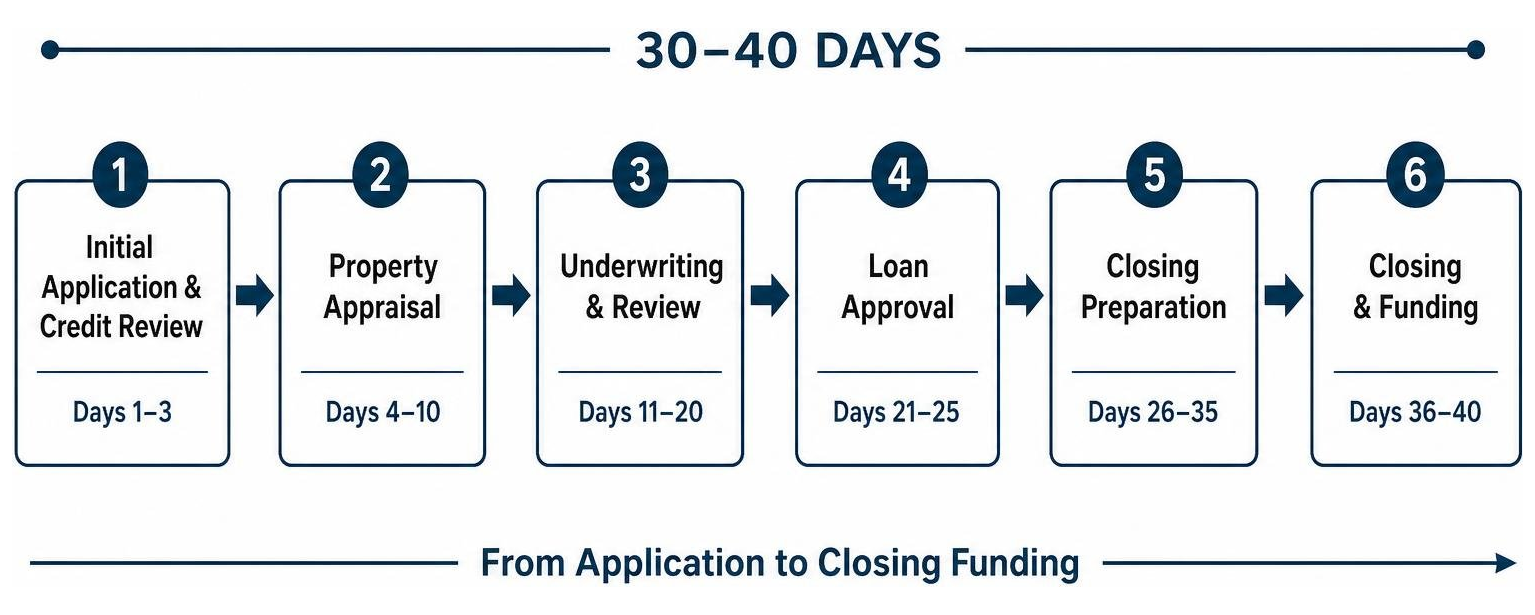
The processing and approval timeline for a home equity loan or HELOC typically takes 30 to 40 days from application to closing.
Here is what happens during that window:
- Initial Application & Credit Review: Your loan officer verifies your credit, income, and asset documentation.
- Property Appraisal: A licensed appraiser inspects your property to establish its current fair market value.
- Underwriting Review: Underwriters verify title history, property liens, and final loan calculations.
- Closing & Disclosure: You review and sign final loan disclosures and closing documents.
- Funding: Following mandatory federal rescission periods (typically 3 business days for primary residence second mortgages), your funds are disbursed in full or your credit line is opened.
Closing costs for equity loans generally run between 1% and 5% of the loan amount, covering appraisal, title search, attorney, and origination fees. Some lenders offer zero-closing-cost promotions, though keeping the account open for a minimum period (such as 36 months) is often required to avoid fee reimbursement clauses.
Alternatives and Risks of Secured Renovation Loans
While leveraging home equity offers lower rates than unsecured debt, using your residence as collateral carries important considerations you must weigh carefully.
Comparing Alternatives: Cash-Out Refinance, Personal Loans, and Cards
To choose the best funding source for your project, compare secured equity products against common alternatives:
- Cash-Out Refinance: Replaces your existing primary mortgage with a brand-new, larger mortgage, handing you the difference in cash. This makes sense if current market interest rates are lower than your existing primary mortgage rate. However, if you already hold a low primary mortgage rate, taking out a separate second mortgage avoids resetting your primary rate.
- Personal Loans: Unsecured personal loans offer fast funding (sometimes same-day) without putting your home up as collateral. However, interest rates average around 12.25%, and borrowing limits are capped lower.
- Credit Cards: Credit cards provide instant convenience for minor DIY projects, but average interest rates hover around 19.98%. Carrying large balances can quickly result in heavy interest costs.
To illustrate the difference, look at the total interest paid on a $20,000 remodeling project over a 5-year repayment term:
- Home Equity Loan (8% APR): Total interest paid = $4,332 (Monthly payment: ~$406)
- Personal Loan (13% APR): Total interest paid = $7,304 (Monthly payment: ~$455)
- Credit Card (20% APR): Total interest paid = $11,789 (Monthly payment: ~$530)
Choosing a secured equity loan saves $7,457 in total interest over a credit card for the exact same $20,000 renovation!
Understanding the Risks of Using Your Home as Collateral
Because an equity loan for home improvements uses your real estate property as securing collateral, it comes with distinct financial risks:
- Foreclosure Risk: Failing to make required monthly payments on a second mortgage or HELOC can result in lender foreclosure actions, risking the loss of your home.
- Market Downturns: If housing market values decline sharply, borrowing heavily against your equity could leave you with a higher total loan balance than your home’s market worth (being “underwater”).
- Variable Rate Increases: For HELOC borrowers, rising market interest rates can increase your monthly payments during the draw or repayment periods.
- Over-leveraging: Taking on loan debt for non-essential luxury items can strain your long-term household budget.
Frequently Asked Questions About Equity Loans for Renovations
Can I deduct home equity loan interest if I renovate my primary residence?
Yes, interest paid on home equity loans or HELOCs is generally tax-deductible if you use the entire loan proceeds to buy, build, or substantially improve the primary residence securing the loan. The total mortgage debt limit for deductions is $750,000 ($375,000 for married filing separately). Always retain detailed receipts and consult a qualified tax professional.
How long does it take to process and fund a home equity loan?
A traditional home equity loan or HELOC typically takes between 30 and 40 days from initial application to funding. This window allows time for property valuation appraisals, title insurance searches, credit underwriting, and the required 3-day federal right of rescission period.
What minimum credit score is needed to qualify for a home equity loan?
Most mortgage lenders look for a minimum credit score of 620 to 640 to approve a home equity loan or HELOC. However, securing the best advertised interest rates and maximum Loan-to-Value limits (up to 85%-90%) generally requires a credit score of 740 or higher, along with a stable income and a Debt-to-Income ratio below 43%.
Conclusion
Unlocking your built-up equity with an equity loan for home improvements offers a powerful, cost-effective way to transform your living space while building long-term property wealth. By choosing between a fixed lump-sum equity loan and a flexible HELOC, matching your loan term to your project scope, and focusing on high-ROI renovations, you can complete your remodeling goals with financial confidence.
At Capital Home Mortgage California, we specialize in helping homeowners across Los Angeles, San Diego, San Jose, San Francisco, Sacramento, Fresno, Riverside, and Irvine unlock their home’s potential. Our experienced team provides personalized, end-to-end guidance, competitive interest rates, low fees, and direct, 7-day-a-week support.
Ready to explore your home equity options and start building your dream space? Explore California Home Loan Options with our team today!


