
Compare Home Renovation Loan Options Before You Borrow
A home renovation loan can pay for repairs, upgrades, or a major remodel when cash savings are not enough. The best choice depends on your project cost, available home equity, need for fast funding, and comfort with using your home as collateral.
Start by comparing:
- APR and fees – Compare the full annual cost, not just the advertised rate.
- Loan amount and term – Match the payment and payoff period to your budget.
- Secured versus unsecured risk – Personal loans do not put your home up as collateral; home equity financing usually does.
- Funding timeline – Unsecured loans may fund quickly, while equity-based options often require an appraisal and closing.
- How you will use the money – Some programs can cover contractor work, while FHA Title I financing may also support materials-only DIY projects.
Personal loan rates for home improvement commonly range from about 7% to 36%, based on credit, income, loan term, and lender. Home equity loans and HELOCs may offer lower rates for qualified borrowers, but falling behind on a secured loan can put your property at risk.
I am Dale Gremillion, a Senior Loan Officer and Producing Branch Manager with more than 25 years of residential lending experience across conventional, FHA, VA, jumbo, and construction programs. I help California homeowners assess each home renovation loan option in the context of their equity, project goals, and long-term mortgage plan.
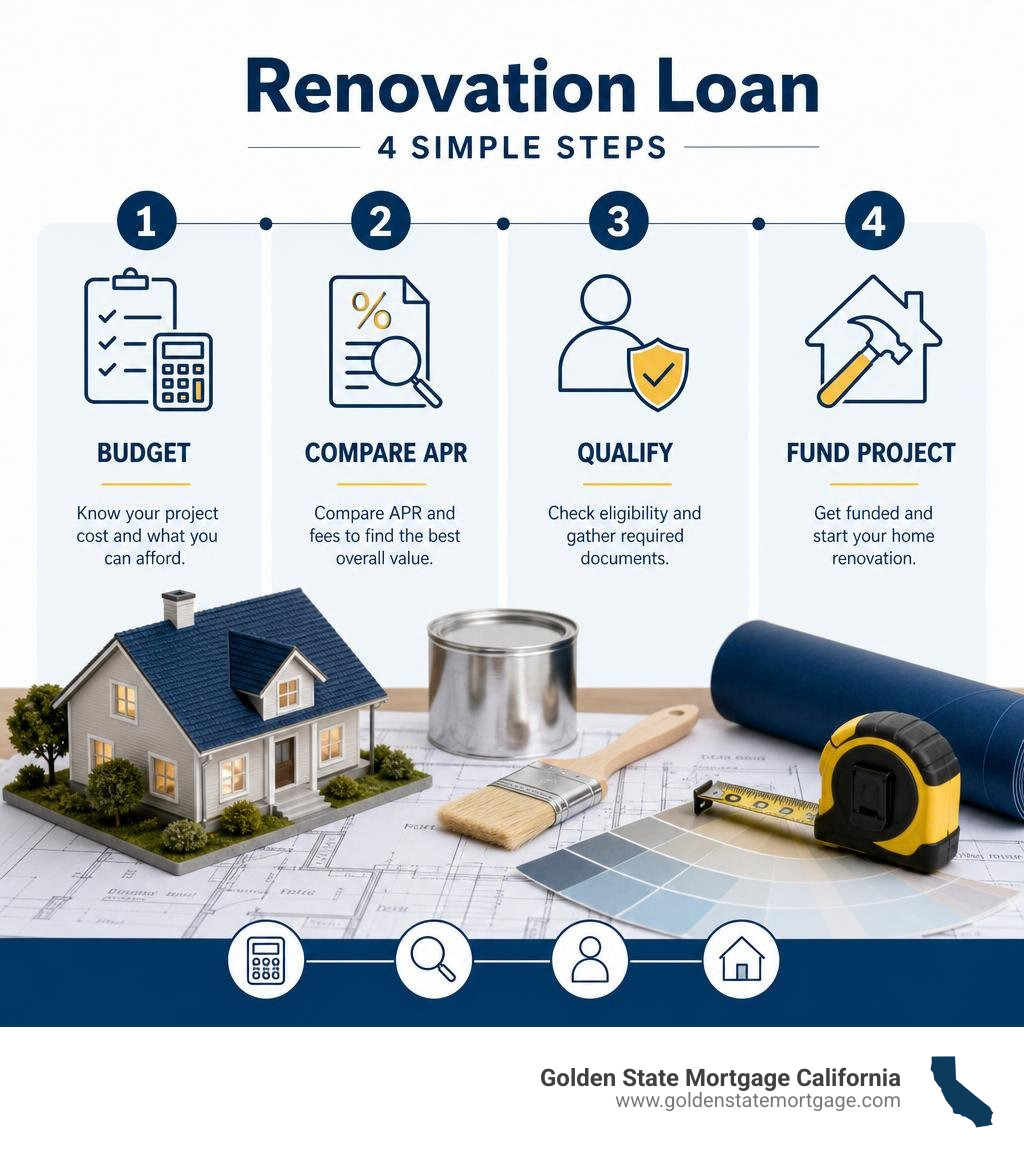
Home renovation loan vocabulary:
Types of Home Renovation Loan Options Compared
When planning home improvements across California—from updating a bungalow in Sacramento to modernizing a kitchen in San Diego—choosing the right financing structure is critical. Different Renovation Loans serve specific borrowing capacities, project sizes, and equity levels.
Every financing vehicle balances speed, borrowing power, borrowing cost, and collateral requirements differently. Unsecured personal loans offer quick cash without risking your real estate, whereas equity-based and government-backed mortgages provide lower interest rates and higher borrowing limits at the expense of longer processing times and collateral requirements.
| Loan Type | Typical Borrowing Limit | Typical APR Range | Collateral Required? | Best For |
|---|---|---|---|---|
| Unsecured Personal Loan | $1,000 to $100,000 | 6.00% – 36.00% | No | Fast funding, smaller repairs, zero equity |
| Home Equity Loan | Up to 85% of equity | 6.50% – 10.00% | Yes (Primary Home) | Large one-time projects with fixed costs |
| HELOC | Up to 85% of equity | Variable (Prime + margin) | Yes (Primary Home) | Multi-stage renovations, ongoing updates |
| Cash-Out Refinance | Up to 80% loan-to-value | Competitive Mortgage Rates | Yes (First Lien) | Substantial remodels, rate restructuring |
| FHA 203(k) / Title I | Up to FHA county limits / $25,000+ | Fixed market rates | Yes / Varies by size | Major structural fixer-uppers or low equity |
Unsecured Personal Loans vs. Secured Home Equity Loans
The primary distinction in renovation financing comes down to collateral. An unsecured personal loan requires no property backing. Lenders evaluate your creditworthiness, income, and debt-to-income (DTI) ratio to grant loan amounts typically ranging from $1,000 to $50,000—with select programs offering up to $100,000.
Because these loans carry no collateral, lenders take on higher default risk, which translates into APRs ranging anywhere from 6% to 36%. However, personal loans excel at speed: applications are streamlined, and qualified borrowers can often see funds disbursed within one business day without paying appraisal fees or closing costs.
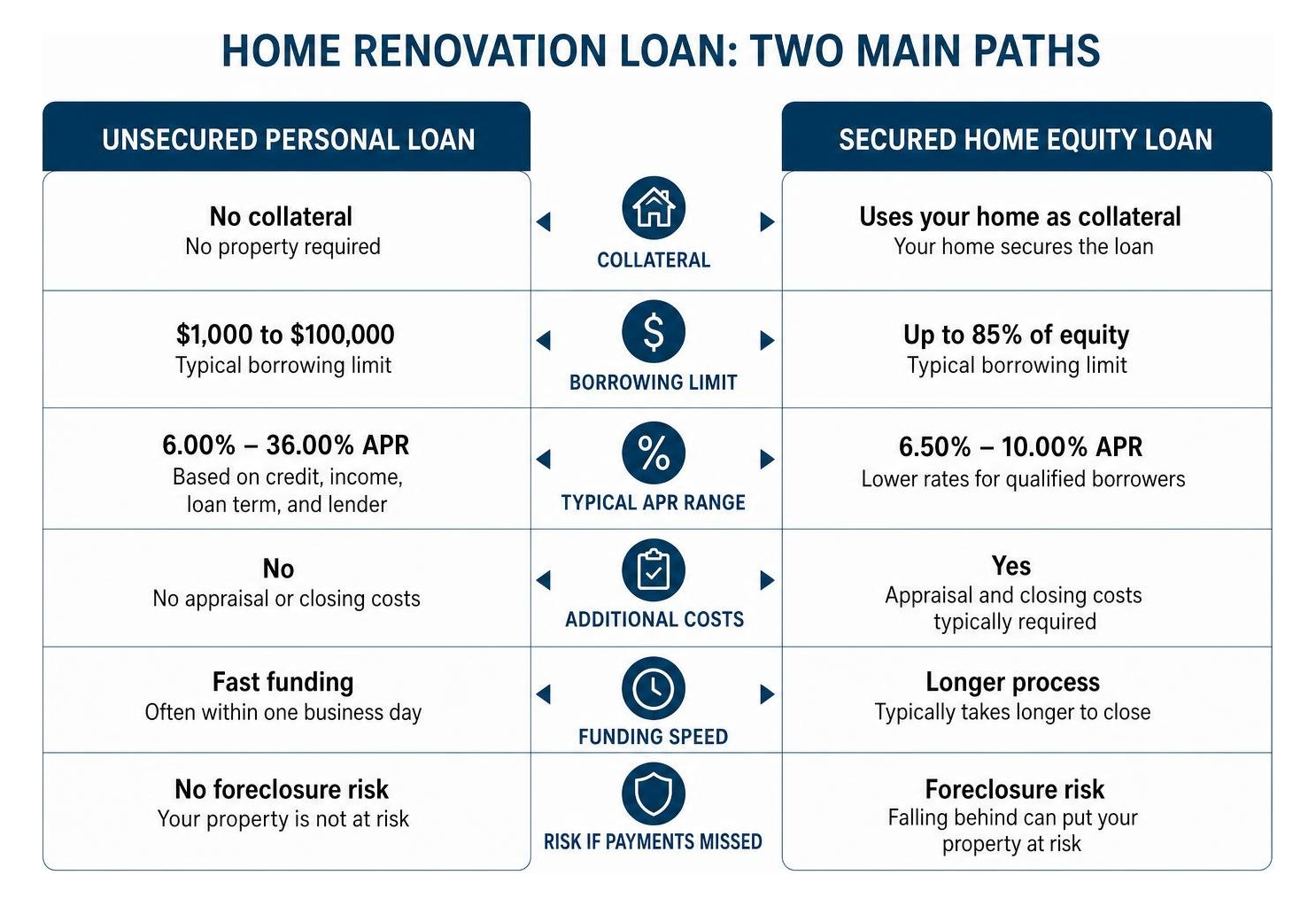
In contrast, a home equity loan is a secured second mortgage. You borrow a fixed lump sum against the accumulated value of your property, repaying it at a fixed interest rate over 5 to 30 years. Because your home serves as collateral, lenders offer significantly lower interest rates than unsecured debt.
The major trade-off is foreclosure risk: if unexpected financial hardship prevents you from making payments, the lender can initiate foreclosure proceedings on your residence.
Government-Backed Programs: FHA 203(k) and FHA Title I
When buying a fixer-upper or upgrading an older property with minimal equity, federal loan programs supervised by HUD provide structured alternatives. The FHA 203(k) Rehabilitation Loan allows borrowers to finance both the purchase (or refinance) of a house and the cost of its rehabilitation through a single mortgage based on the projected post-renovation value.
For targeted updates without refinancing your entire mortgage, the FHA Title I Property Improvement Loan is designed specifically for homeowners with limited equity. Title I loans can finance alterations, repairs, and site improvements.
A unique aspect of Title I financing is that it supports both contractor-led jobs and DIY property improvements (where the loan covers materials only). For rural homeowners in eligible areas, programs such as the Single Family Housing Repair Loans & Grants in California offer specialized repair assistance for low-income families addressing health and safety hazards.
Lines of Credit and Cash-Out Refinancing
If your project spans multiple stages—such as remodeling living spaces room by room—a Home Equity Line of Credit (HELOC) provides flexible borrowing. Similar to a credit card secured by real estate, a HELOC offers a revolving draw period (usually 10 years) where you only borrow and pay interest on the money you actively use.
Homeowners often favor using a HELOC to give your house a total makeover because it allows draw flexibility as contractor invoices come due.

When market interest rates are favorable, or when you are planning an extensive six-figure overhaul, cash-out refinancing replaces your existing first mortgage with a new, larger loan. You receive the difference in cash at closing.
Reviewing how to cash out your home equity to build your dream space shows that cash-out refinancing spreads the cost of your remodel over a standard 15- or 30-year term, offering predictable, lower payments than short-term loans.
Key Criteria for Comparing Renovation Financing
Navigating your options requires evaluating more than just the initial interest rate. We help borrowers assess total financing costs, including origination charges, closing expenses, flexibility, and tax implications, before choosing a path within our comprehensive Refinancing suite.
APR, Hidden Fees, and Repayment Terms
The Annual Percentage Rate (APR) reflects the true annual cost of borrowing because it factors in upfront origination fees, discount points, processing charges, and closing expenses. While an unsecured personal loan might advertise zero closing fees, its higher baseline interest rate could cost more over five years than a low-rate home equity loan that charges an appraisal fee.
Key items to check in your loan disclosures include:
- Origination and Processing Fees: Ranging from 0% to 6% of the loan amount on unsecured loans.
- Prepayment Penalties: Ensure the lender does not penalize you for paying off the principal balance early.
- Draw Fees or Annual Inactivity Fees: Common in revolving HELOCs.
- Closing Costs: Title search, recording fees, and appraisal fees on secured equity loans.
To analyze your numbers accurately, calculate your cash-out refinance savings and loan amounts easily before committing to any specific lending vehicle.
DIY Project Materials vs. Licensed Contractor Labor
Your choice of who executes the renovation influences your financing eligibility:
- DIY Projects (Sweat Equity): Most conventional construction loans and FHA 203(k) loans require work to be completed by licensed, insured general contractors. If you plan to build a deck or repaint yourself, an unsecured personal loan or an FHA Title I DIY loan (which covers material costs only) gives you complete discretion over fund distribution.
- Licensed Contractor Work: For structural changes, electrical overhauls, or additions, lenders providing major renovation financing disburse funds directly to contractors through staged escrow draws following independent progress inspections.
Qualifying for a Home Renovation Loan
Lenders evaluate key financial metrics during underwriting:
- Credit Score: Unsecured loans typically demand higher credit scores (680–740+) for the lowest advertised rates, though some lenders accept scores down to 600. First-lien mortgage programs (FHA) accommodate scores starting at 580.
- Debt-to-Income (DTI) Ratio: Your total monthly debt obligations (including the new loan payment) should ideally remain below 43% of your gross monthly income, though select programs allow up to 50%.
- Combined Loan-to-Value (CLTV): For home equity loans and HELOCs, most lenders cap total borrowing at 80% to 85% of your property’s appraised value.
Project ROI and Financial Risk Management
Renovating is not only about comfort—it is an investment in your property’s equity. Balancing project expenses against market returns protects your household wealth.

High-ROI Home Improvements That Add Value
Certain home improvements consistently recoup a high percentage of their costs upon resale:
- Garage Door Replacement: Recoups an impressive 193.9% of its installation cost on average.
- Steel Entry Door Replacement: Delivers approximately 188.1% return on investment by instantly upgrading curb appeal and energy efficiency.
- Manufactured Stone Veneer: Adds distinctive exterior architectural appeal while recouping roughly 153.2% of project costs.
- Minor Kitchen Remodels: Yields higher percentage returns than full luxury overhauls by prioritizing cabinet refacing, energy-efficient appliances, and modern countertops.
Choosing the Right Home Renovation Loan for Your Project
Selecting the ideal loan boils down to matching project size, equity availability, and timeline:
- Small Projects ($1,000 to $20,000): Minor repairs or quick updates are well-served by unsecured personal loans, eliminating closing costs and appraisal delays.
- Mid-Sized Projects ($20,000 to $75,000): Kitchen updates, roof replacements, or multi-room improvements often benefit from a HELOC or fixed-rate home equity loan.
- Major Overhauls ($75,000+): Structural additions, second-story builds, or whole-home restorations are best financed via cash-out refinancing or construction-to-permanent loans. Consult a practical guide to comparing cash-out refinance options to see how tapping existing equity can lock in long-term stability.
Contractor Due Diligence and Fraud Prevention
Financing a renovation successfully requires protecting your capital from disreputable contractors. Ensure smooth project execution with these best practices:
- Verify Licensing and Insurance: Confirm the contractor holds an active license with the California Contractors State License Board (CSLB), along with active general liability and worker’s compensation insurance.
- Obtain Multiple Itemized Bids: Request at least three written, itemized estimates breaking out labor, material, and permit costs.
- Tie Payments to Milestones: Never pay the full balance upfront. Structure payments around verifiable progress milestones, withholding a 10% retention until the final inspection is passed and mechanics lien waivers are signed.
Frequently Asked Questions About Renovation Financing
Are home improvement loans tax-deductible?
Under current IRS guidelines, interest paid on unsecured personal loans is not tax-deductible.
However, interest on secured loans (home equity loans, HELOCs, or cash-out refinances) may be tax-deductible if the funds are used exclusively to buy, build, or substantially improve the taxpayer’s primary or secondary residence securing the loan. Always consult a certified tax professional regarding your individual tax situation.
How quickly can loan funds be disbursed for emergency repairs?
Unsecured personal loans provide the fastest funding turnaround, with many lenders offering same-day decisions and disbursing funds within 24 to 48 hours of approval.
Secured equity options (HELOCs, equity loans, and cash-out refinances) take longer—typically 2 to 4 weeks—due to the need for home appraisals, title searches, and property underwriting.
What happens if I use a secured loan and fall behind on payments?
If you default on an unsecured personal loan, the lender can report the delinquency to credit bureaus, assess late fees, and pursue legal collection actions, but they cannot directly seize your home.
If you fall behind on a secured home equity loan or HELOC, the lender holds a legal lien against your real estate and has the right to initiate foreclosure proceedings to recover the outstanding balance.
Conclusion
Renovating your home should increase your living comfort and elevate your long-term property value without creating financial distress. By carefully weighing borrowing costs, disbursement timelines, and collateral requirements across personal loans, home equity lines, and mortgage refinancing, you can choose the optimal financing strategy for your specific renovation goals.
At Golden State Mortgage, we offer a complete suite of residential lending and refinancing options backed by in-house processing and personalized, seven-day-a-week support. Whether you are planning a master suite addition in Los Angeles or upgrading an exterior in San Francisco, reach out to our lending team today to structure a financing plan built for your home.


