
How a Home Equity Line of Credit Renovation Works
A Home equity line of credit renovation works much like a credit card, but it is backed by your home. Instead of receiving a single lump sum, your lender approves a maximum line of credit based on your built-up equity.
During the initial phase, known as the draw period—which typically lasts 10 years—you can borrow money whenever you need it, up to your maximum limit. You can make interest-only payments on the exact amount you draw, giving you financial breathing room while work is underway. Once the draw period ends, the line converts to a repayment period (often lasting 20 years), during which you pay back both principal and interest.
Most standard HELOCs feature variable interest rates tied to a prime index, meaning your interest rate can fluctuate over time. Because your property serves as collateral, it is important to manage your borrows carefully to protect your home.
Standard HELOC vs. Renovation HELOC Options
While a standard HELOC lets you borrow against your home’s current market value, a specialized Renovation HELOC factors in your home’s projected After-Renovation Value (ARV).
- Standard HELOC: Borrowing capacity is based strictly on existing accrued equity. This option works great if you have lived in your California home for years and accumulated substantial equity.
- Renovation HELOC: Uses the estimated future appraisal value after your planned renovations are complete. This approach allows newer homeowners or those with lower current equity to secure higher credit limits without doing a full cash-out refinance.
Both options allow you to preserve your original primary mortgage—a major advantage if you locked in a historical low first-mortgage rate.
Determining Loan Limits for Your Home Equity Line of Credit Renovation
To calculate how much you can borrow, lenders look at your home’s Combined Loan-to-Value (CLTV) ratio. Most traditional lenders cap total borrowing—including your first mortgage and your equity line—at 80% to 85% of your home’s appraised value, though select programs allow up to 95% CLTV.
For instance, if your California home is appraised at $800,000 and your existing mortgage balance is $500,000:
- At an 80% CLTV limit, your total allowed debt is $640,000 ($800,000 × 0.80).
- Subtracting your $500,000 current mortgage leaves you with a $140,000 potential credit line.
Staying updated on market trends via What’s Happening with California Real Estate Prices in 2025 can help you estimate your current property value before applying.
Financing Options Comparison: HELOCs vs. Home Equity Loans and Refinancing
Choosing the right way to fund your renovation project depends on your timeline, project structure, and comfort with variable rates.
| Financing Type | Structure & Access | Interest Rate Structure | Best Used For |
|---|---|---|---|
| HELOC | Revolving line of credit over a 5–10 year draw period | Variable (tied to Prime) | Multi-phase projects with staggered contractor invoices |
| Home Equity Loan | Single lump sum distribution | Fixed rate | Single, fixed-cost projects with set quotes |
| Cash-Out Refinance | Replaces primary mortgage with a larger loan | Fixed or Variable | Homeowners looking to lower primary mortgage rates while getting cash |
| Personal Loan | Unsecured lump sum distribution | Fixed rate | Smaller, fast repairs where you prefer not to use your home as collateral |
Comparing Interest Rates and Payment Terms
Secured home financing options generally offer lower interest rates than credit cards or personal loans. HELOC and home equity loan rates average around 8%, whereas credit card rates average nearly 20% and personal loans average around 12%.
For a $20,000 remodeling project, financing at 8% APR over 5 years results in monthly payments around $406 with $4,332 in total interest. That same project on a 20% credit card costs approximately $530 per month and $11,789 in total interest. You can review current market baseline parameters on our Rate Assumptions page.
Tax Deductibility Guidelines for Remodeling Interest
Under federal tax code rules, interest paid on a Home equity line of credit renovation may be tax-deductible if the funds are used to buy, build, or substantially improve the home securing the loan.
To qualify for itemized deductions:
- The funds must go directly toward capital improvements (e.g., adding square footage, replacing a roof, or renovating a kitchen), not routine maintenance like painting or minor repairs.
- Total combined mortgage and equity debt must fall under the federal tax ceiling ($750,000 for single or joint filers).
To learn more about maximizing tax savings, see this guide on How to Use Home Equity for Remodeling.
Key Qualification and Application Requirements

Getting approved for equity financing requires demonstrating stable income, good credit health, and adequate equity backing.
Credit Score, DTI, and Equity Thresholds
While requirements vary depending on the specific program, standard guidelines include:
- Credit Score: Most programs require a minimum FICO score of 620 to 640, with optimal interest rates reserved for scores of 720 and above.
- Debt-to-Income (DTI) Ratio: Lenders generally prefer a total DTI ratio below 43%, including primary housing payments, new equity debt, and recurring liabilities.
- Equity Stake: Borrowers typically need to retain 15% to 20% equity in their property after factoring in the new loan.
Check out our educational guides on Mortgage Education for more tips on preparing your profile for underwriting.
Essential Documentation and Contractor Preparation
To ensure a smooth underwriting process, organize your documentation early:
- Income Documents: W-2 forms, recent pay stubs, and two years of personal tax returns.
- Asset Statements: Recent bank and investment account statements.
- Property Documentation: Current mortgage statement, home insurance policy details, and property tax bills.
- Renovation Documentation: Detailed scope of work, itemized cost estimates from licensed contractors, and signed contractor agreements.
Having clear construction contracts protects you against supplier disputes and mechanic’s liens down the road.
Best Remodeling Projects and Budgeting Guidelines

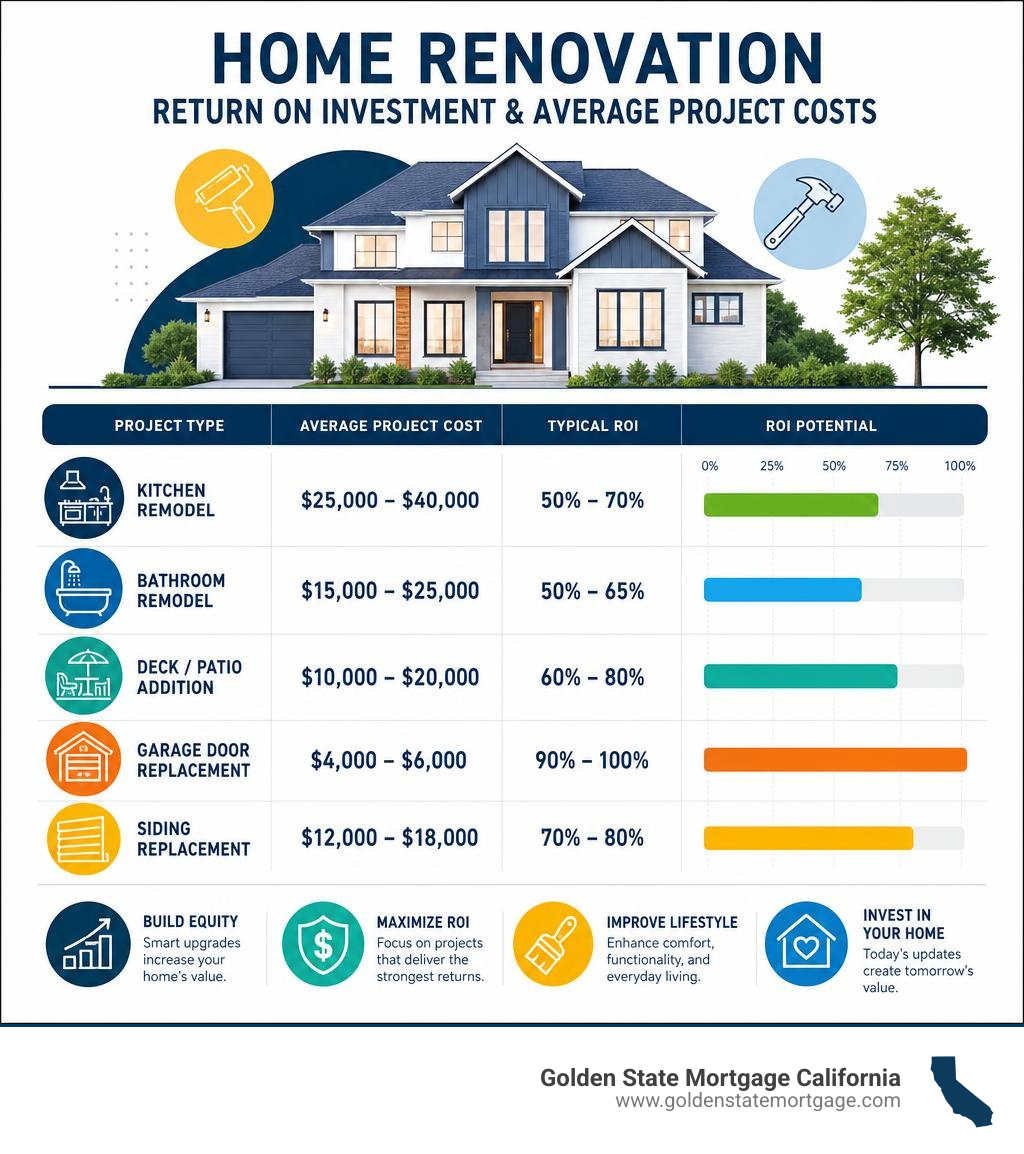
Not all home upgrades deliver the same return on investment (ROI). Prioritizing high-impact spaces helps maximize your home’s equity over time.
High-ROI Projects for Total House Makeovers
When planning a total home makeover, focusing on functional, high-value improvements yields the strongest return:
- Kitchen Remodels: National costs range from $25,000 to $40,000, recouping about 50% to 70% of costs upon resale.
- Bathroom Refreshes: Updating a bathroom averages $15,600 (ranging from $12,700 to $24,700), providing high practical value and solid appeal.
- Essential Building Shell Maintenance: Replacing an aging roof (averaging near $9,600) prevents interior water damage and protects overall structural integrity.
- Outdoor Additions: Decks or patios cost anywhere from $1,900 to $11,220 and expand your usable living space.
If you are exploring living space alternatives, review the California Manufactured Homes Advantages guide to learn about efficient construction methods.
Managing Cost Overruns with a Contingency Buffer
Renovation projects frequently run over initial estimates. Roughly 78% of home remodels face cost increases due to hidden structural issues or material price changes.
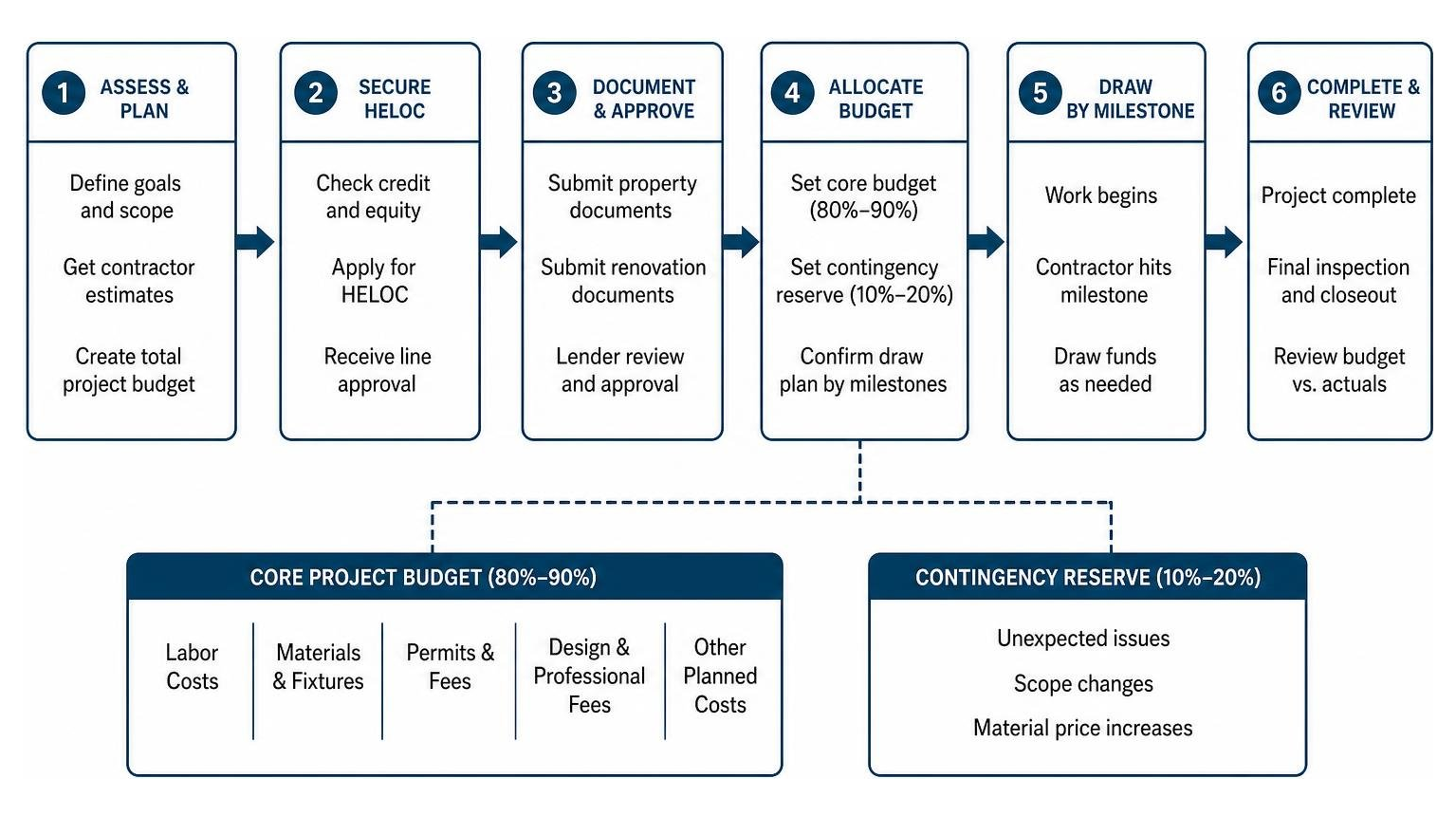
To avoid financial stress:
- Apply the 30% Rule: Keep your total renovation budget below 30% of your home’s current value to avoid over-improving for your neighborhood.
- Build a Contingency Reserve: Set aside 10% to 20% of your line limit specifically for unexpected expenses.
- Pace Your Draws: Take funds out only as your contractor hits specific milestone markers.
Navigating Risks and Repayment Strategies
Using a Home equity line of credit renovation requires disciplined financial planning to avoid common pitfalls.
Managing Payment Shock in a Home Equity Line of Credit Renovation
Transitioning from an interest-only draw period to a fully amortizing repayment period can double your monthly payment overnight—a scenario known as payment shock.
To prevent surprises:
- Make voluntary principal payments during the draw period whenever possible.
- Calculate future principal-plus-interest payments assuming a 2% rate cushion so you know what to expect.
- Pay down high-balance draws as soon as project phases are completed.
What Happens When Selling a Home with a HELOC Balance
If you decide to sell your home while holding an open HELOC:
- The outstanding line balance functions as a secondary lien against your title.
- At closing, settlement funds pay off your primary mortgage and HELOC balance first.
- The remaining net equity is paid directly to you.
Frequently Asked Questions About Renovation HELOCs
Can I get a renovation HELOC if I recently bought my home?
Yes. If you recently purchased a home and have limited accrued equity, an ARV-based Renovation HELOC allows you to borrow against the property’s projected post-renovation value rather than its purchase price.
How does After-Renovation Value (ARV) affect my credit line?
An appraiser reviews your contractor’s scope of work, architectural plans, and material estimates to project what the property will be worth after completion. This future value serves as the baseline for your borrowing limit.
What is the 30% rule for home renovation budgeting?
The 30% rule suggests capping total home improvement expenditures at 30% of your property’s current total market value. This prevents over-customizing your home beyond regional neighborhood standards.
Conclusion
Planning a home makeover should be an exciting milestone. A flexible equity line allows you to draw funds as contractor bills come due, keeping your project moving smoothly without disrupting your first mortgage.
At Golden State Mortgage California, our in-house team provides personalized service, competitive rates, low fees, and 7-day-a-week support. Whether you need guidance on HELOC choices, cash-out refinancing, or construction loans, we are here to help.
Explore our latest insights on our Blog or connect with our mortgage professionals today at Golden State Mortgage California to start planning your home makeover.


