
San Diego First-Time Homebuyer Programs Can Lower Your Upfront Costs
A first home buyer program San Diego residents may qualify for can reduce the cash needed to buy a home through down payment loans and closing-cost grants. Start by checking your household income, completing required homebuyer education, and speaking with a participating lender before making an offer.
For example, the San Diego Housing Commission’s low-income program may offer eligible buyers a deferred down payment assistance loan of up to 17% of the purchase price, capped at $125,000, plus a closing-cost grant of up to $10,000. Buyers generally need income at or below 80% of Area Median Income, a minimum 640 credit score, and a qualifying debt-to-income ratio.
These programs have strict rules on property location, purchase price, owner occupancy, cash contribution, and repayment. The good news: understanding those rules early can help you focus on homes and loan options that fit your budget.
I’m Dale Gremillion, a Senior Loan Officer and Producing Branch Manager with more than 25 years of residential lending experience. I help California buyers evaluate each first home buyer program San Diego offers alongside conventional, FHA, VA, and other financing paths so they can make a clear, informed choice.
Understanding Every First Home Buyer Program San Diego Has to Offer
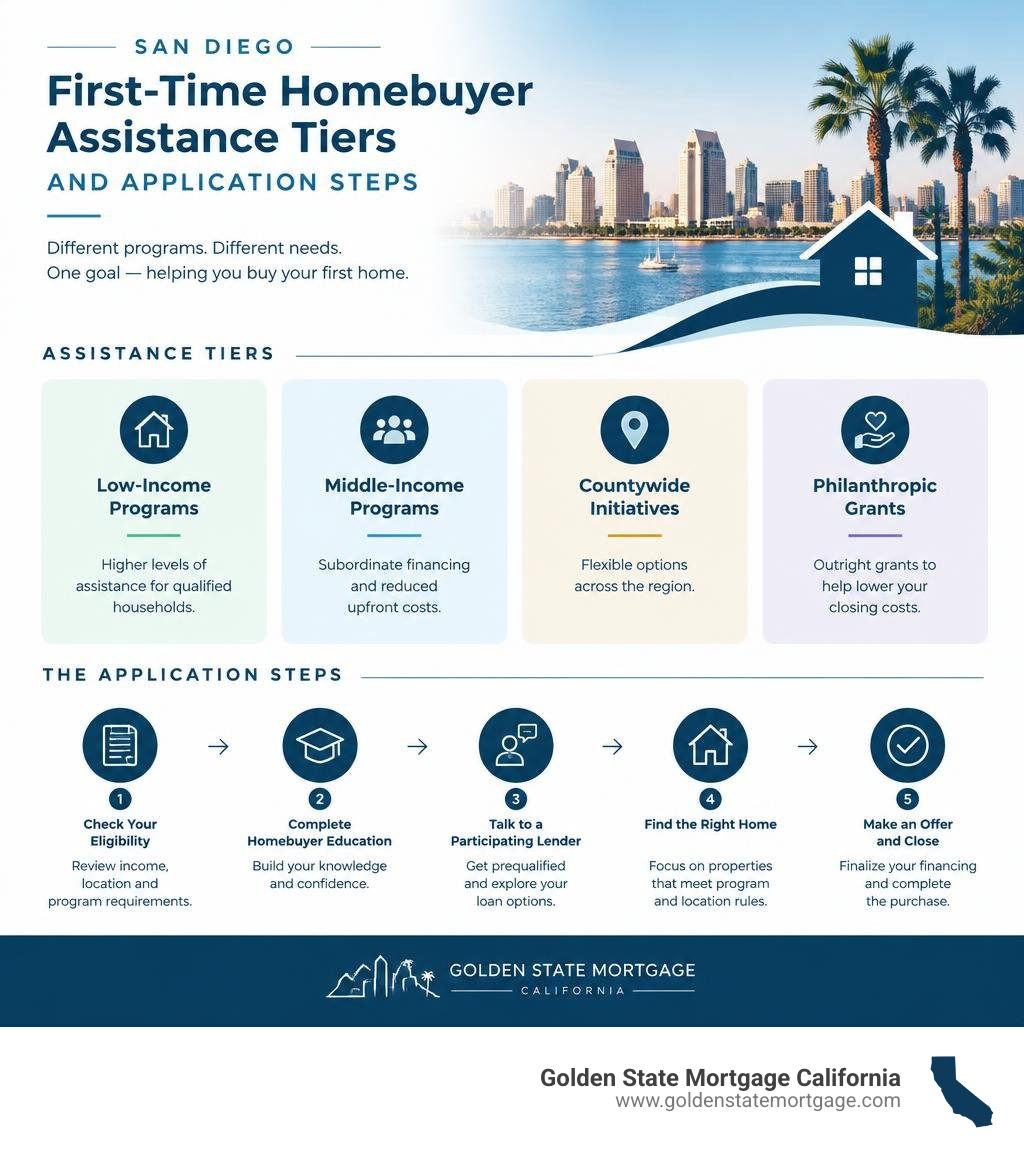
Navigating the local real estate landscape in Southern California can feel overwhelming, but buyers have access to a robust network of municipal, county, and foundation-backed resources. The primary administrator of city-level assistance is the San Diego Housing Commission First-Time Homebuyer Programs portal, which organizes financing into distinct tiers based on income, location, and property type.
Assistance in the region is broadly split into low-income programs, middle-income programs, countywide initiatives, and philanthropic grants. Each initiative targets specific household budgets, offering varying levels of subordinate financing, deferred interest, and outright grant allocations to reduce out-of-pocket costs at the closing table.
| Program Track | Target AMI Limit | Maximum Assistance Amount | Interest Rate / Terms | Maximum Purchase Price Cap |
|---|---|---|---|---|
| City Low-Income (SDHC) | ≤ 80% AMI | Up to 17% (max $125k) + $10k closing grant | 3% simple interest; 30-year deferred repayment | $883,025 |
| City Middle-Income (SDHC) | 80% – 150% AMI | $40,000 loan + $10,000 closing grant | 4% fixed; 5-yr deferred, 10-yr amortized | $1,250,000 |
| County DCCA Program | ≤ 80% AMI | Up to 22% down + up to $10k (4%) closing grant | 3% simple interest; 30-year deferred loan | $743,000 |
| Access Granted (SDF/LISC) | ≤ 120% AMI (or 80%) | Up to $40,000 grant | 0% (No repayment required; true grant) | Varies by first mortgage |
Low-Income Down Payment Assistance and Closing Cost Grants
For households earning at or below 80% of San Diego’s Area Median Income (AMI), the low-income program delivered via the San Diego Housing Commission provides substantial financial leverage. Under this pathway, buyers can secure a second mortgage covering up to 17% of the home’s purchase price or appraised value (whichever is lower), capped at a maximum of $125,000.
This subordinate loan accrues a modest 3% simple interest rate with no monthly payments due for 30 years, giving homeowners time to build equity without adding to their monthly obligations. Alongside the down payment loan, qualified applicants can receive a closing cost assistance grant of up to 4% of the purchase price, capped at $10,000. This grant is forgiven at the close of escrow, directly reducing out-of-pocket transaction costs for buyers exploring options for a first home buyer.
Middle-Income Assistance and County Alternatives
Recognizing that many working professionals exceed low-income thresholds yet still face affordability challenges, the city established dedicated pathways governed by the CITY OF SAN DIEGO FIRST-TIME HOMEBUYER PROGRAM FOR MIDDLE-INCOME (80% – 150% AMI) HOUSEHOLDS GUIDELINES. This middle-income track offers a $40,000 deferred down payment loan alongside a $10,000 closing cost grant. Unlike the 30-year low-income loan, the $40,000 middle-income loan defers payments for the first five years, converting in year six to an amortized loan repaid over 10 years at a 4% fixed interest rate.
Outside the City of San Diego proper, the County Down Payment and Closing Cost Assistance (DCCA) program provides aid across participating municipalities including Carlsbad, Coronado, Del Mar, Encinitas, Imperial Beach, La Mesa, Lemon Grove, Poway, San Marcos, Santee, Solana Beach, Vista, and all unincorporated county areas. The DCCA provides up to 22% of the purchase price for down payment assistance paired with up to $10,000 (or 4%) for closing costs. Buyers can also look into foundation-backed alternatives, such as the Program Guidelines | LISC San Diego for the San Diego Foundation Access Granted program, which offers non-repayable grants up to $40,000.
Eligibility Criteria, Income Limits, and Property Standards
Qualifying for these public assistance funds requires meeting strict criteria set by local housing authorities and the U.S. Department of Housing and Urban Development (HUD). Because these programs utilize public funding sources, compliance guidelines are detailed in the official San Diego Housing Commission First-Time Homebuyer Program Manual & Guidelines.
Core Eligibility Rules for the First Home Buyer Program San Diego
To qualify, all adult household members must meet the definition of a first-time homebuyer, meaning they have not owned a residential property within the past three consecutive years. This restriction applies globally—owning residential real estate in another state or country disqualifies an applicant, though exceptions are made for displaced homemakers and single parents who previously only owned a home with a former spouse.
Eligible property types include existing single-family detached homes, townhomes, condominiums, and manufactured homes situated on permanent foundations. The home must serve as the borrower’s primary residence; investment properties, vacation homes, and co-signers who will not live on the property are strictly prohibited. Properties must be vacant or owner-occupied at the time of purchase—programs prohibit purchasing tenant-occupied properties unless the buyer is the existing tenant displaced by the purchase.
Household Income Limits and Debt-to-Income Calculations
Program limits are tied directly to household size rather than just the individuals on the loan application. Total gross annual income from all adult household members must fall within the designated AMI brackets. For current 2026 guidelines, 80% AMI income caps for low-income programs and 150% AMI caps for middle-income programs establish strict operational ceilings:
- 1-Person Household: 80% AMI cap is $97,950; 150% AMI cap is $137,450
- 2-Person Household: 80% AMI cap is $111,950; 150% AMI cap is $157,100
- 3-Person Household: 80% AMI cap is $125,950; 150% AMI cap is $176,750
- 4-Person Household: 80% AMI cap is $139,900; 150% AMI cap is $196,350
- 8-Person Household: 80% AMI cap is $184,700; 150% AMI cap is $259,200
Beyond income limits, underwriters apply debt-to-income (DTI) calculations. Generally, housing debt (Principal, Interest, Taxes, Insurance, and HOA dues) cannot exceed 30% to 35% of gross monthly income, while total back-end debt cannot exceed 45% to 50%. A minimum credit score of 640 is standard for low-income city and county programs, whereas middle-income tracks require a 660 credit score for DTIs up to 45%, or a 720 score if the DTI reaches between 45% and 50%.
Financing Rules, Down Payment Requirements, and Loan Terms

Understanding the rules governing purchase prices and loan subordinate structures prevents unexpected surprises during escrow. The City of San Diego adjusts purchase price caps periodically based on local housing affordability metrics.
The maximum purchase price for attached and detached properties under the city’s low-income assistance program is set at $883,025 (effective December 2025 through 2026). For middle-income buyers, the purchase price ceiling expands to $1,250,000, reflecting higher market inventory tiers. For the County DCCA program, the purchase price cap stands at $743,000.
Deferred Interest Loans, Grant Forgiveness, and Repayment Triggers
The low-income SDHC assistance loan is structured as a 30-year deferred second trust deed. Interest accrues at a 3% simple annual rate. You make no monthly payments toward principal or interest during the 30-year lifespan of the loan. Instead, the full loan balance plus accrued simple interest becomes due and payable upon the occurrence of specific repayment triggers:
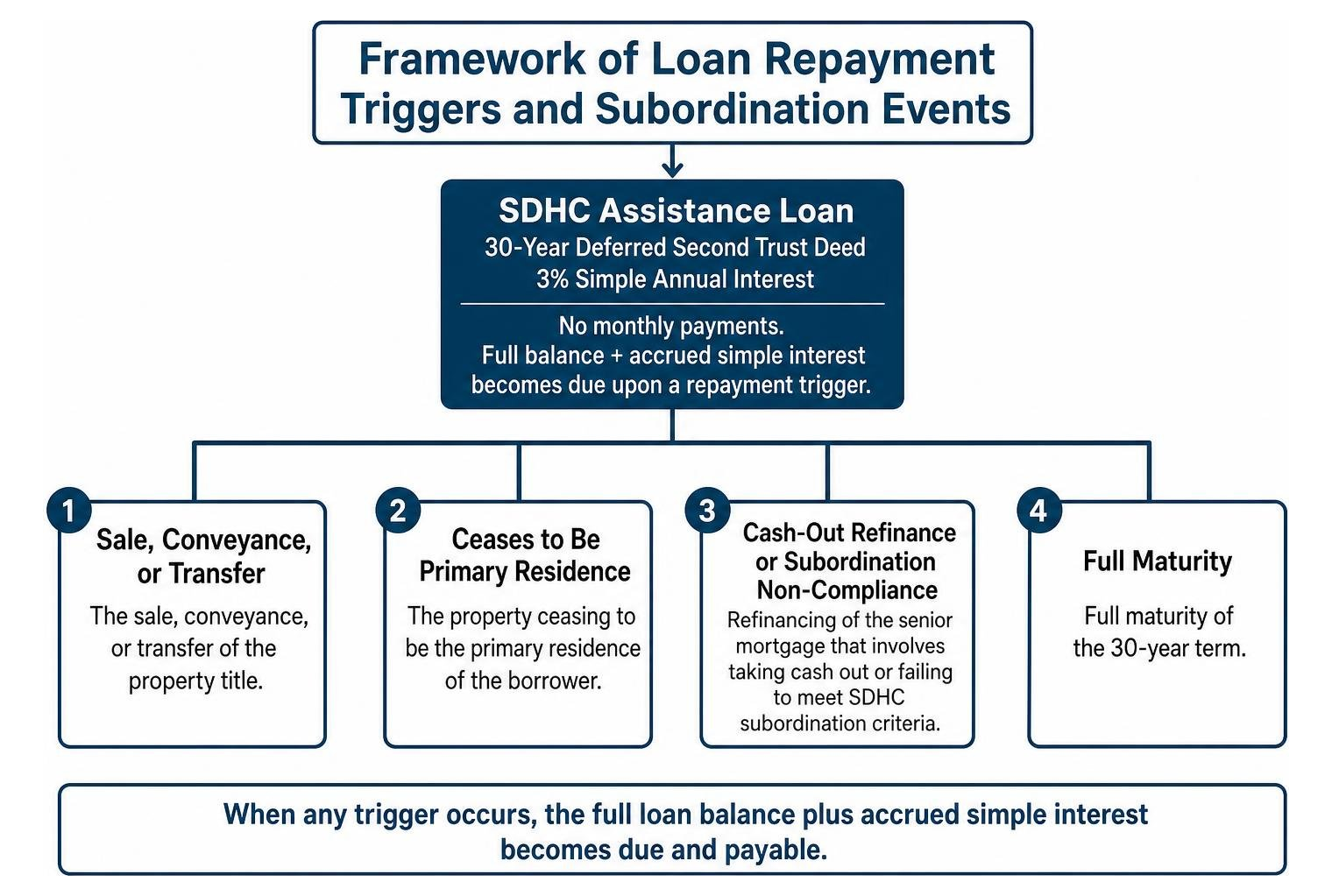
- The sale, conveyance, or transfer of the property title.
- The property ceasing to be the primary residence of the borrower.
- Refinancing of the senior mortgage that involves taking cash out or failing to meet SDHC subordination criteria.
- Full maturity of the 30-year term.
For the middle-income track, the $10,000 closing cost grant is fully forgiven after three years of continuous owner occupancy, while the county closing cost grant requires six years of occupancy for complete forgiveness.
Minimum Buyer Investment, Gift Funds, and 401(k) Asset Rules
While down payment assistance covers the bulk of initial equity, borrowers must maintain personal investment in the transaction. SDHC guidelines mandate a minimum total down payment of 3% of the purchase price, with at least 1% coming directly from the borrower’s own seasoned liquid savings.
The remaining down payment balance may be funded using bona fide gift funds from family members or through structured retirement account withdrawals, such as a 401(k) or IRA distribution. However, programs place a ceiling on liquid wealth: buyers cannot contribute more than a 20% down payment, and post-closing liquid reserves are generally capped (often requiring at least two months of PITI reserves, but barring excessive remaining liquid assets that indicate no need for public subsidies). Reviewing specialized programs for a first home buyer helps structure these asset combinations properly.
Step-by-Step Application for a First Home Buyer Program San Diego
Applying for municipal assistance requires coordinating your efforts before you begin touring properties. Because city and county funds are allocated on a first-come, first-approved basis, having a complete loan package prepared is critical.
Required Documentation and Underwriting Verification
When applying, lenders must assemble a comprehensive underwriting file to verify household income and asset compliance. The required file includes:
- Tax Returns & W-2s: Signed federal tax returns and W-2 forms for the last three consecutive years for all adult household members.
- Income Verification: Consecutive pay stubs covering the most recent 30 to 60 days.
- Self-Employment Records: Two years of signed business tax returns, year-to-date Profit & Loss (P&L) statements, and balance sheets for self-employed applicants.
- Asset Documentation: Two months of complete, consecutive bank statements for all checking, savings, investment, and retirement accounts.
- Special Disclosures: Written explanations for any large deposits, letters of explanation for credit inquiries, and legal decrees (such as divorce or child support documentation) where applicable.
Participating Lenders and Homebuyer Education Classes
You cannot apply directly to the city housing agency as an individual. Applications must be submitted through an approved, participating lender certified by the SDHC. The lender originates the first mortgage (typically a 30-year fixed conventional or government loan) and submits the subordinate assistance application directly to the commission’s portal.
Prior to loan approval, buyers must complete an 8-hour HUD-approved homebuyer education course along with one-on-one pre-purchase counseling. Education certificates from approved non-profit housing counseling agencies remain valid for one year. Further background details on regional administrative filings can be reviewed on the The San Diego Housing Commission (SDHC) offers a Mortgage Credit Certificate (MCC) program documentation page.
Frequently Asked Questions About San Diego Homebuyer Grants
What is the maximum purchase price allowed under San Diego assistance programs?
Under the SDHC low-income first-time homebuyer program, the maximum allowable purchase price for attached or detached properties is $883,025. The middle-income program permits a purchase price up to $1,250,000, while the County of San Diego DCCA program sets its maximum purchase price cap at $743,000.
Can I combine down payment assistance with gift funds or retirement savings?
Yes. Program guidelines require that at least 1% of the purchase price come directly from the buyer’s own personal liquid savings. The remaining required down payment (up to the minimum 3% threshold or higher) can be funded using gift funds from immediate relatives or distributions from retirement accounts like a 401(k) or IRA. Total combined down payment assistance and personal funds cannot exceed 20% of the purchase price.
What happens to my deferred loan if I sell or refinance my home?
If you sell the property or transfer title, the full original principal balance plus any accrued simple interest becomes immediately due and payable from the sale proceeds. If you refinance your primary mortgage to secure a lower interest rate without taking cash out, you may apply for an SDHC loan subordination, allowing the assistance lien to remain in second position behind your new primary mortgage.
Conclusion
Securing down payment assistance and closing cost grants can bridge the affordability gap for prospective homeowners across San Diego. By understanding AMI thresholds, purchase price limits, and minimum asset rules, you can move through the market with clarity and financial confidence.
At Golden State Mortgage California, we provide personalized, end-to-end guidance with competitive rates, low fees, and direct in-house processing. Whether you are exploring city grants, county assistance, or standard residential loan options, our team is available 7 days a week to help you get pre-approved and close on time.


